Scientific Smoking Cessation Roadmap: From Preparation to Maintenance
Many people fail to quit smoking not because they "don't want to quit enough," but because they treat quitting as a sprint of willpower rather than a plannable behavioral and physiological adjustment project. The real way to improve success rates is to break the process into clear stages, advancing three things simultaneously at each stage: behavioral intervention, medication support, and environmental adjustment.
This article provides an actionable scientific smoking cessation roadmap, covering the action checklist from preparation to maintenance. It can serve as the general outline for a series of content or be used independently as a long-form reference.
Disclaimer: This article is a health science education piece and does not constitute individual diagnosis, prescription, or medication guidance. Those with cardiovascular disease, mental/psychological conditions, severe respiratory disease, or those who are pregnant/preparing for pregnancy/breastfeeding, or minors, should develop a cessation plan under the guidance of a licensed physician. The medication descriptions in this article are only for conceptual reference; whether to use medication, which type, and for how long must follow medical advice and drug instructions.
I. Establish the Correct Mental Model First
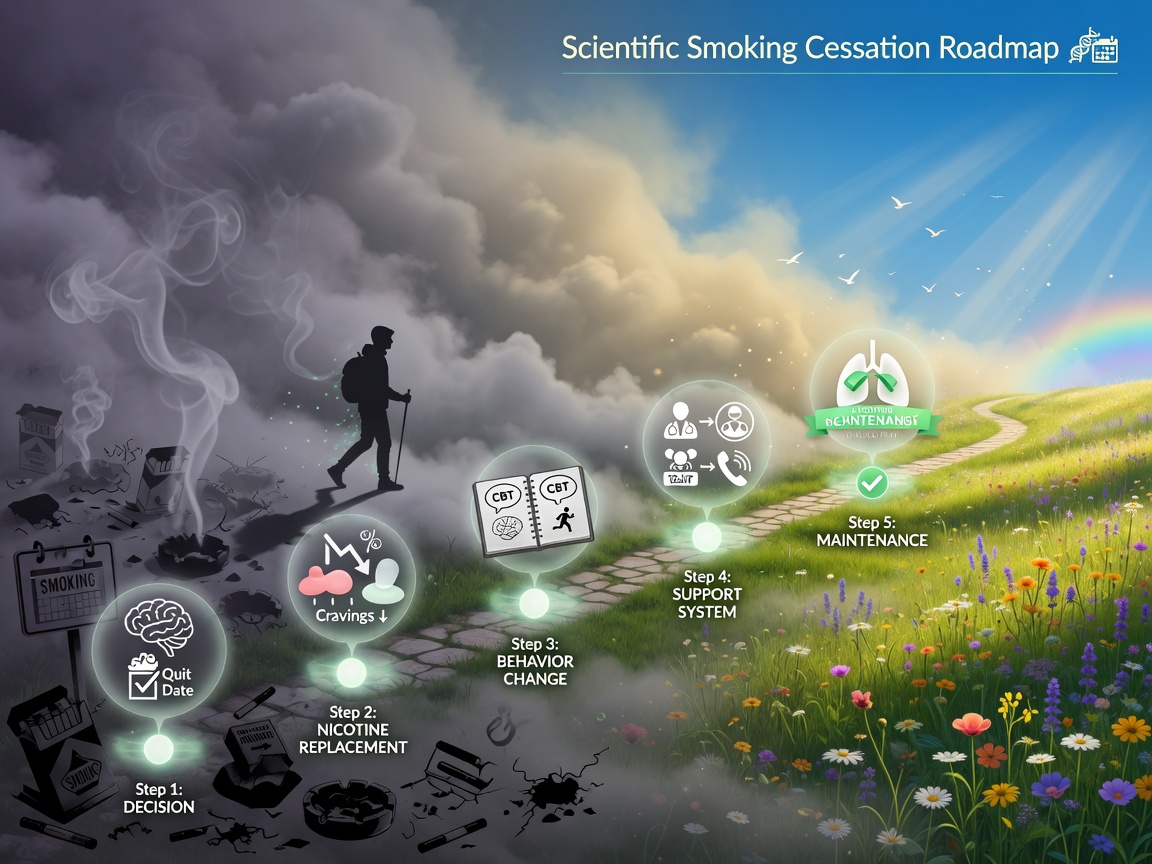
Many people fail to quit because they treat it as a willpower sprint rather than a plannable behavioral and physiological adjustment project.
Three stages, three pillars: Behavioral intervention, medication support, and environmental adjustment advancing simultaneously.
From preparation to maintenance to long-term sustainability, each stage has a clear task list and success indicators.
1. Quitting Is Not "Endure a Few Days," It's "Replace the System"
Tobacco dependence usually consists of two intertwined threads:
| Type | General Manifestation | Main Countermeasure |
|---|---|---|
| Physiological Dependence | Irritability without smoking, poor concentration, strong cravings, sleep and appetite changes | Nicotine Replacement Therapy (NRT), prescription medication, gradual reduction strategy |
| Psychological/Behavioral Dependence | One after meals, one while driving, comfort during overtime, automatic social smoking | Trigger identification, alternative behaviors, cue exposure management, identity and habit reconstruction |
| Environmental Maintenance | Smoke smell at home, colleagues offering cigarettes, ashtray in the car, smoking cues in short videos | Clearing space, boundaries, social scripts, smoke-free space engineering |
对比观点
Willpower Only
Treats quitting as a one-time willpower sprint — no stage planning, no replacement tools, no environmental clearing. Collapses at the first high-trigger scenario, followed by a self-blame cycle after relapse.
Scientific Roadmap
Advance three pillars in stages: behavioral intervention + medication support + environmental adjustment. Tools pre-set in preparation, response scripts in acute stage, new identity solidified in maintenance. Restart within 24 hours of relapse without resetting to zero.
Fixing only one thread still allows the other two to pull you back. The value of the roadmap is letting you know at different stages: which thread to focus on now, and which items to check off.
2. Stage Division (Can Be Adjusted Personally)
| Stage | Approximate Duration | Core Goal | Success Indicator (Example) |
|---|---|---|---|
| Preparation | Days to weeks before quit date | Reduce failure rate of blind start | Clear quit date, trigger map, support system, clearing completed |
| Action/Acute Withdrawal | About 1–4 weeks from quit date (focus on weeks 1–2) | Safely pass peak cravings and withdrawal discomfort | Increasing consecutive smoke-free days, having response scripts rather than toughing it out |
| Maintenance | About 1–3 months (can extend to 6 months) | Turn "temporarily not smoking" into a stable new habit | High-risk scenarios predictable and manageable, near-relapse debriefing possible |
| Long-term Maintenance | After 6 months | Prevent the "just one cigarette" logic from returning | Stable identity, long-term smoke-free environment |
The article focuses on the first three stages; long-term maintenance is bridged at the end of the maintenance stage.
II. Roadmap Overview: How the Three Pillars Shift Focus Across Stages
| Stage | Behavioral Intervention Focus | Medication Support Focus | Environmental Adjustment Focus |
|---|---|---|---|
| Preparation | Identify triggers, set rules, rehearse high-risk scenarios | Assess whether medication support is needed, complete doctor/pharmacist consultation | Physical clearing, remove smoke smell, designate smoke-free zones |
| Acute Stage | Minute-level craving management, alternative actions, HALT self-check | Use regimen steadily, avoid "rushing to find medication only when suffering" | Strong avoidance of smoking spots and cigarette-offering occasions, manage digital cues |
| Maintenance | Habit solidification, rewards, near-relapse review, identity shift | Discuss reduction and discontinuation timeline with doctor, prevent premature discontinuation rebound | Make smoke-free the default environment, maintain family/workplace boundaries |
III. Preparation: Decision to Quit → Quit Date
Preparation is not procrastination, but reducing the chaos on the first day of battle. Many people "start today on a whim" and collapse when a high-risk scenario hits the next day; preparation is about pre-laying escape routes and tools for you.
1. Behavioral Intervention: Turn Vague Resolve into an Executable Plan
(1) Write Down "Why Quit" and "What You Fear"
Use a two-column note (phone memo is fine):
- Benefits column: Breathing, oral and nasal comfort, money saved, family secondhand smoke reduced, exercise ability, sense of self-control (write specific scenarios, not vague statements).
- Concerns column: Fear of weight gain, insomnia, work pressure explosion, social embarrassment, withdrawal being too uncomfortable.
Each concern must have a contingency plan (e.g., fear of weight gain → prepare sugar-free gum + daily step minimum; fear of social situations → prepare refusal scripts + seat away from smoking area).
(2) Set a Quit Date
- Choose a date with relatively controllable stress, not the night before a major exam, deadline, or wedding.
- Once chosen, put it in your calendar and inform at least 1–2 supporters.
- 3–7 days before the quit date, start "rehearsing not smoking at certain trigger points" (e.g., wash dishes first after meals before leaving the table) to reduce automatic behavior.
(3) Draw a "Trigger Map"
Record actual smoking over the past 3–7 days in a table (no shame, the more honest the better):
| Time | Scene | Mood | Accompanying Behavior | Craving 0–10 | Notes |
|---|---|---|---|---|---|
| E.g., 7:40 | Bathroom after waking | Dazed, annoyed | Looking at phone | 8 | First cigarette almost unconscious |
| E.g., 12:30 | After lunch | Satisfied | Chatting with colleagues | 7 | Social reinforcement |
| E.g., 22:10 | After overtime | Tired, empty | Scrolling short videos | 9 | Reward smoking |
Common high-frequency triggers: first cigarette of the day, after coffee/tea, after meals, bathroom, commuting/driving, waiting, drinking, after an argument, "reward cigarette" after completing a task.
(4) Prepare an Alternative Tool Kit (Place Within Reach the Night Before Quit Date)
- Water bottle, sugar-free gum/lozenges (non-medication), toothpicks or healthy snack strategy (watch total calories)
- Notebook or check-in app, timer (for the 5-minute rule)
- Mask/nasal saline spray for personal care (if you have nasal sensitivity, follow existing medical advice)
- Refusal script cards (see Environment section)
(5) Dependence Level Self-Assessment (Educational Level, Not Diagnostic)
Refer to questions like "How soon after waking do you have your first cigarette?", "Is it hard to stay away from smoking areas during the day?", "Do you still smoke when sick?" to roughly judge whether dependence is mild or heavy. The stronger the dependence, the more seriously you should consider medication support + professional smoking cessation clinic/helpline, rather than blaming yourself for "weak will."
2. Medication Support: Ask the Right Questions During Preparation
Medication is not "the enemy of willpower" but a legitimate tool to increase success rates. What preparation requires is information and decision-making, not buying and taking things randomly online.
Question list to bring when consulting a doctor/pharmacist:
1 Based on my smoking amount and dependence level, am I suitable for NRT or prescription medication?
2 I have high blood pressure, depression/anxiety medication, epilepsy history, pregnancy plans, etc. — what are the contraindications?
3 Is the combination of patches (steady-state) + on-demand lozenges/gum (peak craving) suitable for me?
4 How to identify underdosing (cravings off the charts all day) vs. improper use?
5 How long should I plan to use medication, how to taper off, what if I miss a dose?
6 If I also have rhinitis, asthma, or oral ulcers, what should I note about dosage forms?
Dosage Form Concepts (For Memory, Not Usage Instructions):
| Type | General Characteristics | Common Applicable Approach (Principle) |
|---|---|---|
| Nicotine Patch | Relatively stable onset and fluctuation | Full-day baseline coverage |
| Gum/Lozenges | On-demand, for sudden cravings | Peak scenario supplementation |
| Other NRT Forms | Vary by region and product | Follow local availability and medical advice |
| Prescription Drugs (e.g., Bupropion, Varenicline) | Act on central pathways, require contraindication assessment | Must be prescribed and followed up |
Explicitly NOT a first-line medical smoking cessation default: Using e-cigarettes/heated tobacco/snus as "self-replacement" cessation therapy. Some people may subjectively feel they "smoke fewer real cigarettes," but the exposure pathways, dependence maintenance, and nasal irritation issues remain complex, cannot be equated with standard cessation treatment.
3. Environmental Adjustment: Disassemble the "Automatic Cigarette Vending Machine" Before Battle
Physical Clearing Checklist (Recommended to Complete the Night Before Quit Date):
Space Rules:
- Declare the home completely smoke-free (including e-cigarette vapor, if your goal is complete nicotine cessation).
- Avoid fixed smoking corners at work; take a lunch route that doesn't pass smoking spots.
- Negotiate with smoking housemates: they should smoke far away outdoors, change clothes, wash hands before contacting infants and sensitive individuals.
Social Script Drafts (Adjust to Your Tone):
- "I'm on a quitting plan, please don't offer me cigarettes this week. Helping me means offering me water instead."
- "It's not that I look down on anyone's cigarette; I'm following a doctor-recommended plan."
- "Toasting is fine, but for cigarettes I'll use tea instead."
Signs of preparation completion: Quit date confirmed, trigger map completed, tool kit ready, clearing done, medication plan consulted (if medication is needed).
IV. Action / Acute Withdrawal Phase: The Critical Battle from Quit Day
1. What You May Experience (Timeline Is Reference, Individual Variation Is Large)
| Time Window | Common Experience | Strategy Focus |
|---|---|---|
| Days 1–3 | Strong cravings, irritability, dizziness/drowsiness, drowsiness or insomnia | Medication steady-state + minute-level coping + strong environmental avoidance |
| Week 1 | Attention and mood fluctuations, increased appetite, changes in oral and nasal sensation | Regular routine, adequate hydration, record "times I got through it" |
| Weeks 2–4 | Physiological withdrawal gradually subsides, but cue-induced cravings remain strong | Guard against "I'm fine now" relaxation of vigilance |
Some people may also experience a temporary increase in coughing, nasal discharge, or throat discomfort — this is sometimes related to cilia function recovery and secretion clearance. If severe or persistent, seek medical attention rather than self-medicating by smoking again to "stop the cough."
2. Behavioral Intervention: Use Scripts Instead of Toughing It Out
(1) The 5-Minute Rule
Cravings are often wave-shaped: they rise quickly, and if not reinforced by smoking, often subside within minutes. The process:
1 Check the time, tell yourself: "Just delay 5 minutes."
2 Leave the trigger point (leave the balcony/bathroom/smoking buddy table).
3 Perform an alternative action: drink water, rinse mouth, walk one flight of stairs, wash face with cold water, box breathing (inhale 4 sec — hold 4 sec — exhale 6 sec, adjust for comfort).
4 Re-score the craving after 5 minutes; if still high, start another 5 minutes while considering on-demand NRT as per medical advice.
(2) HALT Self-Check
Many "I want to smoke" moments are actually:
- Hungry
- Angry
- Lonely/Bored
- Tired
Address these first: eat something, leave the conflict scene, message a friend, take a short nap or stretch for 5 minutes, then reassess if it's still a nicotine craving.
(3) High-Risk Scenario Scripts (Write "If… Then…" in Advance)
| If… | Then… |
|---|---|
| Want to smoke after a meal | Immediately stand up, wash dishes/brush teeth/go for a 10-minute walk |
| Someone offers a cigarette | Accept water or tea with both hands, use refusal script, change topic |
| Overtime breakdown | 5-minute timed walk + on-demand NRT (if prescribed) + record stress source |
| Drinking party | Try to postpone attendance; if must go, shorten stay, don't drink on empty stomach, designate a "guardian friend" |
| See someone smoking | Move away, look at the "benefits column" written during preparation |
(4) Daily Minimum Record (1-Minute Version)
- Smoke-free today? Yes/No
- Strongest craving score and scenario
- What coping method was used
- Any abnormalities in mood/sleep/caffeine
Recording is not for self-blame; it's for the maintenance phase to know which plank needs reinforcing.
3. Medication Support: The Acute Stage's Biggest Fear Is "Cliff-Style Discontinuation"
Principle reminders:
- Regular use of baseline forms (e.g., patches) is often better than "using only when you can't bear it anymore."
- On-demand forms are for predictable peaks (before meetings, after meals, commuting).
- If significant palpitations, severe rash, acute mood deterioration, or suicidal thoughts occur, immediately stop the suspected medication and seek medical attention.
- Don't translate "today is really hard" into "the medication doesn't work" or "I'm hopeless" — more often it's a mismatch of dosage/form/behavioral strategy that needs professional adjustment.
Caffeine and alcohol: After quitting, some people become more sensitive to caffeine; alcohol strongly weakens self-control. During the acute stage, reduce alcohol and adjust caffeine based on your own reactions.
4. Environmental Adjustment: "Avoidance" Is the Top Priority in the Acute Stage
- For two weeks, try to decline pure smoking gatherings; choose smoke-free sections for group meals and leave early.
- Change commuting routes, avoid smoking clusters at the workplace entrance.
- Phone: reduce smoking-related content pushes; when your "hands need something to do," use stress-relief toys or voice memos.
- Family cooperation: no "just one cigarette won't hurt" testing in front of you.
Acute Stage Checklist:
V. Maintenance Stage: From "Holding On" to "Stabilizing" (About 1–3 Months)
The acute stage relies on survival strategies; the maintenance stage relies on new automation. The danger: the body is less noisy, but the brain says "I've got this under control, let me have one celebratory cigarette."
1. Behavioral Intervention: Solidify Identity and Reward
(1) Identity Statement Switch
Say less: "I'm quitting smoking, it's so painful."
Practice more: "I don't smoke."
Language influences situation selection: a non-smoker doesn't stand in the smoking corner "just to chat."
(2) Near Miss Review
When you almost relapsed (already touched a cigarette, already accepted one), write three sentences within 24 hours:
1 What was the trigger?
2 Where could it have been interrupted?
3 What's the new script for the same scenario tomorrow?
This is a hundred times more useful than "calling yourself worthless."
(3) Healthy Rewards, Not Food-Punishment Compensation
- Use the money saved on cigarettes for "visible rewards" (headphones, clothes, weekend trip fund).
- Exercise: start with 10–15 minutes of brisk walking daily, prioritize improving mood and sleep, not immediate high-intensity fat loss.
- Weight: a slight increase is common; manage with protein/fiber, regular meals, strength training — not by relapsing to control weight.
(4) Emotions and Stress
If significant depression, worsening anxiety, or loss of interest persists for more than two weeks, this is beyond "normal withdrawal emotions." Seek mental health or smoking cessation clinic support, and if necessary, evaluate interactions and indications between existing prescriptions and cessation medications.
2. Medication Support: Tapering Should Have a Rhythm, Not "Stop Once You Feel Better"
Common maintenance error: feeling good in week 3, stopping medication prematurely, then getting wiped out on a social drinking night.
Principles:
- The tapering plan should be individualized, following medical advice and the recommended course in the instructions, not friends' experiences.
- Ensure high-risk days still have protection before discussing reduction.
- For 2–4 weeks after stopping, raise the level of behavioral and environmental strategies again.
3. Environmental Adjustment: Make Smoke-Free the Default
- Complete a deeper round of thirdhand smoke cleaning: AC filters, curtains, carpets, clothing storage bins.
- Normalize workplace boundaries: establish a fixed rule of "not holding meetings in the smoking room."
- Don't withdraw the support system too early: switch to once-weekly check-ins instead of daily complaints.
- Write clear houseguest rules: designated outdoor smoking spot, guests take care of their own cigarette butts.
Maintenance Checklist:
4. Transition to Long-Term Maintenance
The main enemies after six months are often:
- The "just one" cognitive distortion
- Major life events (job loss, breakup, bereavement, windfall celebration)
- Drinking sessions combined with late-night fatigue
One-sentence maintenance strategy: Always keep your 5-minute rule + one person you can ask for help + zero tolerance for "just one."
VI. Relapse Is Not Zero: 24-Hour Restart Kit
One lapse is very common. What really destroys cessation is the narrative after relapse: "Since I already smoked, might as well finish this pack/this month."
Execute Immediately (Within 24 Hours of Relapse)
1 Stop the loss: Destroy remaining cigarettes, don't "finish them before quitting again."
2 Label it: This is an event, not an identity judgment.
3 Five debrief questions: When, where, with whom, mood, what happened in the preceding 30 minutes.
4 Plug the leak: Behavioral script / medication interruption / environmental backsliding — reinforce the weakest of the three.
5 Reset quit date: It can be "right now," no need to shamefully wait for next Monday.
6 Seek help when needed: Smoking cessation clinic, helpline, family doctor, trusted friend.
Those with multiple severe relapses or heavy dependence should more strongly consider structured professional treatment, rather than repeating the same "pure endurance" approach.
VII. One-Page Master Checklist (Printable)
Preparation
Acute Stage
Maintenance
VIII. Common Misconceptions Quick Clarification
| Misconception | More Reasonable Understanding |
|---|---|
| "Cold turkey is the only real way to quit" | Any method that safely achieves cessation is a good method; medication support is evidence-based |
| "Willpower is enough" | Willpower is limited; systems (behavior + medication + environment) are more reliable |
| "E-cigarettes = scientific cessation" | Cannot simply be equated with standard treatment; may maintain nicotine dependence |
| "One cigarette now and then is fine" | For people with dependence, one is often the ignition for a full relapse |
| "Cessation medication creates a new addiction" | Under proper use it's a controllable course; risk-benefit requires medical evaluation |
| "Failure means I'm hopeless" | Failure provides data; restarting after review is the standard path |
| "Preparation is just an excuse" | Unprepared battle significantly increases chaos and shame cycles |
IX. Serialization Suggestions (Optional)
If you use this article as a series outline, subtopics to explore further include:
1 Identifying and dismantling psychological vs. physiological dependence
2 Smoking cessation failure review and restart
3 Managing post-cessation weight, mood, and upper respiratory discomfort
4 Home smoke odor removal and air quality
5 Communities, check-ins, and tracking tools
6 Special pathways for smokers with nasal sensitivity
Each corresponds to a module in the roadmap; readers can jump to where they are stuck.
X. Conclusion
The essence of scientific smoking cessation is not turning yourself into a hero, but:
1 Preparation — clear the battlefield and collect intelligence;
2 Acute stage — use behavioral scripts and (if needed) medication to survive the dual peaks of physiology and triggers;
3 Maintenance — weld the new identity, environment, and tapering strategy in place, and learn to stop-loss and restart from relapse events.
You don't need a perfect day. You need a repeatable next step. Start by checking off the first item in preparation: write down your quit date, map today's triggers, remove the pack of cigarettes in front of you.
Reference Directions (For Extended Reading, Not a Citation List)
- WHO and national public health agencies' tobacco control and cessation recommendations
- The principled framework of behavioral counseling and first-line medications in clinical tobacco dependence treatment guidelines
- Local smoking cessation clinics, helplines, and community health service resources
- ENT and respiratory department health education materials on smoking-related upper and lower respiratory symptoms
Reminder: Individual health conditions vary greatly. When initiating medication or experiencing severe physical/mental symptoms, please seek professional medical help promptly.