3.2–4.3M ha
Global Tobacco Area
2%–5%
Deforestation Share
~200,000 ha/yr
Annual Forest Impact
124+ countries
Producer Countries
15%–20%
Zimbabwe Share
~1/4
Malawi Share
~57%
Firewood Reduction
~7,500 ha/yr
Annual Forest Saved
The Relationship between Traditional Tobacco Cultivation and Deforestation, Land Use Change
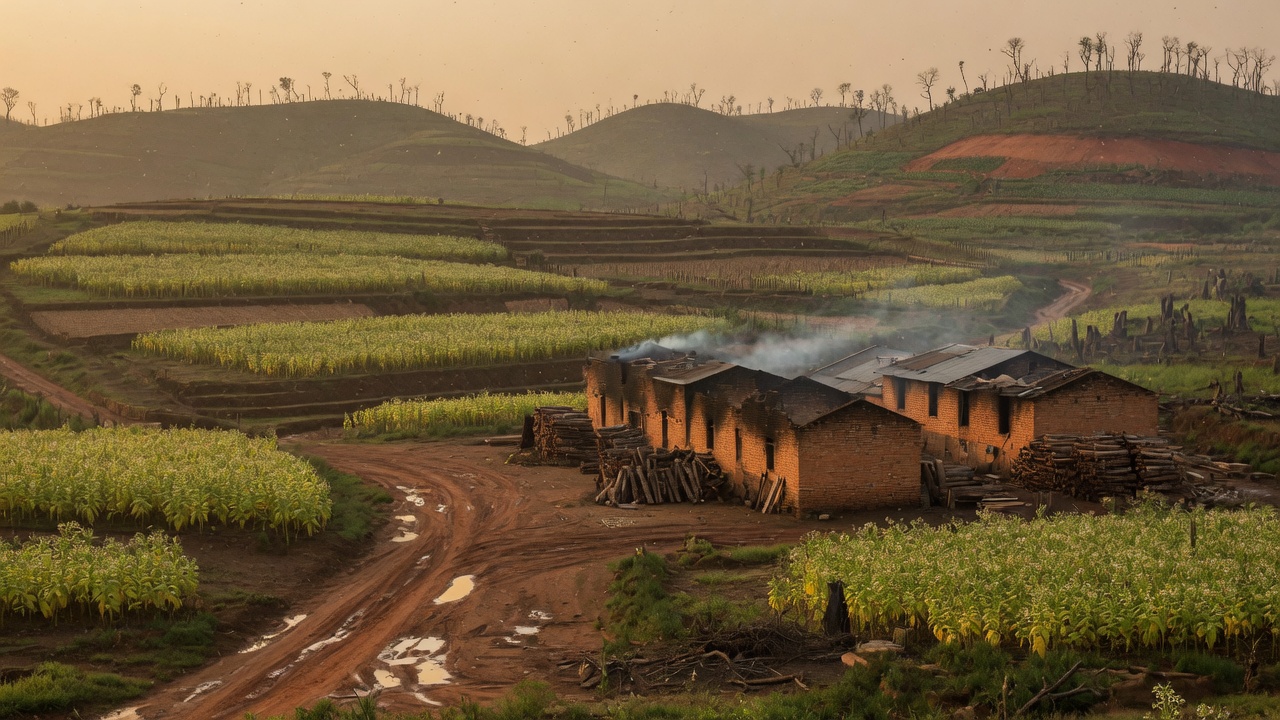
In August 2019, I was on a dirt road near the Kasungu–Lilongwe corridor in central Malawi, passing an oxcart loaded with freshly cut firewood. The rainy season was not yet fully over; yellow muddy water pooled in the wheel ruts, and the air carried the scent of wet wood and the sweet-smoky aroma of tobacco leaves drifting from distant curing barns. The local agronomist walking with me pointed to patches of pale discoloration on the hillside: that used to be miombo woodland, now mostly converted to burley or flue-cured tobacco fields; further in, there were more recent clearings — not for an extra row of grain, but for more bundles of firewood to survive the 7-to-10-day curing season.
In that moment, the abstract percentages of “tobacco-related deforestation” from international reports crystallized into a concrete supply chain: the land is cultivated, but the trees are burned away. The share of global farmland occupied by tobacco is actually very small, yet the forest loss it drives is disproportionately amplified across a group of developing producer regions in southern Africa. Below I lay out this relationship through the mechanisms, the numbers, and several points I have visited.
1. Putting the Scale in Perspective
Open literature and institutional estimates roughly converge on several sets of figures (with variations across years and definitions; I use them with “magnitude credible, direction consistent”):
| Indicator | Magnitude | Meaning |
|---|---|---|
| Global tobacco leaf planting area | Approximately 3.2–4.3 million hectares (FAO/WHO related statements) | Less than 1% of global agricultural land |
| Tobacco-related deforestation share | Approximately 2%–5% of global deforestation (varying estimates) | Small land area, relatively high deforestation contribution |
| Annual forest clearing/impact | Approximately 200,000 hectares (WHO and other sources); also “approximately 3.5 million hectares affected by tobacco cultivation” with broader statistical scope | Includes clearing + curing firewood + related disturbance |
| Production concentration | Over 124 countries grow commercial tobacco, mainly in low- and middle-income countries | Environmental costs highly externalized to southern producing regions |
My assessment is straightforward: Focusing only on “tobacco field area share” severely underestimates the problem; the real land-use impact occurs beyond the fields — in firewood forests, fencing and curing barn materials, and the abandoned farmland–reclearing cycle after soil exhaustion. Geist et al. in sustainability-related reviews have also emphasized this structure: the global share of tobacco fields is small, but its contribution to deforestation can reach several percentage points — in land-use research, this is a classic “high-intensity driver,” not a “large-area crop.”
Another calculation frequently cited for public understanding: roughly every 300 cigarettes’ worth of tobacco leaf corresponds to one tree cut down. It is a simplified narrative, not precise carbon accounting, but the direction is correct — curing and construction materials, not the leaf stem, are what consumes the trees.
2. Three Mechanisms: Clearing, Curing, and Abandonment
In traditional producer regions (especially African smallholder flue-cured/burley systems), I break the tobacco–deforestation–land-use change into three parallel and mutually reinforcing mechanisms.
2.1 Marginal Land Expansion: From Woodland to Tobacco Ridge
Smallholder plots are often less than 2 hectares. Fluctuations in tobacco leaf prices and the cash pressure of inputs (fertilizer, pesticides, floating seedling trays) mean the rational response for farmers is often not “cultivate more intensively” but open another plot to spread fixed costs. Where does the new land come from? Adjacent scrub, miombo woodland, roadside public forest margins. The common clearing method is slash-and-burn: lighting fires at the end of the dry season, ash temporarily raising pH and potassium levels, then transplanting before the rainy season.
In 2018, I saw a household expansion near Mashonaland West in Zimbabwe: the father pushed the boundary about 30–40 meters into the forest edge, saying “the company wants good-quality middle leaves, and the old plot has too many insects.” That season he gained half a hectare but lost a short path for collecting firewood — the firewood radius expanded from a 40-minute walk to nearly 2 hours. This is not an isolated case. Regional research repeatedly documents: low prices and contract purchase pressure → area expansion → forest retreat.
2.2 Curing Firewood: The “Second Engine” of Deforestation
Flue-cured tobacco is most sensitive to fuel. The typical process is:
- Seedling (seedbed or floating tray) → 2. Field transplanting → 3. Topping, suckering, and leaf picking → 4. Loading sticks into curing barn → 5. Raising temperature, color fixing, and stem drying (continuous stoking for several days and nights) → 6. Grading and selling.
What really consumes trees is steps 4–5. The empirical numbers in the miombo region are unsettling: studies estimate each kilogram of dry tobacco leaf can correspond to tens of kilograms of firewood (varying greatly by kiln efficiency; in the review by Jimu et al. on Zimbabwe/Malawi, there are extreme cases of “approximately 31 times the firewood equivalent per kilogram of tobacco leaf,” pointing to inefficient curing barns). Another commonly cited industry estimate: curing the leaf yield from 1 hectare of tobacco often requires several hectares of woodland growth for fuel — in the Malawi context, a rough calculation of “at least about 3 hectares of trees for 1 hectare of tobacco” is common.
For Zimbabwe, systematic reviews and official/academic discussions frequently cite tobacco-related activities accounting for approximately 15%–20% of national deforestation; Malawi has long been referenced as tobacco curing accounting for about 1/4 of deforestation (early Geist et al. assessments and subsequent domestic papers corroborate each other, differing in detail years, but the “one-quarter magnitude” impression is firmly embedded in policy circles). Community materials from northern Zambia’s Lumezi area also note: one cycle of tobacco cultivation consumes land and forest on the order of “several hectares,” not by tobacco ridge area.
During the 2017 dry season, I spent three nights at a community curing barn cluster in central Malawi. At 2 a.m., the curer used a long hook to stir the fire; the firewood went from wrist-thick branches down to only shrub roots available nearby. He calculated: that season his approximately 0.8 hectares of flue-cured tobacco cost him firewood expenses (cash + self-cutting labor) nearly a third of the sale proceeds; after nearby forests were cleared, he had to hire transport to haul wood from more distant forest edges — the cost curve rose steeply, forcing the next season either to reduce planting or continue expanding outward for “free” wood.
This is the feedback loop of land-use change: low curing efficiency → expanding firewood radius → rising transport and time costs → re-clearing nearby forest to compress costs. Solar-assisted curing barns, insulation improvements, and centralized energy-efficient barns in pilot projects can cut firewood use by more than half — a Malawi study claims a ~57% reduction in firewood use could save approximately 7,500 hectares of forest annually — but adoption is constrained by upfront costs, maintenance networks, and whether procurement prices cover the retrofit. Smallholders will not pay for the “global deforestation rate,” only for whether “this season can break even.”
2.3 Soil Exhaustion and Abandonment–Reclearing
Tobacco is a heavy consumer of potassium and nitrogen. After several years of continuous cropping, leaf quality drops, and bacterial wilt/root-knot nematodes increase. The traditional response is to abandon the field or rotate to coarse grains for one or two years, then clear new land. On satellite imagery you see: fragmented patches, saw-toothed forest edge progression, old tobacco land turning into sparse scrub or low-yield maize fields. This is not the gentle story of “normal agricultural rotation” but shifting the fertility debt to the next patch of forest.
Add another layer of pesticides and washing water: nursery insecticides, field herbicides, post-harvest treatment — runoff enters small watersheds. The reduced surface roughness + sheet erosion during rainy season caused by deforestation makes shallow wells and seasonal streams around tobacco fields more prone to turbidity and drying up. Land-use change is therefore not just a classification switch from “forest to farmland” but a cascading degradation of hydrological and soil functions.
3. Food vs. Tobacco: The Politics of the Same Fertile Land
Around 2023, the WHO’s “grow food, not tobacco” initiative pushed the debate to the forefront: hundreds of millions of people worldwide still face severe food insecurity, a large proportion of them in Africa; at the same time, over a million hectares of fertile land are used for tobacco. The farmer statements I heard near the Malawi–Zambia border zone were more direct: “Maize you can eat; tobacco pays for school fees and fertilizer credit.”
There is no romantic answer here. Many producer regions are heavily dependent on tobacco for foreign exchange (Malawi has long counted tobacco as one of its key export crops, with significant GDP and employment shares); government budgets, input supply chains, and procurement station infrastructure all revolve around tobacco. If you simply say “switch to cassava/soybeans,” you ignore:
- Procurement channels: tobacco has grading, contracts, and a buying season; alternative crops often get stuck on transport and price volatility;
- Labor time structure: tobacco is labor-intensive, with high involvement of household child labor and women’s labor; converting would create a high risk of cash flow disruption;
- Sunk assets: curing barns, drying sheds, and grading sheds cannot turn into grain storage overnight.
So the essence of the land-use conflict is short-term cash crop lock-in vs. long-term forest/grain resilience. Blaming only the farmers is neither fair nor capable of changing the structure; blaming only “cultural habits” is even lazier. The real drivers are procurement rules, fuel technology, land tenure, and enforcement capacity.
4. Asian Comparison: Not a Copy of Africa, but Isomorphic Pressure
In some outer islands and dryland tobacco areas of Indonesia, deforestation narratives are often drowned out by palm oil and pulpwood, but traditional sun-cured and local flue-cured tobacco also consume firewood and construction timber. In 2016, at a smallholder curing shed in Sumatra, I saw: bamboo-wood structures repaired every year, the nearby secondary forest picked clean into “matchstick forest.” Land pressure in Southeast Asia manifests more as mosaic competition with food and cash crops, rather than large-scale miombo-style clear-cutting, but the logic is isomorphic — processing energy consumption + marginal expansion.
Some mountainous historical tobacco areas in southwestern China also experienced firewood shortages and transitioned to coal- or electric-powered curing, showing that technological substitution can decouple the tobacco–forest link. The problem: the power grids, coal prices, carbon accounting incentives, and smallholder realities in developing producer regions are not the same. What is transferable is the principle (improving curing barn thermal efficiency, prohibiting uncompensated expansion), not the equipment model.
5. My View: What Deserves Blame Is Not the “Leaf,” but the “Fire” and the “Edge”
Writing to this point, my personal stance can be sharpened further:
- The relationship between traditional tobacco cultivation and deforestation is structural, not incidental. In Malawi, Zimbabwe, and similar regions, tobacco can explain one to two tenths or even more of deforestation; on a global scale, less than 1% of farmland corresponding to 2%–5% of deforestation already proves it is a high-intensity driver.
- In ranking causes, I put curing firewood at least tied for first with land clearing for expansion. Many plots themselves are not large, but one season’s curing fire can consume several years’ worth of surrounding forest growth. Only “return tobacco land to forest” without improving curing barns shifts the pressure to the next patch of public forest.
- Land-use change is a cycle, not a single event. Clearing – exhaustion – abandonment – reclearing, plus the outward push of firewood radius, creates a “shifting tobacco frontier.” Remote sensing sees patches; fieldwork sees debt, child labor, and firewood getting farther away.
- The industry’s “zero-deforestation commitments” are just PR if they do not simultaneously transform smallholder fuel and procurement. If companies audit only the boundaries of directly supplied plots but not the source of curing barn firewood or indirect land use, they are effectively leaving environmental costs on forest-edge communities.
- Alternative livelihoods must be designed together with markets. Otherwise “growing food” becomes the next excuse for deforestation — because poor people still need cash.
Feasible priorities, ordered by what I have repeatedly cross-checked in producer regions:
- First fix the fire: insulated curing barns, waste-heat recovery, legal sustainable charcoal forests, localized electric/solar assistance; bring down the coefficient of “several hectares of woodland per hectare of tobacco.”
- Then lock the edge: combine plot GPS/contract boundaries with satellite spot checks — no subsidies or tobacco purchases for expanded boundaries; establish truly enforceable logging bans for community forests.
- Later rotate the crop: under the premise of improved curing efficiency and stable cash flow, promote grain-forage rotation and high-value non-tobacco crops, not just empty calls for conversion.
- Data transparency: publish provincial/district-level tobacco–forest coupling statistics; stop using “global tobacco farmland share is very small” to dilute regional disasters.
6. Back to That Dirt Road
Before leaving the Kasungu corridor, the agronomist pointed to a patch of fast-growing trees planted two years earlier: the company had distributed seedlings and required farmers to “supply their own firewood.” The trees were not yet as tall as a person; beside them, a newly opened tobacco field had already consumed another corner of scrub. He smiled faintly: “Trees take five years; tobacco season is every year.”
The relationship between traditional tobacco cultivation and deforestation, land-use change, is ultimately a mismatch of time scales: tobacco’s cash cycle is one season; the forest’s recovery cycle is a decade. The market rewards the former, and the ecological bill is left for the latter. The miombo ridges, river-valley terraces, and forest-edge villages of developing producer regions are exhausting their visible green buffer to supply the “golden leaf” at the end of a global cigarette supply chain.
I wrote this article not to deny that tobacco farmers need a livelihood, but to refuse to continue building that “livelihood” on the pretense of presumed renewability. Leaves can continue to grow in legal farmland; trees should not continue to enter curing barns, only in exchange for a purchase receipt that has already been squeezed in price.