How to Determine Whether a Cigar Has Reached Its Drinking Window and Peak Through Technical Indicators
For many cigar enthusiasts, "aging" is a word filled with mystery and allure. We have heard stories of ten-year-old Cuban cigarsemitting aromas as smooth as cream, and we have also seen cigars that, due to improper storage, became cracked and bitter. But the question is: is this process of "improvement" uncontrollable? Can we, like wine tasting, use a set of objective technical indicators to scientifically determine whether a cigar has crossed its youthful stage and entered its "drinking window," or even its fleeting "peak"?
In fact, cigar aging is not magic but aintricate interplay of humidity, temperature, and chemical reactions. By observing three core technical indicators—humidity, combustion performance, and smoke sensory qualities—we can establish our own "diagnostic system."
I. Humidity: The Soul You Cannot See and the Internal Moisture Balance
In the world of cigars, humidity is the foundation of all flavor development. Many people mistakenly believe that as long as the relative humidity (RH) in the humidor is maintained between 65%-70%, everything is fine. But this is only the external environment; the true core indicator of a cigar is its **internal moisture content**.
1. The Ideal "Moisture Balance Point"
Research shows that a well-conditioned cigar should have an internal moisture content typically maintained between **12% and 15%**. When a cigar is within this range, the oils, aromatic substances, and moisture in the tobacco leaves achieve a perfect balance.
• **Too Low (<12%)**: The cigar becomes brittle and may even develop cracks. When smoking, you will experience an unusually dry and灼热 smoke, even with a pungent "burnt paper" sensation. I once had an extremely regrettable experience: during a trip, due to excessively dry conditions in a safe, a five-year-old Partagas became as fragile as dry twigs, crumbling at the slightest touch. After lighting, the smoke not only lacked richness but was filled with unpleasant sharpness and bitterness.
• **Too High (>15%)**: The cigar feels "heavy." The draw becomes exceptionally tight, as if sucking through a waterlogged straw. The smoke appearscloudy and turbid , dull, and lacking inlayering , often with a noticeable "steamy" quality.
2. Touch and Tool Verification
In addition to using a professional hygrometer to monitor the environment, we can obtain apreliminary judgment through the "pinch test." A cigar in its drinking window should have moderate elasticity when pressed—neither as soft as a sponge nor ashard as a stick. This "resilience" reflects the uniform distribution of internal moisture.
II. Combustion: The "Verdict" Given by the Flame
If humidity is the inner soul, then combustion performance is the "external verdict" of a cigar's condition. Every lighting is a practical test of the cigar's aging degree.
1. Burn Line Evenness
Ideal combustion should be uniform and steady. If a cigar exhibits severe "canoeing" or "tunneling" during burning, this is usually a sign of uneven humidity distribution.
• **Too Dry**: The burn rate accelerates, the flame temperature rises, causing the smoke to become sharp and harsh on the throat.
• **Too Wet**: The burn line lags behind, and the cigar may evenfrequently extinguish, often indicating that the internal moisture has not yet reached balance through aging.
2. Ash Analysis: The Overlooked Science
For seasoned enthusiasts, observing cigar ash is an advanced skill for judging cigar condition.
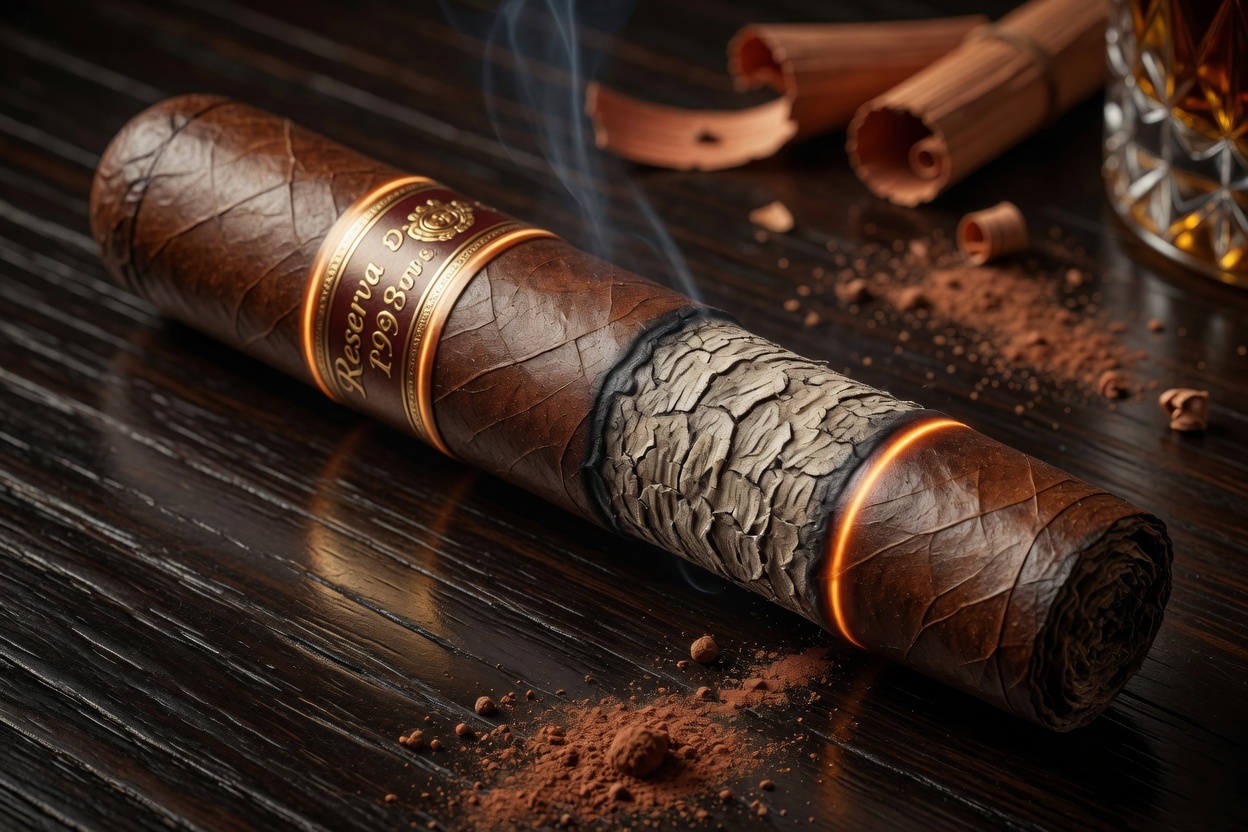
• **Color**: A cigar in its drinking window typically produces ash that is a refined, light gray or milky white (especially for non-Cuban cigars). If the ash is too dark, it usually means the combustion temperature was too high (too dry) or the fermentation was excessive.
• **Texture and Stability**: Perfect ash should be as fine as chalk dust and hold together exceptionally well. When you observe clear, ring-like patterns in the ash and it can stably support more than 2 cm without easily falling off, this indicates that the oils in the tobacco leaves have achieved perfect cohesion through aging.
• **The Moment Ash Falls**: I once observed an 8-year-old Montecristo whose ash maintained an elegant columnar structure throughout the burn, falling off cleanly only at the very end. This "stability" is a key indicator of structural integrity.
III. Smoke Characteristics: The Ultimate Peak Experience
All technical indicators ultimately return to the most essential experience—the sensory quality of the smoke. The hallmark of the drinking window is the transition "from conflict to harmony."
1. From "Green" to "Round"
New cigars often carrynoticeable 的 "greenness" or ammonia notes from insufficient fermentation. Over time, these pungent chemical compounds gradually decompose, replaced by deeper, more complex aromas.
• **Flavor Profile Evolution**: During the drinking window, you will find that the initiallysingular sharpness gradually evolves into acomplex profile of cedar, cocoa, nutty, and even creamy notes.
• **Mouthfeel**: The smoke at its peak is not just "good-smelling" but also "textured." It should wrap around the tongue like velvet—substantial yet notempty , rich yet not cloying.
2. Finish Persistence
Another important detail for judging whether a cigar has reached its peak is the finish. A cigar in its drinking window will leave alingering , clean, andsweet aftertaste in the mouth. If the finish carriesnoticeable 的 bitterness or metallic notes, the cigar may either not yet be mature or has already passed its peak.
IV. Practical Guide: How to Conduct a "Drinking Window Diagnosis"
For ease of operation, I have summarized a standardized diagnosticprocedure :
1. **Visual and Tactile Pre-check**: Inspect the wrapper for abnormal cracks or mold; pinch to test elasticity.
2. **Cut and Draw Test**: After cutting, test the draw to see if it is smooth. Too tight indicates wetness; too loose and hot indicates dryness.
3. **Lighting and Observation**: After lighting, do not rush to smoke. Observe whether the burn line is even in the first 3-5 minutes and whether the ash color meets expectations.
4. **Deep Tasting**: From the first third, middle third, to the final third, record theprogression of layers of flavors. Focus on whether the "greenness" has disappeared and whether the aroma showsnoticeable 的 complexity.
Conclusion: Scientific Verification, Sensory Judgment
Judging a cigar's drinking window is a dialogue betweenrational technical analysis andperceptual intuitive experience. Humidity, combustion, and ash—thesehard technical indicators provide us with an objective coordinate system; while flavor, mouthfeel, and finish are the ultimate judgment of the individual soul.
Do not blindlyblindly worship age, nor follow trends without thought. When you learn to "read" a cigar through these indicators, you truly begin to master the art of smoking.