How to change the environment, substitute behavior, and select medications — this article designs a complete quitting pathway for nasally sensitive smokers.
# Quitting Pathways for "Nasally Sensitive" Smokers
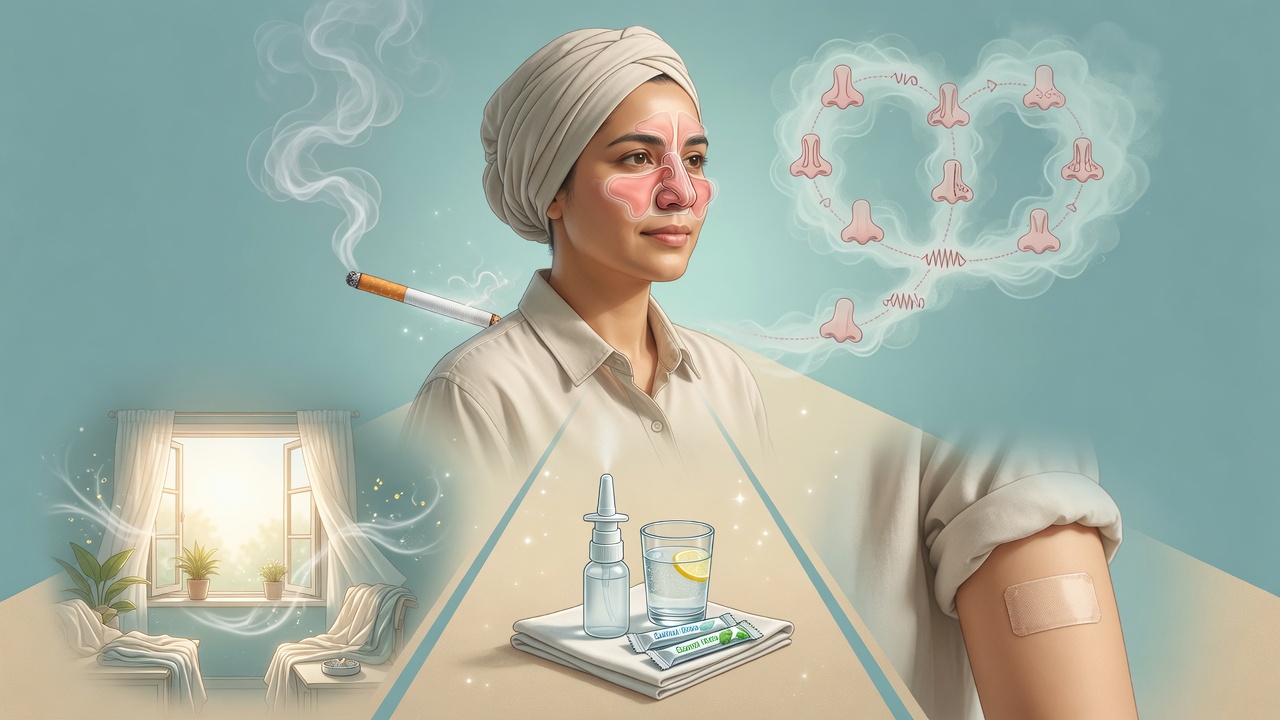
There is a category of smokers facing a particularly sharp contradiction: their nose gets stuffier, runs more, and they even sneeze after smoking, yet they still light the next cigarette. They are not "insensitive" to smoke—quite the opposite—they are overly sensitive to smoke stimulation. This article is specifically designed for these "nasally sensitive" smokers, focusing on three key areas: how to change the environment, how to substitute the behavior, and how to choose medications, along with a phased action checklist.
**Disclaimer:** This article is for health education purposes only and does not constitute individual diagnosis or prescription advice. Individuals with chronic rhinitis, sinusitis, asthma, cardiovascular disease, mental illness, or those who are pregnant or planning pregnancy should consult a licensed physician.
I. Are You a "Nasally Sensitive" Smoker?
1. Typical Profile
If you frequently experience 3 or more of the following, the strategies in this article may be especially suitable for you:
| Manifestation | Common Description |
|---|---|
| Immediate nasal reaction | Nasal congestion, clear/sticky rhinorrhea, nasal itching, sneezing during or within minutes after smoking |
| Environmental triggers | Nose "protests first" when entering a smoking room, mahjong parlor, or secondhand smoke area |
| Morning worsening | Night mouth-breathing + smoke residue, more pronounced morning congestion yet craving a "first cigarette" for a pick-me-up |
| Olfactory fluctuation | Sometimes dull sense of smell, sometimes oversensitive to smoke, cooking oil, or perfume |
| Associated symptoms | Post-nasal drip, throat clearing, dry throat, irritative cough, dry and itchy eyes |
| Contradictory motivation | Knows smoking harms the nose, but withdrawal anxiety and habit cues are too strong, leading to "suffering while smoking" |
These individuals often fall into a vicious cycle:
Nasal congestion → Irritation/desire for stimulation → Light a cigarette → Brief nicotine satisfaction or distraction → Increased mucosal irritation → More congestion → Smoke again.
The key to breaking the cycle is not "finding another way to irritate the nose" but reducing total nasal exposure + replacing the addictive behavior + medication support when needed.
2. How to Differentiate from "Ordinary Rhinitis" (Educational Level)
"Sneezing and nasal congestion when smoking" may involve multiple mechanisms. There's no need to rush into self-diagnosis, but knowing the general direction helps:
- **Irritant/Vasomotor Reaction:** Particulates, acrolein and other irritant gases in smoke, along with sudden temperature/humidity changes, can directly trigger nasal mucosal vasodilation and gland secretion—not necessarily classic IgE-mediated allergy.
- **Coexisting Allergic Rhinitis:** For those allergic to dust mites, pollen, or pet dander, smoke often acts as a **non-specific aggravating factor**—the allergy isn't resolved, and smoke makes symptoms "much worse."
- **Infectious or Chronic Rhinosinusitis:** Purulent discharge, facial pain/pressure, significantly reduced sense of smell, symptoms lasting weeks—seek medical evaluation rather than just "toughing it out" with quitting.
- **Drug-induced or Anatomical Factors:** Deviated nasal septum, inferior turbinate hypertrophy, long-term improper use of decongestant sprays can also present as "always congested."
Red Flags (seek ENT/general medical evaluation promptly, rather than increasing nasal irrigation or continuing smoking):
- Unilateral persistent nasal congestion or unilateral bloody discharge
- Severe headache, vision changes, proptosis, or diplopia
- High fever with facial swelling
- Complete loss of smell within a short period accompanied by other neurological symptoms
Smoking cessation benefits long-term upper respiratory health, but cannot replace professional evaluation for tumors, severe infections, or serious allergic conditions.
II. Why Does Smoke Specifically "Bully" Your Nose?
Understanding the mechanism helps you choose the right strategy, not to create panic.
1. The Nose is the Body's "Sentinel Filter"
When breathing air, the nose warms, humidifies, and filters it. Smoke contains:
- **Particulate Phase:** Tar-related particles, carbonaceous particulates, etc., which can adhere to the mucosa near the turbinates and middle meatus;
- **Gaseous/Semi-Volatile Irritants:** Various carbonyl compounds, volatile organic compounds, etc., that directly stimulate sensory nerve endings;
- **Drying and Temperature Impact:** Smoking often accompanies mouth-breathing, air-conditioned rooms, and enclosed spaces, further disrupting the nasal microenvironment.
For sensitive individuals, the same cigarette triggers stronger local inflammation and neural reflex, manifesting as sneezing, watery rhinorrhea, and alternating nasal congestion.
2. The Mucociliary Clearance System's "Tendency to Strike"
Healthy nasal mucosa relies on rhythmic ciliary beating to transport the mucus blanket backward. Long-term tobacco exposure and repeated inflammation reduce ciliary function and alter mucus properties, making secretions more prone to stagnation—subjectively experienced as congestion, stickiness, constant need to blow the nose, and constant throat clearing.
3. Nicotine and the "False Patency" Illusion
Nicotine has complex central and peripheral effects. Some smokers experience attention shift and a temporary decrease in anxiety after smoking, subjectively feeling "a bit better," but mucosal irritation and inflammatory burden are accumulating. This creates a classic illusion:
"When I feel congested, I take a puff, and it seems to help."
This is more like addiction-driven symptom masking, not an improvement in nasal pathology. The quitting pathway must replace this illusory relief with proper nasal care + behavioral substitution.
4. Secondhand and Thirdhand Smoke: Is "Smoking Less" Safe?
Even if the number of cigarettes smoked decreases, if you still spend long periods in smoky environments:
- **Secondhand Smoke:** Sidestream smoke is often no less irritating than mainstream smoke;
- **Thirdhand Smoke:** Tobacco-related chemicals and odors lingering on curtains, sofas, car upholstery, and clothing can still trigger nasal itching and sneezing in highly sensitive individuals.
Therefore, for nasally sensitive quitters, environmental engineering often carries greater weight than for ordinary quitters.
III. Pathway Overview: Three Pillars
| Pillar | Goal | Special Emphasis for Nasally Sensitive |
|---|---|---|
| Environmental Adjustment | Reduce total nasal mucosal irritation load | Removing smoke odor, controlling humidity, establishing smoke-free zones, avoiding smoking spots prioritized over "sheer willpower" |
| Behavioral Substitution | Break the cue–automatic smoking chain | Specifically dismantle the "congested → still want to smoke" cycle |
| Medication/NRT Choice | Reduce withdrawal symptoms, increase success rate | **Caution with nasal-irritating formulations**; prioritize transdermal patches ± oral forms under medical advice |
IV. Environmental Adjustment: Lighten Your Nose's Load
1. At Home: Transform a "Smoke-Filled House" into a "Recoverable Microenvironment"
(1) Hard Rule: Completely Smoke-Free Indoors
Smoking on balconies, in bathrooms, or under kitchen range hoods still causes backflow and residue. For the nasally sensitive, the only sustainable rule is zero smoking indoors—including guests.
(2) Ventilation: "Timed" Rather Than "Wide Open All Day"
- When outdoor pollution is heavy or pollen counts peak, blindly opening windows for long periods may worsen conditions for those with coexisting allergies;
- Opt for brief cross-ventilation during periods of better outdoor air quality;
- When possible, use appropriate air filtration equipment and **replace filters on time** (otherwise the filter itself becomes an irritant source).
(3) Humidity: A Comfort Zone Around 40%–60%
Too dry: mucosal dryness, crusting, increased bleeding tendency;
Too humid: dust mite and mold proliferation, aggravating allergic rhinitis.
Northern heating season and air-conditioned rooms require special attention: cleaning humidifiers is more important than "just keeping them running" to avoid secondary pollution.
(4) Thirdhand Smoke Cleanup Priority (High to Low)
1. Textiles in direct contact with mouth and nose: pillowcases, duvet covers, curtains, sofa covers, car seat covers
2. High-contact surfaces: remote controls, keyboards, door handles, sofa armrests
3. Deep fabric cleaning and sun/ventilation; professional cleaning for curtains and carpets when necessary
4. Air conditioner and ventilation filter screens, vent dust
No need to aim for a "whole-house renovation" in one day. Progress one high-exposure area per week for less psychological burden.
(5) Restrain Fragrances and Irritating Cleaners
During the quitting period, nasally sensitive individuals often experience aggravated irritation or allergic reactions to perfumes, chlorine-based cleaners, and strong essential oils. Prioritize gentle cleaning, avoiding the "mask smoke odor with heavy air freshener" approach that causes secondary harm.
2. Workplace and Commute
- Physically distance yourself from company smoking spots and building ventilation dead zones;
- In elevators or enclosed meeting rooms with smoke odor, turn away, breathe shallowly, wash face and hands after meetings (reduce odor adhesion);
- For commutes where others often smoke, adjust carriage position or shift schedules; masks offer some physical barrier against particulates but are not a cure-all for gaseous irritants.
3. Social Scenarios (Ready-to-Use Phrases)
- "My nose is really sensitive to smoke—I get congested immediately. I'm quitting this week. Thanks for understanding."
- "I'm using the alternative my doctor suggested. If I have one real cigarette, I'll feel terrible. Don't make me suffer."
- At gatherings, choose an outdoor upwind seat or leave during periods with lighter smoke.
Defining refusal of offered cigarettes as a health boundary, not a social failure, greatly reduces psychological resistance.
4. Nasal Local Care Environment (Educational Scope)
With physician or pharmacist approval, many people can benefit from:
| Measure | Rationale | Notes |
|---|---|---|
| Isotonic saline spray/rinse | Physical removal of irritants and secretions, improving ciliary function | Device hygiene; improper concentration or water quality can cause irritation; consult physician for children and special anatomy |
| Moderate humidification and hydration | Alleviate dryness-related discomfort | Avoid excessive humidity |
| Prescription/OTC nasal medications | Anti-inflammatory, anti-allergic, etc. | **Decongestants should not be used continuously long-term**, risk of drug-induced rhinitis |
| Allergen control | Bedding covers, reducing carpets, pet zoning, etc. | Better combined with cessation environmental engineering |
Important: High-concentration homemade saline, unclean rinsing, or shared rinsing devices can cause irritation or infection risk. Those with a history of otitis media or recent nasal surgery must consult a doctor before rinsing.
V. Behavioral Substitution: Dismantle "Automatic Smoking"
1. First, Map Your Triggers
Track for 3 consecutive days (phone memo is enough):
| Time | Scene | Mood | Nasal State | Smoked? | Cravings (0–10) |
|---|---|---|---|---|---|
| Eg: 7:10 | Wake up, toilet | Sleepy | Moderate congestion | Yes | 8 |
High-frequency triggers often cluster around: morning waking, after meals, coffee/alcohol, driving, computer lag, bathroom, after arguments, seeing others smoke.
Nasally sensitive individuals should add one more column—"More likely to smoke when congested?" If yes, you need a congestion response kit (below), not a cigarette.
2. Use a "Hand–Mouth–Nose" Substitution Chain to Replace "Take Cigarette–Light–Inhale Deeply"
Design 3 layers of substitution, deployable within seconds:
0–30 Seconds (Cut off initiation)
- Change rooms / open a window for side-breathing / drink a sip of room-temperature water
- Occupy hands: stress ball, squeeze a towel, wash hands
30 Seconds–5 Minutes (Survive the craving peak)
- Slow breathing: gently inhale through the nose (if severely congested, inhale slowly through the mouth)—pause 1 second—longer exhale, repeat 10 times
- Sugar-free gum, sugar-free lozenges (watch oral health and dental condition)
- Walk down two flights of stairs or stretch in place for 2 minutes
After 5 Minutes (Rebuild reward)
- Check off a tracker, listen to a fixed "quit song," accumulate small rewards
- Visualizing "I got through it" is more effective than abstract willpower
The 5-Minute Rule: Most urges subside within a few minutes. Your job is not to "never crave," but to survive this wave.
3. Specifically Addressing: "When My Nose is Blocked, Would a Puff Help?"
Keep a congestion response kit at home (example):
1. Saline spray
2. Tissues (sterile)
3. Lip balm (reduce dry lips from mouth-breathing)
4. Warm water
5. Rhinitis medication as prescribed (if any)
6. A card: front says "Congestion ≠ time for a cigarette"; back lists your 3 reasons to quit
Fixed procedure:
Notice congestion → Saline/medication → Wash face and hands → 5-min alternative behavior → Reassess craving
In most cases, cravings intensity decreases; even if still present, the automatic sequence has been interrupted.
4. Behavioral Alternative Menu (By Scenario)
| Scenario | Old Habit | New Habit |
|---|---|---|
| Morning wake-up | First cigarette | Wash face + saline spray + drink water, delay cigarette and gradually eliminate |
| After meals | Light up immediately | Get up, do dishes / take a 10-min walk + gum |
| At computer | "Smoke when stuck" | Pomodoro break: look far + stretch; smoke-free desk |
| Drinking session | Smoke and drink trigger each other | Non-alcoholic drink strategy or seating away from smoking circle; alcohol lowers self-control, limit in advance |
| Driving | Smoke in car | Thoroughly clean car, make it permanently smoke-free, keep water and gum |
| Anxiety | Deep inhale of smoke | 4-6 breathing method or briefly leave the scene |
5. Relapse Is Not Zero
Nasally sensitive people often self-attack after relapse because "my nose hurts again." A more productive debrief asks three questions:
1. Was the trigger environmental, emotional, or alcohol-related?
2. Was an alternative available at the time?
3. What is the pre-script for the same scenario next time?
Define a single relapse as a data point, not a character failure, to stay on the path.
VI. Medication and Product Choices: Priorities for the Nasally Sensitive
The core tools for increasing smoking cessation success rates include: behavioral support + Nicotine Replacement Therapy (NRT) and/or prescription medications. The following explains the selection logic based on nasally sensitive characteristics (always follow medical advice).
1. NRT: Prioritize "Low Nasal Irritation" Routes
| Formulation | General Characteristics | Implications for Nasally Sensitive |
|---|---|---|
| Nicotine patch | Transdermal steady release, simple to use | **Often the base choice**; bypasses the nose, no smoke irritation |
| Nicotine gum/lozenge | On-demand use for peak cravings | Bypasses the nose; use correct "chew–park" technique to avoid gastric discomfort |
| Nicotine inhaler/oral device | Mimics hand-to-mouth action | Generally not nasal delivery, but oral/throat irritation varies by individual |
| Nasal spray nicotine formulations | Fast onset | **Usually requires special caution for nasally sensitive**; may directly worsen nasal irritation; should be evaluated by a physician |
Common combination logic (illustrative, not prescription):
Patches provide a steady base level throughout the day, reducing constant cravings; gum/lozenges manage peak cravings before meetings or after meals. Whether combination is suitable and how doses are titrated depends on daily cigarette consumption, medical history, and medical advice.
Nasal-related reminders when using NRT:
- NRT addresses **nicotine withdrawal**, not environmental smoke irritation—environmental engineering remains essential;
- Some people may experience initial throat irritation or sleep changes, requiring feedback to their doctor;
- Do not use NRT while continuing to smoke heavily—this is unsafe and disrupts dose assessment.
2. Prescription Medication Directions (Educational Only)
After physician evaluation, some quitters may use:
- **Varenicline, etc.:** Acts on nicotine receptor pathways, reducing reward and withdrawal; requires monitoring of mood, sleep, skin reactions, and other individual differences and contraindications;
- **Bupropion HCl, etc.:** May be considered for those with depressive tendencies or specific smoking patterns; not suitable for those with seizure history or other contraindications.
Nasal sensitivity alone is not sufficient reason to "add a prescription drug," but if multiple willpower-only attempts have failed, smoking volume is high, and withdrawal symptoms are severe, discussing medication assistance with a doctor is a rational choice, not weakness.
3. E-Cigarettes, Heated Tobacco, Snuff: Why Not the Main Path Recommended Here
| Product | Common Misconception | More Realistic Concerns for Nasally Sensitive |
|---|---|---|
| E-cigarettes | "Vapor is harmless" | Aerosols and flavorings can still irritate the upper airway; nicotine addiction can persist; not a first-line medical cessation tool |
| Heated tobacco | "Doesn't burn, so it's safe" | Still tobacco exposure; airway irritation and addiction remain |
| Snuff/oral tobacco | "Doesn't go into lungs, so it's fine" | Dry nasal powder **directly impacts the nasal mucosa**; oral forms damage oral mucosa and maintain nicotine dependence |
For someone whose nose is already vulnerable, replacing cigarettes with another tobacco/nicotine delivery format is often just switching irritation sites or chronic exposure, not a true exit path.
If, under medical supervision, someone uses certain products as stage-based harm reduction tools, that is an individualized medical decision; this article, as foundational educational content, recommends: stop combustible tobacco + behavioral support + approved cessation medication/NRT.
4. How to Coordinate with Rhinitis Medication
- Those currently using **nasal corticosteroids, antihistamines, antileukotrienes, etc.** should generally **continue regular use as prescribed** during the quitting period, not stop to "see if quitting works."
- Weeks to months after quitting, some may experience nasal symptom improvement and can discuss adjusting rhinitis medication during follow-up visits.
- **Decongestant sprays** should only be used short-term for severe congestion; daily long-term use risks rebound congestion.
- For complex cases involving asthma or aspirin sensitivity, specialist coordination is essential.
5. Simplified Decision Tree
Ready to set a quit date within 2–4 weeks?
├─ No → Start with environmental smoke-free + trigger tracking + reduce smoke-exposure situations
└─ Yes → Any complex medical history (cardiovascular, mental health, pregnancy)?
         ├─ Yes → Prioritize outpatient/smoking cessation clinic evaluation
         └─ No → Discuss NRT (patch ± gum/lozenge) ± prescription medication
                  Simultaneously initiate behavioral substitution and social scripts
                  Nasally sensitive: default avoidance of "nasal-irritating" self-selected products
VII. Phased Quitting Roadmap
Phase 0: Preparation (Approx. 3–14 days)
Goal: Lower the barrier to starting, not "perfect willpower" on day one.
- □Complete 3-day trigger mapping
- □Declare home and car smoke-free; begin first wave of thirdhand smoke cleaning
- □Inform family/colleagues of boundaries and help signals
- □Schedule a doctor or official cessation resource appointment (if needed)
- □Prepare saline spray, gum, water bottle, response kit
- □Set a quit date (avoid extremely high-pressure deadlines and wedding/party stacking days, if possible)
- □Calculate daily cigarette consumption for NRT discussion with doctor
Phase 1: Acute Withdrawal (Approx. 1–2 weeks from quit date)
Goal: Survive peak withdrawal and peak nasal "transition discomfort."
Expect: irritability, decreased concentration, appetite changes, lighter sleep, oral emptiness; the nose may still be sensitive, even reacting more noticeably to environmental smoke—this doesn't mean "quitting wrong," it reflects contrast effects and residual inflammation.
Action focus:
- Apply patch/take prescribed medication on time; use on-demand gum/lozenge before cravings hit 9/10
- Strictly no indoor smoking; reduce drinking sessions
- Perform fixed nasal saline care twice daily (if medically approved)
- When cravings hit, only start the substitution chain—don't debate "just one"
- Moderate sleep and caffeine management to avoid exhaustion-triggered relapse
Phase 2: Consolidation (Approx. 1–3 months)
Goal: Automate new habits; handle occasional situational cravings.
- Review the 1–2 most dangerous scenarios; write pre-scripts
- Continue environmental maintenance (filters, fabrics)
- Gradually introduce exercise: brisk walking, swimming (within capacity) for mood and weight management
- If rhinitis symptoms improve, follow up for reassessment; if no improvement, investigate allergens and chronic sinusitis
- Reduce NRT per instructions or medical advice; avoid abrupt cessation to prevent rebound
Phase 3: Long-Term Maintenance (3+ months)
Goal: Prevent "celebratory relapse" and stress-induced relapse.
- Maintain smoke-free identity: "I am someone with a sensitive nose who has quit smoking"
- Major stress events (job change, conflict, bereavement) warrant increased support in advance
- Single relapse → return to Phase 1 toolbox within 24 hours, not "give up completely"
- Regularly review cessation benefits: congested days, morning comfort, sense of smell, bad breath, exercise endurance, and other perceptible indicators
VIII. Summary Table: Environment × Behavior × Medication
| Phase | Environment | Behavior | Medication/Care |
|---|---|---|---|
| Preparation | Indoor smoke-free legislation; start cleaning | Trigger tracking; script practice | Prepare NRT/doctor visit; saline + response kit |
| Acute | Zero-exception indoor smoke; fewer drinking sessions | 5-minute rule; congestion response kit | Patch ± on-demand; caution with nasal irritants |
| Consolidation | Deep thirdhand smoke cleaning | High-risk scenario scripts | Dose reduction per medical advice; rhinitis medication follow-up |
| Maintenance | Social boundary normalization | Stress contingency plans | Support as needed; watch for relapse chain |
IX. Common Misconceptions Clarified
Misconception 1: "Since my nose is so sensitive, the toxins are all blocked in my nose—my lungs are fine."
Nasal sensitivity does not equal lower respiratory safety. Combustion smoke can still be inhaled through the mouth to reach airways and alveoli; systemic nicotine and cardiovascular risks remain.
Misconception 2: "Switch to snuff/smokeless tobacco—my nose will get used to it."
Nasal tobacco products apply irritants directly to already sensitive mucosa—logically counterproductive.
Misconception 3: "E-cigarettes have no smoke odor, so my nose is relieved."
Reduced odor ≠ no irritation, no addiction. For some, aerosols still trigger throat and airway discomfort, and may delay true cessation.
Misconception 4: "Saline can be used freely—higher concentration means cleaner."
Incorrect concentration and improper device hygiene actually damage the mucosal barrier. Follow product instructions or medical advice.
Misconception 5: "All cessation drugs are harmful—I'll rely on willpower alone."
For highly dependent individuals, evidence supports medication + behavioral combination as more effective. Using approved medications under medical supervision is often more manageable than cumulative harm from repeated relapses.
Misconception 6: "When congested, taking a puff clears my nose."
This is the classic trap of the addiction cycle. Return to the congestion response kit.
X. Perceptible Progress Indicators (Feedback for Yourself)
Don't just focus on "do I still want to smoke." Nasally sensitive individuals can additionally track:
1. Number of days per week with smoke-triggered sneezing/runny nose
2. Morning nasal congestion score (0–10)
3. Recovery time after entering a previously smoked-in room
4. Subjective rating of smell for food aromas
5. Consecutive smoke-free day count
When these curves improve, even with occasional cravings, your brain receives reinforcement that "the strategy is working."
XI. Conclusion: Sensitivity Is Not a Weakness—It's an Alarm System
"Nasally sensitive" smokers actually receive their body's warning earlier: the upper respiratory tract is already protesting smoke exposure with congestion and runny nose. In the past, this alarm was often drowned out by nicotine's reward circuitry; now, you can turn that same sensitivity into a lever for quitting—
- Use environmental engineering to reduce every innocent mucosal assault;
- Use behavioral substitution to dismantle automatic smoking;
- Use approved medication/NRT to survive physiological withdrawal;
- Use specialist follow-up to address coexisting rhinitis and sinus issues.
The true endpoint is not "enduring a stuffy nose," but giving your nose no reason to work overtime for every wisp of smoke, and giving yourself no reason to apologize for every cigarette.
Reference Directions (For Further Verification)
- WHO and national public health agency public materials on tobacco harm and cessation interventions
- Clinical cessation guidelines on behavioral support and first-line medications (NRT, prescription drugs) frameworks
- ENT literature on chronic rhinitis, allergic rhinitis, mucociliary function, and environmental stimulation
- Epidemiological and toxicological reviews on environmental tobacco smoke (secondhand smoke) and upper respiratory symptoms
Specific drug dosages, courses, and product choices should be based on licensed physicians, pharmacists, and local prescribing information.
Intended use: Foundational educational content related to nasal-inhalation smoking cessation; emphasizes the environment–behavior–medication comprehensive pathway for the nasally sensitive subtype; does not involve hard promotion of specific commercial brands.
Traditional path: pure willpower
Environment unchanged, habits intact, no medication support; the nose keeps getting irritated and relapse is more likely.
This pathway: environment × behavior × medication
Reduce total nasal exposure, dismantle automatic smoking, use medication support when needed — multidimensional synergy boosts success.
Note: follow medical advice for specific medications and dosages.
Note: numbers and units are quoted from the original text.
Note: this article does not involve specific commercial brands.