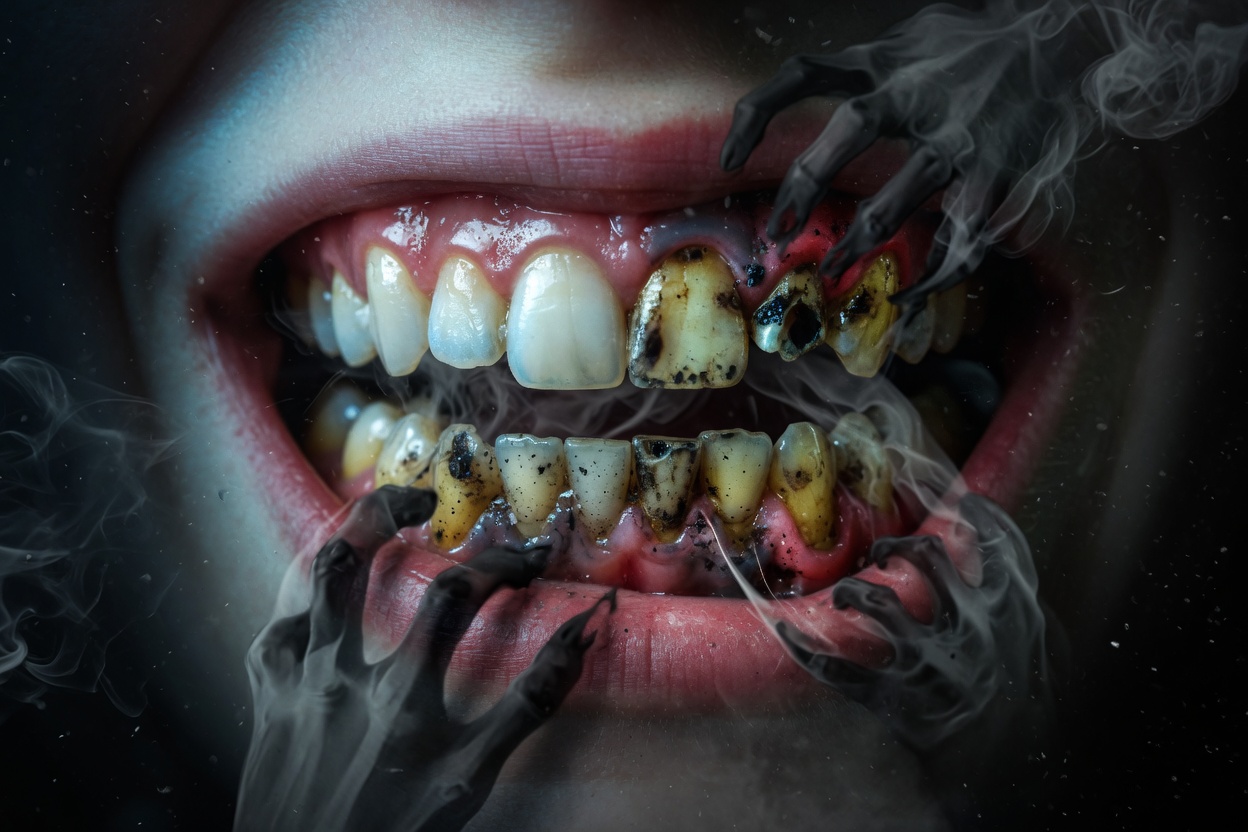
If you think smoking only yellows your teeth and gives you bad breath, you may be seriously underestimating the damage this habit does to the structural support of your face. From the perspective of dental medicine, smoking is not just a "bad habit"—it is a precision attack on your gums, periodontal tissue, and even your alveolar bone.
Many long-term smokers have a misconception: "My gums look healthy, I rarely even have the gum bleeding that smokers usually get." This "healthy illusion" is precisely the most dangerous signal. It's not because your periodontal condition is good, but because smoking is quietly "locking down" your immune system, accelerating the destruction silently.
This article will take you deep into the microscopic world, deconstructing how smoking alters bacterial flora, weakens immunity, blocks blood supply, and disrupts bone metabolism—ultimately leading to gum recession, tooth loosening, and even the loss of all your teeth.
Chapter 1: The "Betrayal" on the Microscopic Battlefield—When the Immune System Is Disarmed
To understand the nature of periodontal disease, we must first recognize that the oral cavity is a highly complex micro-ecological battlefield. In healthy periodontal tissue, bacteria and the host immune system maintain a delicate balance: pathogens are continuously cleared, and inflammation is kept under control.
However, when smoke enters the mouth, this balance is shattered instantly.
1. Recruiting the "Enemy": Ecological Dysbiosis of the Flora
Smoking doesn't just introduce toxins—it alters the oral environment, creating a "breeding ground" for dangerous pathogens.
Research shows that cigarette smoke significantly changes the composition of the subgingival microecology. The most typical example is **Porphyromonas gingivalis**—one of the most vicious "ringleaders" in periodontal disease. Smoking induces these bacteria to upregulate their key virulence factors, such as fimbrial antigen (FimA) and outer membrane protein expression. This means that the oral environment after smoking not only favors the survival of these bacteria but also makes them more "aggressive" than usual.
More frighteningly, smoking helps these bacteria form a more robust "biofilm." This is like putting a bulletproof vest on the bacteria, making it difficult for your immune cells to penetrate and eliminate them. In this state of dysbiosis, what would normally be a controllable mild inflammation rapidly escalates into destructive periodontitis.
2. Immune System "Disability": Disarmed Defenders
If the pathogenic bacteria are the "rebel army," then smoking is directly "disarming" your immune defenders—**neutrophils**.
As neutrophils (the body's first line of defense) attempt to engulf bacteria, the nicotine and various chemicals in smoke directly interfere with their chemotaxis and phagocytic ability. Imagine soldiers who should be charging into battle to intercept the enemy, now slow, sluggish, and unable to identify targets.
Furthermore, smoking significantly reduces levels of immunoglobulins (such as IgA) in saliva and lowers the concentration of specific antibodies (IgG) against periodontal pathogens in the blood. This double blow—strengthening the enemy while weakening your own defenses—leaves periodontal tissue virtually "undefended" against bacterial invasion.
What's even more deceptive is that smoking triggers a "paradoxical inflammatory response": on one hand, it stimulates the production of pro-inflammatory cytokines (such as IL-1, IL-6), accelerating tissue destruction; on the other hand, due to its vasoconstrictive effect on microvessels, it masks the typical "bleeding" sign of inflammation. This is why many smokers still think their "gums are fine" even when periodontal disease has reached the middle or late stages—until their teeth start to wobble.
Chapter 2: The "Strangulation" of Oxygen Deprivation—Suffocated Gum Tissue
If bacterial imbalance is "external invasion," then the vasoconstriction caused by smoking is an internal, long-term "suffocation" of the gums.
1. Nicotine's "Tightening Spell": Microvascular Dysfunction
Nicotine is a potent vasoconstrictor. When you inhale smoke, nicotine rapidly enters the bloodstream and acts on the smooth muscles of the gingival microvessels, causing vasoconstriction.
In long-term smokers, the capillaries in gum tissue often show abnormal morphology: they become tortuous, narrowed, with significantly reduced diameters. This structural change directly leads to **hypoxia** in the gum tissue.
For periodontal tissue, oxygen is the lifeblood for repair and maintenance of vital activities. Due to microvascular dysfunction, the gums cannot obtain sufficient oxygen and nutrients, which not only weakens cellular metabolism but also keeps periodontal tissue in a state of "chronic starvation."
2. The "Vicious Cycle" of Healing: Why Smokers Struggle to "Fix" Their Teeth
This hypoxic state is particularly evident in clinical treatment.
When you undergo periodontal scaling, gum surgery, or dental implant surgery, tissue healing critically depends on fresh blood supply (revascularization). However, due to smoking-induced microvascular damage, smokers' wounds heal extremely slowly and are highly prone to infection.
This is why clinical data consistently shows that periodontal treatment outcomes (such as attachment level recovery) are significantly worse in smokers than in non-smokers. This "difficulty in healing" means that every minor periodontal injury can potentially become irreversible tissue loss.
Chapter 3: Crumbling Foundation—From Collagen Degradation to Gum Recession
As inflammation persists and oxygen becomes scarce, the physical structure of periodontal tissue begins to collapse from within.
1. Collagen "Melting"
The strength of gums and periodontal ligaments primarily relies on **collagen fibers**. These fibers act like the steel reinforcement in a building, supporting the gums to tightly envelop the teeth.
However, smoking directly destroys these "steel bars" through two pathways:
- **Cytotoxicity**: Nicotine and tobacco toxins directly damage gingival fibroblasts (hGFs), reducing their ability to synthesize collagen.
- **Enzymatic Degradation**: Smoking significantly increases the activity of matrix metalloproteinases (MMPs, especially MMP-2 and MMP-9). MMPs are "enzymes" specialized in degrading the extracellular matrix. Under normal circumstances, they are responsible for tissue remodeling, but in the mouth of a smoker, they behave like an uncontrolled demolition crew, frantically breaking down the collagen fibers that should remain stable.
2. Gum Recession: The Disappearing "Protective Barrier"
When collagen fibers are extensively degraded, the attachment of the gums decreases. As periodontal pockets deepen and tissue is lost, the gums begin to recede toward the root of the tooth—this is what we call **gum recession**.
The consequences of gum recession are a chain reaction:
- **Root Exposure**: Without gum coverage, the tooth root (dentin) is directly exposed to the oral environment.
- **Tooth Sensitivity**: Exposed dentinal tubules cause sharp pain when you drink cold beverages or eat hot food.
- **Root Caries**: Exposed roots are more susceptible to bacterial attack than the crown, leading to root caries.
Chapter 4: The Endpoint of Collapse—Alveolar Bone Resorption and Tooth Loosening
If gum recession is the peeling away of the "outer wall," then alveolar bone resorption is the collapse of the "foundation." This is the most severe stage of periodontal disease and the direct cause of tooth loss.
1. Bone Metabolism "Out of Control": Collapse of the RANKL/OPG Axis
The reason teeth can firmly stand in the jawbone is the precise balance between alveolar bone (the bone tissue supporting teeth), osteoclasts (responsible for bone resorption), and osteoblasts (responsible for bone formation). This balance is primarily regulated by the **RANKL/OPG axis**.
Smoking completely disrupts this balance. By inducing oxidative stress and the massive release of inflammatory factors (such as PGE2), it significantly increases **RANKL** (a signal that promotes osteoclast formation) levels while inhibiting the production of **OPG** (which protects bone and counteracts RANKL).
The result is: **Osteoclasts are overactivated while osteoblasts are powerless to respond.** The alveolar bone gradually resorbs, thins, and disappears along the tooth root, as if being eroded by acid.
2. Tooth Loosening: A "Drifter" Without an Anchor
As the height of the supporting alveolar bone decreases, the tooth has fewer and fewer "anchor points." At this point, the tooth is no longer firmly rooted in the bone but hangs precariously from the remaining periodontal tissue.
You will feel a slight wobble when chewing. As bone resorption worsens, this wobble evolves into obvious tooth **loosening**. In many cases of heavy smokers, the final outcome is that teeth fall out completely—not from external force, but simply from the force of chewing.
Chapter 5: Clinical Record—A Tale of "Silence"
To help you understand this destruction more intuitively, let me share a real case I encountered in clinical practice.
Patient Mr. Li, 52 years old, with a 30-year history of heavy smoking (a pack or more per day). When he first came for consultation, he didn't feel anything seriously wrong with his teeth. He even complained: "Doctor, my gums don't feel much. Unlike my non-smoking friends who bleed when brushing, I don't see a drop of blood."
However, when I performed deep periodontal probing, I was shocked. Mr. Li's periodontal pocket depth had reached 6–7 mm—a sign of very severe periodontitis. More critically, due to long-term nicotine-induced vasoconstriction, his gums showed an abnormal "pallor" and "tightness," with almost no inflammatory redness, swelling, or bleeding.
On X-rays, we could clearly see that his alveolar bone resorption had reached moderate-to-severe levels, with nearly half of the bone around the tooth roots already lost.
Mr. Li's teeth had already begun to show obvious looseness in multiple areas. When he realized the severity of the problem and tried to quit smoking and undergo deep scaling treatment, the challenges we faced were immense. Due to long-term tissue hypoxia, his periodontal surgery healing rate was far below expectations, and with bone loss already at a critical point, we had to recommend extraction of some teeth and plan for subsequent implant restoration.
Mr. Li's case is a microcosm of countless smokers: **They think "no bleeding" is a sign of health, not realizing it is the signal of disease silently stealing their smile.**
Chapter 6: How to Perform a Self-Examination?
Since smoking masks the signs of inflammation, how can you identify risks? Please regularly perform the following self-checks:
1. **Observe Color and Morphology**: Even if you don't bleed often, be alert if your gums appear abnormally pale, recessed, or if tooth roots are exposed.
2. **Test Sensitivity**: Do you feel sudden, sharp pain when eating hot or cold food? This may be a sign of gum recession leading to root exposure.
3. **Check for Gaps**: Have you noticed abnormal gaps (black triangles) appearing between your teeth? This is often a sign of gum tissue loss.
4. **Test Stability**: Try gently pressing your teeth with your fingers, or pay attention to any "wobbling" sensation when chewing.
5. **Professional Examination (Most Important)**: Regardless of how you feel, if you have a history of smoking, get a professional periodontal probing and full-mouth X-ray at least once a year.
Chapter 7: After Quitting—The Road to Restoration
Many people ask me: "Doctor, my periodontal disease is already this bad. Is it too late to quit now?"
The answer is: **As long as your teeth are still there, there is hope.**
Quitting smoking cannot magically "regrow" lost alveolar bone, but it can fundamentally reverse the vicious cycle:
- **Improve Microcirculation**: After quitting, the vasoconstrictive effect disappears, blood flow to the gum tissue gradually recovers, providing necessary oxygen and nutrients for tissue repair.
- **Restore Immune Balance**: As nicotine is metabolized, neutrophil function and the oral microecology stabilize, and the inflammatory response is no longer "out of control."
- **Enhance Treatment Outcomes**: For ongoing periodontal treatment, quitting smoking greatly improves surgery success rates and healing quality.
After quitting, your gums may go through an "adaptation period," with even temporary redness and swelling in the early stage—but this is usually a positive sign that the body is rebuilding its defense mechanisms.
Conclusion: Choose Another Way to "Breathe" for Your Smile
Periodontal disease is an extremely insidious opponent. It doesn't knock you off your feet like a cold. It is more like a thief lurking in the shadows, stealing your alveolar bone bit by bit, peeling away your gums little by little, until finally, it takes away your ability to chew, your confidence in speaking, and the smile that was once radiant.
The fleeting pleasure of smoking should not come at the cost of your oral health for the rest of your life. If you are smoking, or trying to quit, remember: **Every time you refuse a cigarette, you are reinforcing the foundation of your teeth.**
To enjoy food for years to come, to show your smile with confidence—start today, and give your periodontal tissue a chance to breathe fresh oxygen.