Simple Technical Parameters and Common Misconceptions for Cigar Aging at Home
For many cigar enthusiasts just starting out, "aging" sounds like a mysterious and esoteric process. Some say the longer you age a cigar, the better; others say aging is simply locking cigars in a box and letting time pass. But from my years of trial and error, aging is far from simple "resting"—it is a precise experiment of temperature, humidity, and airflow.
If your environmental control is improper, aging will not make your cigars mellow; instead, it will turn your expensive premium cigars into moldy, cracked pieces of "waste wood." Today, I want to skip the textbook theories and share the practical technical parameters that truly matter in home aging, along with the common pitfalls that can cost you dearly, based on my hard-earned lessons in various climates.
Temperature: The "Pulse" of Aging
If aging is compared to a marathon, then temperature is the athlete's heart rate. It determines the speed of chemical reactions.
During the aging process, organic compounds, oils, and ammonia substances inside the cigar slowly change. What we need is a "slow and stable" evolution.
My Experience Value: 18°C Is the Sweet Spot
In my practice, I always keep the aging environment between **16°C and 21°C**, with my personal comfort zone at **around 18°C**.
Why not higher? I remember the summer of 2021 when I lived in an apartment in Shanghai. Due to aging air conditioning, my humidor would frequently jump above 24°C late at night due to indoor temperature fluctuations. During that period, I noticed that cigars that should have gradually released woody notes and oils instead emitted an unpleasant sour smell resembling old paper. Worse, high temperatures greatly stimulate tobacco beetle activity. If you find fine, sand-like powder on the surface of your cigars, or tiny holes inside, do not doubt—that is the price of high heat.
Why not lower? If you keep cigars below 12°C, they can be well preserved, but the aging process becomes extremely slow, nearly stagnant. More troublesome is that humidity control becomes very tricky at low temperatures, making it difficult for moisture to penetrate the tobacco fibers evenly.
**Core conclusion:** Pursuing "stability" is far more important than pursuing "accuracy." An environment that deviates by 1°C but stays stable for 24 hours is far better than one that oscillates between 18°C and 22°C.
Humidity: The "Palette" of Flavor
If temperature controls speed, then humidity (RH) controls flavor concentration and depth.
Breaking the "Double 70" Myth: Why I Prefer 65% RH
Many veteran smokers or textbooks will tell you the "double 70" principle—70°F temperature and 70% humidity. This is a decent standard for daily smoking storage, but for **long-term aging**, it is actually a huge pitfall.
Over a two-to-three-year aging cycle, maintaining 70% or higher humidity carries significant risks. Excess moisture makes cigars "muddy," producing heavy, unrefined smoke during burning, and can even mask the cigar's delicate flavor layers.
My practical parameter is: **64% – 68% RH**.
This range is called the "sweet spot." It ensures the tobacco retains enough oils to prevent cracking from dryness, while avoiding mold or combustion issues from excess moisture.
Ventilation: The "Rhythm" of Breathing
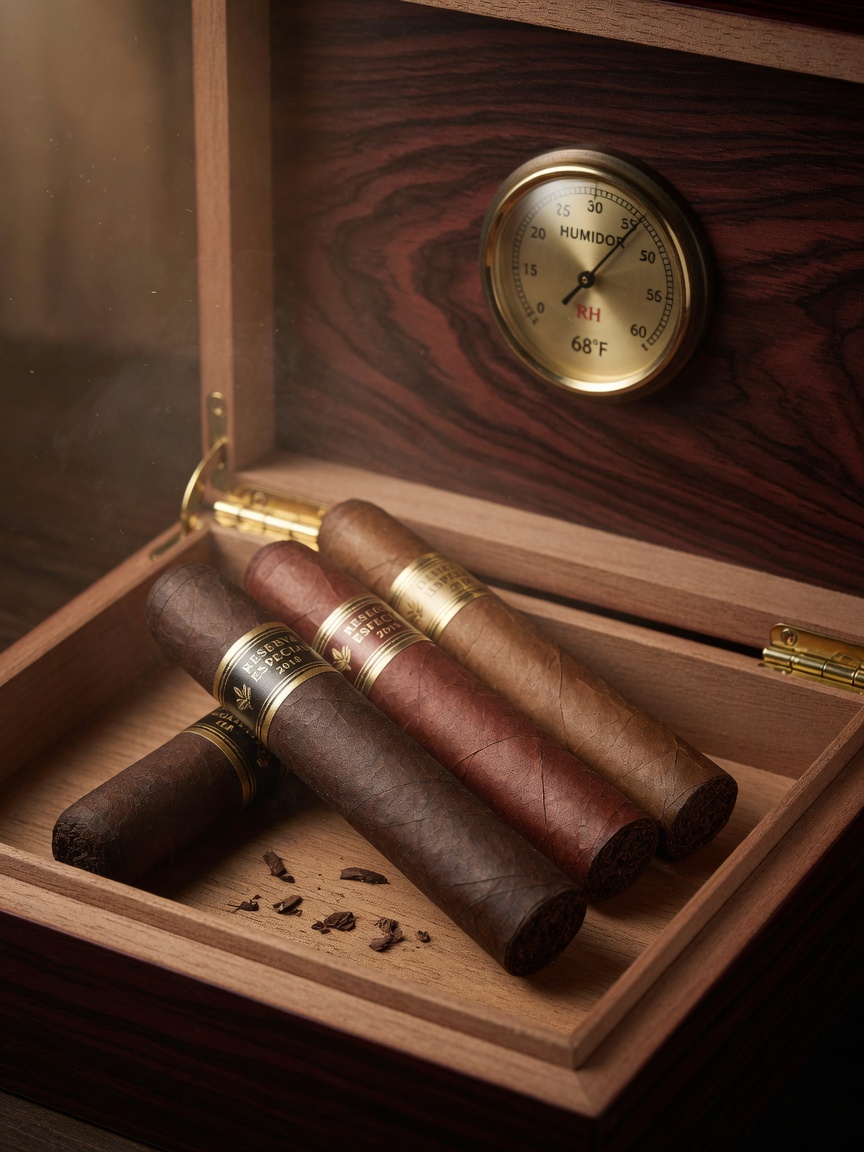
Many people believe humidors must be completely airtight, which is a major misconception.
Cigars are "alive." During aging, they need extremely weak but continuous air exchange. If the environment is completely sealed, the air becomes stagnant, and carbon dioxide and volatile substances cannot escape, causing the tobacco to develop a strange, over-fermented sour odor.
In my humidor setup, I leave about **25% empty space**. Do not pack cigars tightly. Leave room for weak airflow between cigars, which helps distribute humidity evenly and prevents localized high-humidity dead zones.
The Pitfalls I've Stumbled Into: Real Cases
Without the lessons of failure, there is no mature experience.
Case One: The 2022 "Mold Disaster"
That year, I tried using a cheap wooden humidor without active temperature control for large-scale aging. During the rainy season, I blindly thought "higher humidity is safer" and set it to around 72%.
In the third month of inspection, I was horrified to find a thin, white, frost-like substance on the surface of two precious boxes of Padron cigars. At first I thought it was natural oils, but soon I saw it moving in the air—it was mold. Due to poor ventilation and excessive humidity, my humidor had become a perfect mold culture. That entire batch was ruined. The loss was not just financial but a blow to my reverence for cigars.
Case Two: The "Dry Crack Nightmare" by the Radiator
Another lesson came from winter. To save trouble, I placed my humidor near a radiator. Although the cabinet itself was sealed, drastic ambient temperature fluctuations caused the hygrometer readings to jump wildly.
Temperature differences caused moisture to condense on the cabinet walls, then rapidly evaporate when the heat came on. This "dry-wet cycle" directly caused fine cracks in the wrappers of several premium cigars. Once the wrapper cracks, the aging process is completely finished—they quickly dry out, become brittle, and their flavor fades.
Pitfall Guide: Debunking Popular Misconceptions
To help you avoid detours, I summarize the following pitfalls you must avoid:
**Truth:** Excess moisture is the enemy of aging. Mold, beetles, and poor combustion are direct consequences. It is better to be slightly too dry than too wet.
2. **Myth: Put cigars in the refrigerator.**
**Truth:** This is the worst thing you can do. Refrigerators are extremely dry and have huge temperature fluctuations; they will instantly suck the oils out of your cigars, turning expensive cigars into dry straw.
3. **Myth: You must remove the cellophane from cigars.**
**Truth:** Many think cellophane hinders aging. But in a home environment, keeping cellophane is actually an excellent protective measure—it prevents direct friction between cigars and provides a weak humidity buffer.
4. **Myth: All cigars are suitable for aging.**
**Truth:** No. Some mild cigars or those from certain regions lose their original freshness and become bland if aged too long. Aging requires "small-scale experiments" for different cigar grades.
Advice for Beginners
- If you want to start your home aging journey, my suggestions are:
- **Invest in reliable tools:** Do not use cheap hygrometers. Buy a reputable digital hygrometer and calibrate it regularly with distilled water.
- **Use two-way humidity packs (e.g., Boveda):** They automatically regulate humidity and are an excellent defense for beginners.
- **Start small:** Do not buy a whole box at once. Buy a few of your favorites and experiment with a small humidor for six months.
- **Record and taste:** Record the date of aging, environmental parameters, and sensory notes every six months. Only through comparison can you truly understand what "aging brings."
- Aging is an art of time. It teaches us, in this fast-paced era, how to wait for an ultimate balance. When you open that long-sealed box years later and smell the deep, mellow, woody, and oily smoke, you will understand that all the waiting was worth it.
Aging is an art of time. It teaches us, in this fast-paced era, how to wait for an ultimate balance. When you open that long-sealed box years later and smell the deep, mellow, woody, and oily smoke, you will understand that all the waiting was worth it.