From sensory judgment to data-driven decision, modern fermentation monitoring is undergoing a technological revolution.
Parameter logic and alarm threshold setting in practice are the core defense for ensuring fermentation quality.
Expert experience beyond textbooks: the three pitfalls of sensor drift, control hysteresis, and data silos.
Baijiu Daqu Fermentation
Temperature curve shows 'slow rise, middle plateau, slow decline' characteristics; material temperature is the core monitoring indicator, and preventing 'burning' is critical.
Bakery Product Proofing
Extremely sensitive to humidity; balance between surface crusting and droplet formation; delay filtering recommended to avoid false alarms from door opening interference.
Modern Fermentation Room Temperature and Humidity Real-Time Monitoring Technical System and Parameter Alarm Thresholds
At three in the morning in the fermentation room, aside from the faint sound of equipment operation, there is that unique stillness filled with the scent of fermentation. In many people's impression, fermentation is a process full of "artistic sense" — veteran masters judge by smelling, looking, and touching based on experience. But in my ten years of industry experience, I have increasingly realized: Without data support, all "experience" is extremely fragile in the face of modern industrial production.
I once experienced an extremely painful lesson. It was late autumn 2021 at a large-scale baijiu production base in the south. Due to the seasonal transition, external humidity fluctuated greatly. We had deployed a basic temperature and humidity monitoring system at that time, but because we were too greedy for cheapness in sensor selection and used non-industrial consumer-grade probes, after three consecutive days of rainy weather, the environmental humidity became too high, causing severe electrochemical drift in the sensors. The system consistently showed humidity around 75%, which looked perfect, but in reality, the actual humidity inside the fermentation pits had soared to over 92%.
When we discovered abnormal "water stains" and unusual moldy odors on the surface of the koji starter blocks the next morning, that batch of valuable koji blocks was completely ruined. This accident taught me: A fermentation monitoring system must not only "see" data, but also "see accurately," and must be capable of surviving in extreme environments while continuously outputting accurate information.
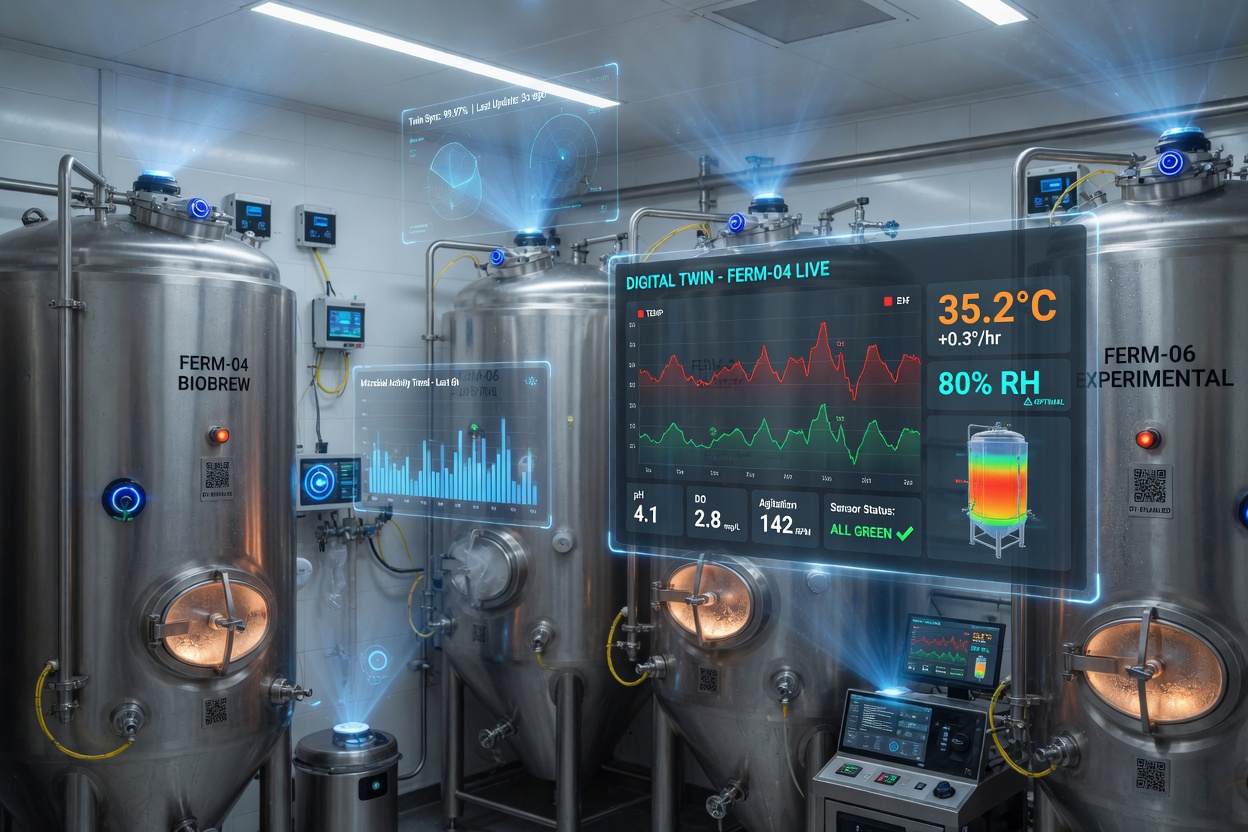
I. From "Sensory Art" to "Digital Twin": The Technical Architecture of Modern Monitoring
Modern fermentation room monitoring has evolved from the era of single instrument panels to the closed-loop IoT (Internet of Things) era of "sensing-transmission-decision-execution." A system that can truly withstand production pressure must have a rigorous four-layer architecture.
1. Perception Layer: Reject "Cheap Accuracy"
In the perception layer, many enterprises easily make a mistake: believing that any sensor with a display accuracy of ±0.1°C is a good sensor. This is completely a misconception. In environments like fermentation rooms with high humidity and possibly corrosive gases (such as CO₂, NH₃), Stability is far more important than Accuracy.
The industrial-grade solution I recommend must meet the following three hard requirements:
2. Transmission Layer: Stability Is the Lifeline
In the selection of transmission protocols, I always adhere to one principle: Critical control logic uses wired, auxiliary monitoring uses wireless.
3. Decision and Execution Layer: The Value of Edge Computing
Many people are superstitious about "cloud monitoring," believing that only processing all data in the cloud counts as intelligence. But in actual production, this is very dangerous. Once there is network fluctuation, your alarms will be delayed.
I advocate "Edge-side decision-making, cloud-side analysis." All alarm threshold judgments and PID temperature control logic must run on the local PLC or edge gateway. The role of the cloud should be to record historical trends and perform long-cycle process optimization analysis, not to be responsible for immediate safety control.
II. Parameter Logic and Alarm Threshold Setting in Practical Scenarios
Parameter setting is not decided by intuition; it must be based on process curves. I will give my recommended settings through two typical scenarios.
1. Baijiu Daqu Fermentation: Capturing the Pulse of the "Middle Plateau"
Baijiu fermentation is a dynamic biological process, and its temperature curve presents the typical characteristics of "slow rise, middle plateau, slow decline."
| Fermentation Stage | Core Objective | Recommended Ambient Temp | Recommended Ambient Humidity | Key Monitoring Indicator |
|---|---|---|---|---|
| Slow Rise Stage | Surface growth, mold development | 25–35°C | 80–90% RH | Observe microbial colonization |
| Middle Plateau Stage | Microbial metabolic peak | 35–45°C | 70–80% RH | Material temperature is the core, prevent "burning" |
| Slow Decline Stage | Cooling, drying | 20–30°C | 50–65% RH | Prevent excessive heat or moisture absorption in later stage |
My recommended alarm thresholds (using the middle plateau stage as an example):
Experience: During the middle plateau stage, never look only at the ambient temperature. If the ambient temperature is low but the material temperature is abnormally high, it indicates excessively active internal fermentation. Immediate cooling intervention is required, otherwise acidity may become uncontrolled.
2. Bakery Product Proofing: The "Balance Beam" of Humidity and Temperature
The proofing room in the baking industry is extremely sensitive to humidity. If the humidity is too low, the dough surface will crust, preventing volume expansion; if too high, water droplets will form on the surface, affecting color and structure.
| Stage | Temperature Setting | Humidity Setting | Recommended Alarm Threshold (Warning / Action) |
|---|---|---|---|
| Primary Fermentation | 26–28°C | 75–85% RH | Temp ±1.5°C / Humidity ±5% RH |
| Final Proofing | 35–38°C | 80–90% RH | Temp ±2°C / Humidity ±7% RH |
Pitfall Guide**: In the final proofing stage, the most common cause of alarms is "door opening interference." When an operator opens the proofing room door for loading or unloading, temperature and humidity drop instantly. If your system is set too sensitively, it will frequently trigger false "cry wolf" alarms. **I recommend adding "delay filtering" to the alarm logic: only when the value deviation exceeds the set threshold and persists for more than 5 minutes should it be judged as a valid alarm.
III. Expert-Level Pitfall Guide: Things Textbooks Don't Tell You
When actually deploying monitoring systems, you will encounter many "non-technical" issues.
IV. Conclusion
Modern fermentation room temperature and humidity monitoring is transforming from an "auxiliary tool" to a "core productive force." It should not merely be a screen displaying numbers, but an intelligent organ capable of sensing risks, predicting trends, and responding autonomously.
Technical tools can replace the naked eye, but cannot replace decision-making. An excellent monitoring system provides experienced veterans with a pair of "digital eyes" that can see through darkness and observe microscopic changes. When we can precisely control every temperature fluctuation and every change in humidity, we have truly mastered the art of fermentation.