Planting Density, Topping Timing, and Leaf-Picking Height: Their Impact on Final Tobacco Technical Indicators
When I evaluate tobacco quality, the first thing I look at is not yield — I check three things: leaf thickness, whether nicotine is under control, and whether the sugar-to-nicotine ratio falls within a usable range. Many fields only realize at the end of flue-curing that the upper leaves are thick, hard, and high in nicotine. People often blame the weather or the curing barn, but the real problem was already set during transplanting density, topping timing, and batch harvesting.
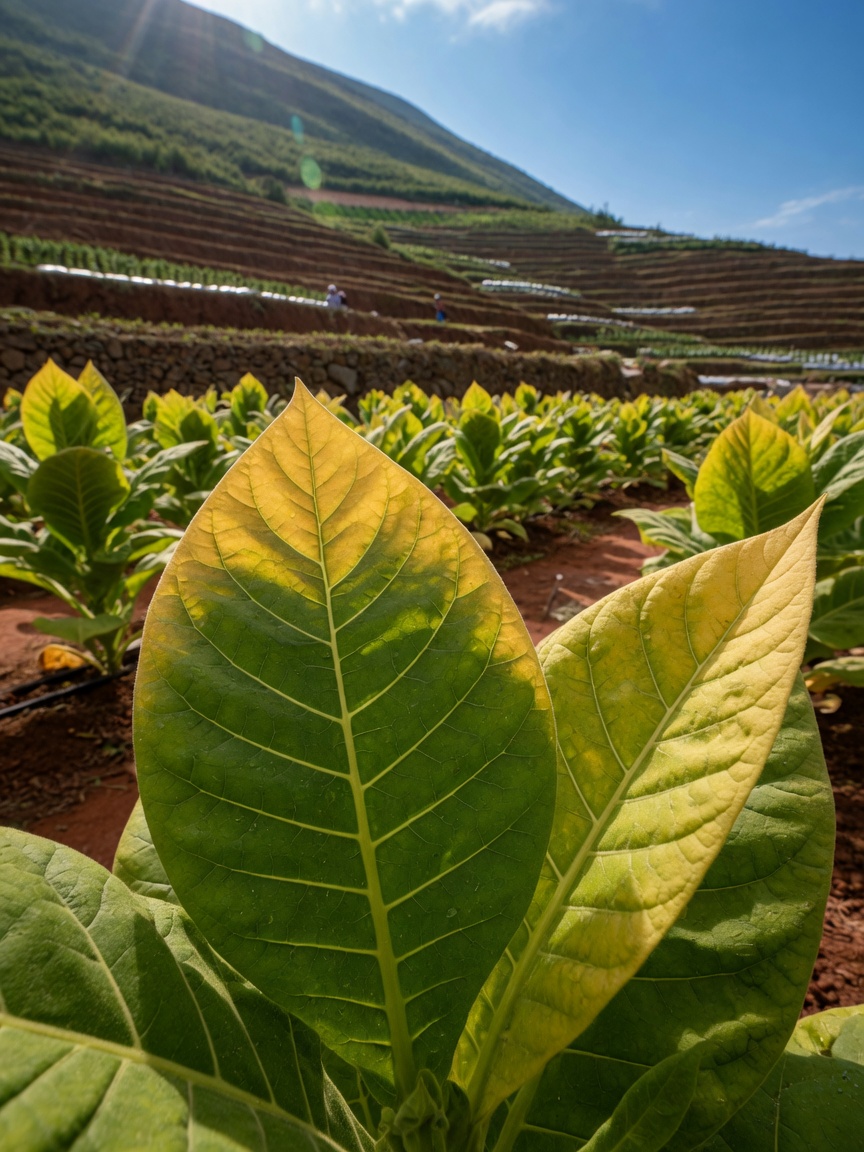
In late April 2024, I conducted a review on a mountain tobacco field at about 1,900 m elevation in Qujing, Yunnan. The variety was a common flue-cured type, the previous crop was corn, row spacing was 120 cm, and plant spacings were 55 cm, 60 cm, and 65 cm. By early July around budding, the field with 55 cm spacing closed canopy fastest, with smaller leaf area per plant; plants at 65 cm looked more spread out and open, but the upper leaves later became thicker and matured slowly. Ultimately I favored the configuration around 120 cm × 60 cm, which translates to about 13,900 plants/hm² or about 925 plants/mu. This judgment was not just visual — trials with Yunyan 87 in the Kunming tobacco region also showed that the 120 cm × 60 cm treatment had better economic traits, with more coordinated total sugar, reducing sugar, potassium, and neutral aroma components.
Planting density essentially regulates per-plant nutrient distribution. Too low — below 13,500 plants/hm² — and individual plants get abundant light, fertilizer, and water, causing upper leaves to grow broad and thick, leaf mass per area to rise, and nicotine to climb later. Too high — above 16,500 plants/hm² — and the canopy closes, ventilation worsens, individual leaves become thinner; yield may increase but aroma and maturity uniformity deteriorate. A K326 trial in Yunnan mountain tobacco set densities at 13,875, 15,150, and 16,665 plants/hm² with nitrogen applications of 90 and 105 kg/hm². The results were instructive: at the same nitrogen level, increasing density reduced per-plant mass, raised total sugar and reducing sugar, and lowered total nitrogen and nicotine. The optimal combination was 15,150 plants/hm² with 105 kg/hm² nitrogen, or roughly 1,010 plants/mu with about 7 kg/mu of nitrogen.
My approach is to treat density as the first valve for nicotine. Targeting moderate middle-leaf thickness, total sugar 18%–22%, nicotine 2.0%–3.5%, and a sugar-to-nicotine ratio of roughly 6–10, I place medium-fertility flat fields at 14,500–15,200 plants/hm²; thin mountain soil can drop slightly to 13,800–14,500 plants/hm² to give roots and leaves some buffer. On high-fertility, high-rainfall fields, do not be greedy with wide spacing; once plant spacing goes from 60 cm to 65 cm, upper leaf thickness and nicotine often rise together.
Nitrogen application must be considered together with density. Discussing density without nitrogen leads to wrong conclusions. Raising nitrogen from 90 kg/hm² to 105 kg/hm² noticeably strengthens early-to-mid growth; yield and output value typically improve, but total sugar and reducing sugar may fall while total nitrogen and nicotine rise. In my experience, low density plus high nitrogen is the fastest way to produce thick, high-nicotine leaves; high density plus low nitrogen easily yields thin, bland, unevenly matured leaves. In practice, I separate basal and topdressing records: basal fertilizer accounts for about 60% before transplanting, topdressing about 40% from rosette stage to vigorous growth, with no more nitrogen after budding. If nitrogen fertilizer is still being used to push upper leaves in early July, it will be very difficult to compensate later through harvest timing.
Topping timing is the second valve. Topping too early abruptly cuts off reproductive growth, redirecting root uptake and assimilates to the leaves — upper leaves become thicker and nicotine accumulates higher. Topping too late increases leaf count and elongates internodes; upper leaves may open better, but nutrients are consumed by the inflorescence and the maturation period is dragged out. Comparisons of pinhead topping (topping at button stage), bud topping, and early-flower topping in the Shixing tobacco region of northern Guangdong showed that as topping was delayed, plant height, effective leaf number, and internode length increased, while upper-leaf maximum area and stem circumference decreased. Early-flower topping, compared with the usual bud topping, improved yield value and the proportion of medium-to-high grade leaves, reduced starch and nicotine, raised potassium, and gave a more coordinated sugar-to-nicotine ratio.
I tend to favor "topping around early flowering, leaving 18–20 leaves," especially in fields prone to thick, hard upper leaves. A Shandong Zhongyan 100 trial supports this direction: early-flower topping with 20 leaves and full-flower topping with 18 leaves both gave good agronomic traits, chemical composition, and sensory quality in upper leaves. Field judgment does not require waiting for many flowers — arrange topping when about 5%–10% of central flowers have opened and the top leaves have not yet visibly shrunk. Top after morning dew dries, inspect for misses within 24 hours, do the first sucker removal within 3–5 days, and recheck every 5–7 days thereafter. This process is tedious, but missed suckers re-divert nutrients and cause uneven upper-leaf maturity within the same plant.
There is an easily overlooked issue with topping's effect on nicotine: later topping does not always mean lower nicotine. A pot trial published in Henan Agricultural Science showed that moderate, timely topping resulted in most tobacco-specific nitrosamine precursors being lower than with early or late topping; with late topping, total nicotine and free nicotine in upper leaves could still increase. In other words, topping must avoid both extremes. My field judgment is that early topping "forces" the upper leaves hard, while late topping "scrambles" the maturation period. What is truly controllable is to seize the window from inflorescence emergence to early flowering, then fine-tune with leaf count.
Leaf-picking height — or harvest stalk position — is the third valve. Lower, middle, and upper leaves are not the same material. Lower leaves are thin and sugar comes up relatively easily, but aroma and structure are weak; middle leaves are best for balance; upper leaves carry the greatest risk of high nicotine, total nitrogen, and thickness. In many fields where the sugar-to-nicotine ratio is out of control, the problem is not the whole plant — it is that upper leaves were harvested too early, too thick, or mixed in with middle leaves for curing.
I typically use "three-stage harvesting": lower leaves about 15–25 cm from the ground, picked at 60%–70% yellow; middle leaves about 25–55 cm, picked at 80%–90% yellow; upper leaves above 55 cm, judged not by calendar but by maturity characteristics: yellow-green turning 50%–70% yellow, midrib fully white, lateral veins about 50% white, leaf edges slightly curled, leaf tip hooked downward before picking is safer. A trial on Yunyan 87 upper stalk positions 11–16 in Ningxiang, central Hunan, showed clear differences among conventional harvest, 5-day delay, and 10-day delay. Delayed harvest reduced single-leaf weight, leaf thickness, and leaf mass per area, while both sugar and nicotine increased; the 5-day delay improved the chemical component usability index, while the 10-day delay risked over-maturity and declining balance. This matches what I have seen in the field: upper leaves are not better the longer you wait; a 5–7 day delay is often beneficial, but waiting until excessive maturity spots appear on the leaf surface and lateral veins are fully white increases the risk of mottling and curing problems.
In early August 2025, I encountered a typical problem in a field with consecutive overcast days after rain. The middle leaves were already 80% yellow, but the upper leaves were still green. The farmer, in a hurry to fill the curing barn, cut all leaves above the 10th position at once. The result after curing was clear: the middle leaves had acceptable color, but the upper leaves were thick, had many green veins, and a low sugar-to-nicotine ratio. Later, we changed the adjacent field to two harvest passes, delaying the upper leaves by 6 days and removing only foot leaves and diseased/damaged leaves before harvest. After curing, the upper leaves were noticeably looser in thickness and more uniform in color. The key here is not "late harvest" but separating material by height and maturity so that upper leaves do not drag down the whole batch.
If the goal is to control leaf thickness, I prioritize three parameters: first, density no lower than 13,800 plants/hm², with high-fertility fields closer to 15,000 plants/hm²; second, top around early flowering, leaving 18–20 leaves, to avoid over-filling upper leaves from early topping; third, delay upper-leaf harvest by 5–7 days with batch picking, and the leaf surface should not still be dark green at harvest. True reduction in leaf thickness usually comes from moderate canopy competition, adequate upper-leaf opening, and continued dry matter conversion during maturation — not from forceful dehydration during curing.
If the goal is to lower nicotine, density and nitrogen fertilizer act earlier than harvest. The operable ranges are: density 14,500–15,500 plants/hm², pure nitrogen 90–105 kg/hm², with high-fertility fields at the lower end and thin soils at the upper end; topping no earlier than early budding, with no fewer than 18 leaves retained; upper leaves not mixed with middle leaves in harvest or curing. For fields with high nicotine, I would rather tighten plant spacing from 65 cm back to 60 cm next season than drastically cut nitrogen first, because cutting nitrogen too aggressively makes the leaves thin and bland, reducing industrial usability just the same.
If the goal is to bring the sugar-to-nicotine ratio back into a balanced range, do not chase sugar alone. In a study on nitrogen rate, planting density, and leaf number for Xiangyan 7 in western Hunan, B2F grade leaves had total sugar 16.50%–23.94%, reducing sugar 15.43%–22.82%, and a sugar-to-nicotine ratio of 3.88–7.72; treatments with excessively high nicotine had notably low ratios. My rule of thumb: when the ratio is below 5, first check whether nitrogen and topping were too early; when above 10, check whether density was too high, nitrogen insufficient, or maturation excessive. The sugar-to-nicotine ratio is not an independent indicator — it is the outcome of carbon-nitrogen metabolic balance.
A relatively reliable set of production parameters can be implemented as follows: row spacing 110–120 cm, plant spacing 55–60 cm, density 14,000–16,000 plants/hm²; medium-fertility fields with pure nitrogen 90–105 kg/hm², adequate potassium supply; top from budding to early flowering, leaving 18–20 effective leaves; harvest lower leaves at 60%–70% yellow, middle leaves at 80%–90% yellow, and upper leaves after they turn from yellow-green to 50%–70% yellow with the midrib fully white. In years with high rainfall, vigorous growth, and dark green leaf color, widen the harvest interval — do not mix upper and middle leaves in one curing batch to save barn turnover.
What I personally oppose most is the approach of wide spacing and high nitrogen early to grow big plants, then hoping to correct the indicators with late topping and late harvest. Tobacco plants are not machines — once the carbon-nitrogen metabolism deviates during vigorous growth, it can only be corrected, not redone. Truly stable tobacco technical indicators come from transplanting density setting the framework for the population, topping timing setting the direction for nutrient distribution, and leaf-picking height setting the boundary for maturity stratification. When all three are done right, leaf thickness, nicotine content, and the sugar-to-nicotine ratio have a controllable range.
References:
- "Effects of Planting Density and Nitrogen Application Rate on Growth and Quality of Mountain Tobacco," Journal of Yunnan Agricultural University.
- "Effects of Planting Density on Quality and Economic Traits of Yunyan 87 in Kunming Tobacco Region," Chinese Agricultural Science Bulletin.
- "Effects of Different Topping Methods on Agronomic Traits and Usability of Upper Leaves in Flue-Cured Tobacco," Journal of South China Agricultural University.
- "Effects of Topping Timing and Leaf Number on Growth of Upper Leaves in Shandong Flue-Cured Tobacco," Crops Magazine.
- "Effects of Topping Time on Tobacco-Specific Nitrosamine Precursors," Henan Agricultural Science.
- "Study on Harvest Maturity of Flue-Cured Tobacco Based on Multi-Index Fuzzy Comprehensive Evaluation," Journal of Yunnan Agricultural University.
- "Effects of Nitrogen Rate, Planting Density, and Leaf Number on Yield and Quality of Xiangyan 7 in Western Hunan Tobacco Region," Crops Magazine.
Early Topping vs Late Topping
Early Topping (button stage or early budding)
Upper leaves become thicker and harder, nicotine accumulation increases, leaves overfill
Late Topping (early to full flower)
Nutrients consumed by inflorescence, maturation period prolonged, upper leaves open better but ripen unevenly
Note: The data cited in this article are from published research; specific parameters should be adjusted according to local variety, climate, and soil conditions.
Note: Suckers should be removed promptly after topping to prevent nutrient redistribution from affecting upper leaf quality.