The Fundamental Difference Between Cigarettes and Cigars in Flavor Expression
On a Friday evening in November 2023, I sat for nearly two hours in a members-only cigar lounge in Jing'an, Shanghai. A guest at the front table had just come down from an office building, and his mouth still carried the taste of a half-smoked filter cigarette — that sweet, slightly paper-charred and mint-cooled residue. What he ordered for himself was a Dominican Robusto with a ring gauge of 50 and a length of about 5 inches. On the third puff after lighting, he frowned: "How is this completely different from what I imagined — bitter and harsh, without that 'aroma' of a cigarette."
The person at the bar said only one sentence: "Don't inhale into your lungs, and don't puff continuously like a cigarette." I watched him tap the ash three times and stretch his puff interval to more than ten seconds; the whole cigar burned up in 25 minutes, and the second half was almost nothing but bitter char. What I noted down that night was not the drinks list, but the inverse of that sentence: the flavor difference between cigarettes and cigars is not first of all "which is more premium," but two completely different combustion–cooling–perception systems. Comparing them as a "big cigarette" and a "small cigar" will inevitably lead to the wrong conclusion.
Below, I split the topic into four main lines: raw materials, combustion temperature and rhythm, inhalation method, and presence or absence of a filter. The numbers and process descriptions try to align with public sources and common tasting experience; my personal judgment comes first: I believe that a cigarette sells a reproducible pack of stimulation, while a cigar sells the narrative of the tobacco itself unfolding over time — the two do not speak the same language, and forcing a translation only distorts it.
I. Raw Materials: One Is a "Formulated Product," the Other Is a "Whole-Leaf Work"
Cigarettes: Cut Tobacco, Blending, Wrapping Paper, Adjustable Parameters
Factory cigarettes are highly controllable engineered products. The tobacco blend mostly comes from a flue-cured–based mixed system, then white burley, oriental tobacco, and others are blended in according to the brand's formula, together with reconstituted tobacco leaf, humectants, sugars, and flavorings. The outer layer is cigarette paper, not tobacco leaf; and one end almost always has a filter. In public literature and industry common sense, cigarettes can be "fine-tuned" through paper permeability, filter ventilation, filter rod materials, and other knobs, squeezing tar, nicotine, carbon monoxide and other metrics into a fairly narrow tolerance band.
What does this mean for the mouth and nasal cavity?
- Flavor sources are largely externalized: sweetness, menthol coolness, fruitiness, roasted notes are often the combined result of flavoring and processing, not the whole story a single leaf grew on its own.
- Batch consistency comes first: whether the same brand and spec you buy at the convenience store "tastes the same" today and three months later is far more stable than handmade cigars.
- Short intake path, fast peak: a few puffs after lighting enter steady output, suited to "handling one nicotine-and-habit cycle in three to five minutes."
When I toured a Yunnan cigarette factory line in 2021, what the guide stressed was not "how unique this leaf is," but blending ratios, moisture content, and rolling uniformity. That on-site logic and the logic of discussing wrapper origin and fermentation batches in a cigar lounge are simply not on the same channel.
Cigars: Wrapper, Binder, Filler — Almost All Tobacco
A premium cigar usually consists of three parts: the outermost wrapper, the middle binder, and the inner filler. In legal and industry definitions, a cigar is "a tobacco roll wrapped in tobacco leaf or tobacco-containing material," while a cigarette is "an object wrapped in paper or material containing no tobacco." This definition itself points to the packaging's first cut on flavor: a cigarette has to deal with paper, glue, and filter materials; a cigar's "packaging" is itself tobacco that participates in combustion.
The filler commonly uses long filler (whole leaf) or short filler (cut up), then goes through air-curing, fermentation, and aging. Fermentation is not an optional "value-added service" but the main factory of flavor generation: the transformation of nitrogen-containing compounds, Maillard-related aromas, the suppression of ammonia and off-notes, and the emergence of butter/cocoa/wood aromas are all tied to fermentation temperature, humidity, and duration. Research reviews often mention: because cigar smoke is high in nitrogen compounds and relatively low in sugar, alkaline substances are more prominent among its combustion products, and smoke pH often falls in a slightly alkaline range; cigarette smoke, in contrast, is mostly acidic. This is not copywriting rhetoric — later it directly determines how nicotine is "read" in the mouth.
Personal view:
The flavor of a cigarette is "a slogan written by a formula engineer"; the flavor of a cigar is "a prose piece stacked up from origin–agriculture–fermentation–hand rolling." A slogan aims to be understood, remembered, and repeatable; prose pursues layers, turns, and surprise. If you listen to prose with the ears of slogans, you will only find it "wordy, bitter, and unfocused."
A comparative exercise (March 2024, hotel terrace in Hangzhou, room temperature about 18°C):
- First smoke half a common flue-cured filter cigarette, stub it out, rinse your mouth and drink water.
- After a 40-minute interval, light a medium-strength handmade cigar with a ring gauge of 52, strictly held in the mouth, about 45–60 seconds per puff.
- The same evening, try again: smoke the cigar with a cigarette's rhythm (inhaling, intervals <15 seconds).
The results were very clear: in the first round, the cigarette was a clean sweetness, char, and coolness (if menthol) plus a "reaching the lungs" satisfaction; the cigar was leather, wood, pepper, and a returning sweetness, and it kept changing from front to middle to back. In the second round, the cigar surged into bitter char within 20 minutes and the aroma burned away — it's not that the cigar "tastes bad," it's that you used the wrong engine speed.
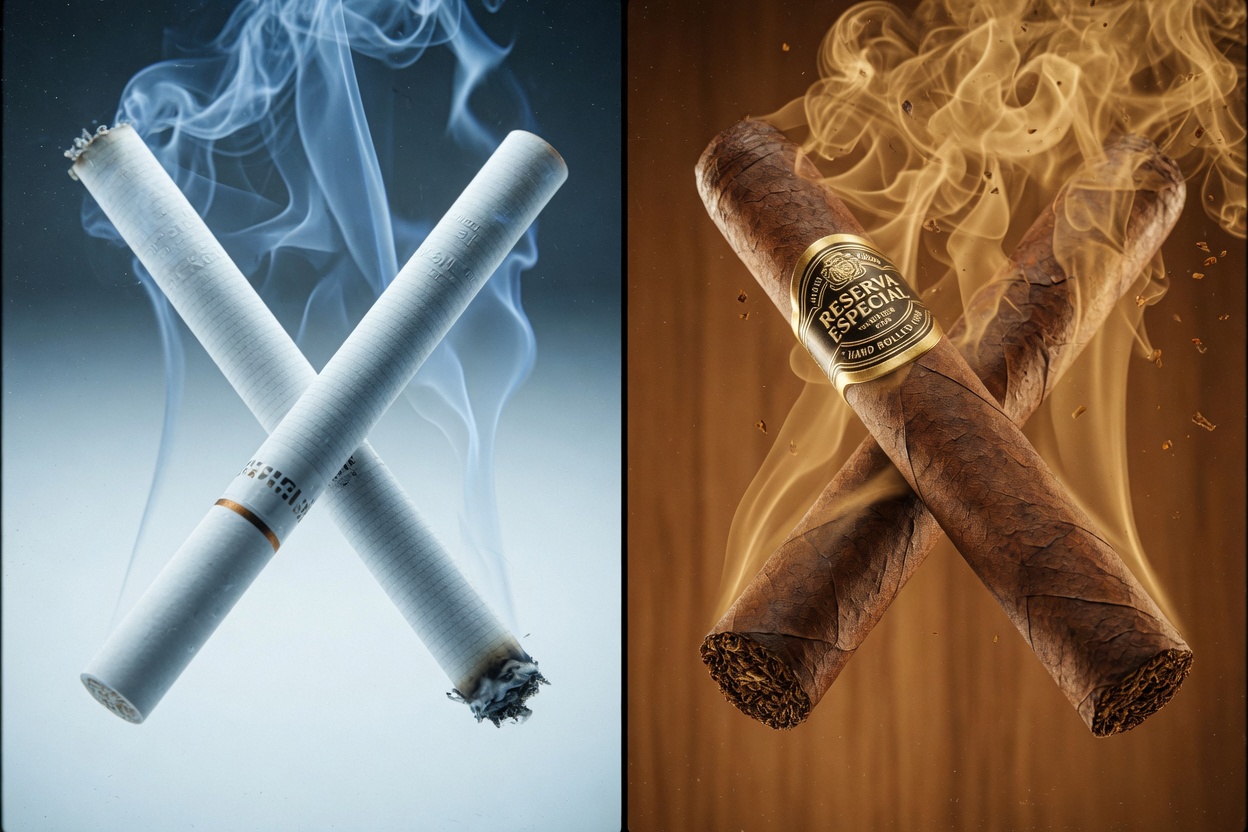
Cigarette (daily)
Fast lung path + filter peak-shaving + minute-scale consumption; flavor as stable as an assembly line.
Handmade cigar (regular tasting)
Slow oral path + whole-leaf fermentation + a temperature narrative of over half an hour; flavor like a live performance.
Note: not inhaling does not equal harm-free; this article only discusses perception mechanisms.
Note: the numbers are empirical ranges, not lab ratings.
II. Combustion Temperature: One Fire, Two "Working Points"
Combustion temperature is seldom discussed by convenience-store smokers, yet it almost decides whether the second half of a cigar is heaven or hell.
Cigarettes: Fast, Hot, Short, "Managed" by Paper and Filter
Cigarettes have a small diameter, finely cut tobacco, and a short ventilation path. Combined with high-frequency puffing (many people are used to taking several puffs in a row), the burning end easily stays in a relatively intense pyrolysis state. Flavorings and sugars quickly contribute volatile aromas at high temperature, while the wrapping paper keeps participating in combustion, bringing that characteristic paper-char undertone. The whole lifespan is usually a few minutes — there is no design space for "waiting half an hour to see the flavor turn a page."
Cigars: Slow, Must Be Even, Afraid of Overheating
The cigar's cross-section is large, and filler density plus wrapper permeability jointly determine oxygen delivery. Simulation and tasting experience both point to the same thing: while puffing, the edge gets better oxygen supply and burns faster; when you stop puffing, the edge is more easily cooled by air. Your rhythm is equivalent to adjusting the furnace fire.
There is a common rule of thumb in the industry (wording varies by person, logic is consistent):
- After a puff, wait roughly 30–60 seconds for the burning cone to return near its relatively stable "golden temperature";
- Too-short intervals → temperature climbs → sugars and oils caramelize → cream, cedar, and nuts are buried under bitter char and spice;
- Temperature too low, or relighting after a near-extinction with a furious draw → condensed tar notes rise, and the smoke turns sticky.
Some call the last third "paradise": the premise is that the temperature is nurtured through the first half, the same thermal history acts on the yet-unburned tobacco for a long time, and aroma substances are more fully "steamed" out. Those who puff too fast will never reach that segment — they only get a linear deterioration that grows more bitter as it burns.
A sense of numbers (empirical ranges, not lab ratings):
| Dimension | Cigarette (daily) | Handmade cigar (regular tasting) |
|---|---|---|
| Duration per stick | about 3–8 min | about 30–90 min (depending on ring and length) |
| Puff interval | often <10–20 s, even continuous | usually one puff per 30–60 s |
| Temperature strategy | quick smoke, instant satisfaction | maintain even temperature, avoid overheating |
| Flavor timeline | almost "peak from power-on" | clearly shifts gears front—middle—back |
At a friend gathering in Guangzhou's Pearl River New Town in 2022, someone torched the cigar head black with a jet lighter, then smoked it in rapid succession like a crush-ball cigarette. That mid-priced Nicaraguan was ruined within 18 minutes: from the middle it tasted like burnt coffee grounds. With the same brand and same spec, the next week I smoked it at one puff per 50 seconds, without flicking ash, letting it fall naturally, and it lasted about 55 minutes, with clear cocoa and cedar in the middle and a pepper rise in the back that was still acceptable. The variable was almost only temperature management. Cigarettes rarely give you that much freedom to "ruin one by hand" — their design is anti-clumsiness, anti-fast-rhythm.
III. Inhalation Method: Is the Lung the Home Field, or the Mouth?
This is the second watershed of flavor expression, and also the place most easily misread in health narratives (let me state it clearly: not inhaling does not equal harm-free; this article only talks about perception mechanisms).
Cigarettes: Lung-Inhaling Logic and Acidic Smoke
Cigarette smoke usually makes the oral environment somewhat acidic. At lower pH, nicotine exists more in its protonated form and is absorbed through the oral mucosa relatively less "smoothly," so culture and habit both push toward inhaling into the lungs, using the huge alveolar surface to complete rapid uptake. The flavor experience therefore carries:
- A strong "reaching the lungs" impact and a dizzying head rush;
- Aromas flashing by in the retro-nasal pathway, more like stimulus labels (sweet, cool, harsh, smooth);
- The filter and ventilation further shave off part of the irritation, making "being able to take many puffs in a row" possible.
Cigars: Mouth-Holding Logic and Alkaline Smoke
Cigar smoke tends to be alkaline. Under alkaline conditions, the degree of nicotine deprotonation changes, making it more easily absorbed through the oral mucosa — so the traditional teaching is to let the smoke linger in the mouth for a few seconds and then blow it out, without inhaling into the lungs. The flavor experience is rewritten accordingly:
- Aromas are slowly read by the tongue, soft palate, and retro-nasal passage: leather, earth, wood, coffee, pepper, returning sweetness;
- The "kick" shows up more as oral astringency, throat sensation, and a slow head effect, rather than the instant lung satisfaction of a cigarette;
- Saliva participates in dissolution and acid–base buffering, and within the same stick, the "solution environment" in the mouth keeps changing between the first 20 minutes and the last 20 minutes.
Popular-science articles like those using COMSOL have described cigars with a simplified physical picture: while puffing, pyrolysis products move toward the mouth end, are cooled en route by unburned tobacco, and partially condense into aerosol — nicotine and much of the flavor live in these tiny droplets. The wrapper's permeability is limited, so dilution is slow. You are actually smoking "smoke that has been filtered and temperature-conditioned by the tobacco itself," not the short-path direct delivery of a paper cigarette.
Personal judgment:
The "aroma" of a cigarette is largely an instant stimulus encoding of the nose–lung synergy; the "aroma" of a cigar is compound release and condensation re-perception bought with mouth residence time. Inhale a cigar like a cigarette and you get a double loss: you scorch the temperature, and you use the blunt senses of the lungs to read details that should be read with the tongue, while also inhaling high-concentration particulates and gases that you didn't have to inhale.
Pitfall record (2020, a teahouse in Chaoyang, Beijing; mistook a small cigar from a beginner gift set for a slim cigarette):
- Operation: deep inhales like a cigarette, interval about 10 seconds.
- Within 5 minutes: dizziness, nausea, numb mouth.
- Flavor memory: only heat and bitterness, zero layers.
- Post-mortem: although the ring was small, the tobacco volume and alkaline smoke logic still resembled a cigar; using the cigarette algorithm caused an instant overdose.
IV. Filter or No Filter: The Peak-Shaving Engineer vs. the Self-Filtering Tobacco Column
Cigarette Filters: Deliberately "Translucent"
Acetate filter, filter-rod additives, and ventilation holes work together to intercept part of the particulates, alter airflow, reduce some irritation, and let brands compete on "smoothness." At the same time they strip away some aroma components you might actually want — that is an engineering trade-off, not an oversight. Paper permeability and filter ventilation also bring in air dilution, further softening the peak.
The result: cigarette flavor tends to be steady in the middle, rounded at the edges, and narrowed in information bandwidth. Suited to fast consumption, not to listening to a 40-minute story.
Cigars Without Filters: The Unburned Section Is the Filter Core and Condenser
The mouth end of a cigar has no industrial filter (machine-made small cigars are a separate case). Cooling, filtering, and re-condensation mainly rely on:
- The yet-unburned column of filler/binder/wrapper;
- The temperature drop brought by puff intervals;
- The ash cap protecting the burning cone (flicking ash carelessly changes local heat dissipation and combustion).
So cigar flavor changes as the burn advances: the front tends to be cleaner and more wrapper-character; the middle opens the main filler body; the back rises in intensity, and heat and pepper may strengthen. This is not marketing talk — the physical length is changing: the "tobacco filter core" the smoke passes through is getting shorter, and condensation and filtering conditions keep shifting.
No filter ≠ "purer and healthier." On the contrary, tar, carbon monoxide and other metrics are not friendly to cigars in many comparison contexts; the amount of tobacco leaf used in one large-format cigar is often likened to the quantity that could roll many cigarettes. This article only emphasizes: the presence or absence of a filter directly decides whether what you perceive is a "peak-shaved stable output" or an "unshaved dynamic spectrum."
V. Four Lines Twisted Into One Sentence: Why the Experience Is "Completely Different"
Lay the four lines on top of each other:
- Raw materials determine the molecular library: flavoring + roasted-cut formula vs. fermented whole-leaf three-part structure.
- Temperature and rhythm determine how the molecular library cracks: fast heat and short burst vs. slow heat and nurtured warmth.
- Inhalation path determines which set of sensory hardware you decode with: rapid lung uptake vs. mouth residence.
- Filter/cooling determines signal bandwidth: engineer's peak-shaving vs. the tobacco column's dynamic filtering.
So it's not "cigars are stronger, therefore different," but the entire chain of encoding, transmission, and decoding is different. A cigarette is like a compressed streaming preview; a cigar is like a vinyl record you must sit through to the end — fast-forward and the noise explodes.
My own conclusion is clear:
- If your need is a predictable nicotine-and-habit loop within 5 minutes, the flavor system of cigarettes (and many alternatives) is optimized for that goal.
- If you want to talk origin, fermentation, and phase transitions, that's where the cigar's flavor system has the interface; but you must pay the time tax and the temperature-management tax.
- Judging cigars by cigarette standards, or despising cigarettes by cigar standards, is a category error. They are not on the same scorecard.
VI. A Reproducible Comparative Experiment (For Those Who Want to Verify It Themselves)
Time suggestion: 1 hour after a meal, with no heavy flavors lingering in the mouth.
Place: a well-ventilated outdoor spot or a room where smoking is allowed, away from cooking fumes and perfume interference.
Materials:
- A: a filter cigarette you are familiar with;
- B: a handmade cigar of medium ring (about 50–54) and medium strength;
- Water, unsweetened coffee, or plain boiled water for rinsing; a timer.
Steps:
- Smoke only A, with your normal habitual puffing, and record keywords for the first three puffs (sweet/spicy/cool/paper-char/lung feeling). Stub it out. Rinse, rest ≥30 minutes.
- Cut the cap, light B evenly with a wooden match or a dedicated lighter; optionally blow away the first accumulated smoke lightly.
- Hold it in the mouth for 3–5 seconds, then blow out; leave 40–60 seconds between each puff; don't flick the ash; don't push the interval below 20 seconds. Record keywords at 0–15 min, 15–40 min, and after 40 min.
- (Optional, at your own risk) On another day, smoke half of the same-spec B at A's rhythm and compare the time when bitter char appears.
What you will most likely see:
A's descriptor words concentrate on stimulation and smoothness; B's descriptor words are forced to switch to material feel (wood, leather, earth, cocoa) and a timeline (front/middle/back). If B is nothing but bitter and spicy all the way, first check humidity (too dry?), whether the light charred it, and whether intervals are too short — operating errors can disguise themselves as \"all cigars taste the same.\"
In a self-test in Chengdu in June 2024, my hygrometer showed the cigar box at about 62% RH; with the same cigar, an interval of 15 s vs. 50 s dropped the bitterness score (self-rated 1–10) from 7 to 3, and the wood aroma went from \"almost none\" to \"persistent through the middle.\" This is not mysticism — it is the combustion working point.
Conclusion: What the Fundamental Difference Actually Is
The fundamental difference between cigarettes and cigars in flavor is not size, not "prestige," and not even a simple "strength":
- One is an industrial formula + filter peak-shaving + a fast lung path + minute-scale consumption;
- The other is whole-leaf fermentation + a self-cooling column + a slow oral path + a temperature narrative of more than half an hour.
The former trains you to recognize brand labels; the latter trains you to recognize whether you have spoiled the burn.
The former's flavor is as stable as an assembly line; the latter's flavor is as fragile as a live performance — when it fails, the audience and the band share the blame.
If you have only smoked cigarettes and find your first cigar "unpleasant," it is often not that your tongue is broken, but that you are still reading sentences meant for the mouth with the grammar of the lungs. Conversely, if a cigar aficionado sneers at cigarettes for lacking "soul" using "layers, returning sweetness, and phases," that also ignores that cigarettes were never designed for soul — they were designed for availability, repeatability, and a fast closed loop.
When I wrote this article, an empty cigarette pack and an unlit dual-ring sample cigar sat side by side on my desk. They share the four characters "tobacco combustion," yet they share almost no flavor grammar. Recognizing this is far more useful than arguing over which is more "premium": at least you will no longer wrong an entire leaf supply chain by burning at the wrong temperature and inhaling the wrong way.