The Technical Impact of Filler Density and Wrapper Tension on Cigar Burn Evenness and Burn Time
For a seasoned cigar connoisseur or manufacturer, a perfect cigar is far more than a stack of premium tobacco leaves; it is more like a precisely engineered "biological combustion machine." The moment the flame touches the foot, a complex interplay of thermodynamics, fluid dynamics, and chemical reactions quietly begins. In this process, the core variables that determine whether a cigar can maintain a stable burn line, offer elegant draw resistance, and sustain an ideal burn duration often lie hidden in construction details imperceptible to the naked eye: filler density (Filling Density) and wrapper tension (Wrapper Tension).
These two are not isolated physical parameters; together they build the "combustion architecture" inside the cigar. The filler determines the fuel load and the oxygen permeation path, while the wrapper acts as an external constraint and heat regulator, ensuring that combustion proceeds at a predetermined rhythm, within a predetermined space. This article explores in depth how these two variables, through precise physical interaction, shape the burning soul of a cigar.
Chapter 1: The Precision Control of Filler Density — The Contest Between Fuel and Oxygen
Chapter lead: how filler density balances fuel and oxygen, shaping the intensity and rhythm of the burn.
If the combustion process of a cigar is likened to a fire, then the filler is the fuel, and the air drawn in through the draw resistance is the oxygen that feeds the flames. The essence of filler density is achieving a dynamic balance, within a unit volume, between fuel mass and effective void volume.
1.1 The Physical Mechanism of Density on Burn Rate
Combustion is essentially an oxidation reaction. Inside the cigar, oxygen enters through the draw and diffuses through the interstitial voids of the filler. Changes in filler density directly alter this diffusion rate, thereby determining the "intensity" of the burn.
In professional manufacturing, the arrangement of the filler (such as the Accordion fold method, the Book fold method, or the Entubado roll method) is itself designed to create specific density gradients.
The High-Density Trap: Oxygen Starvation and "Tunneling"
When the filler is over-compressed, or when high leaf moisture causes physical volume expansion, the cigar enters a "high-density state." At this point, the internal voids shrink drastically, and oxygen encounters enormous resistance while passing through the filler layers.
From a thermodynamic standpoint, this state leads to two extreme consequences:
First, there is draw overload (Plugged Draw). The smoker feels noticeable resistance, which not only affects the experience but also causes the combustion temperature to rise abnormally, because smoke accumulates heat in the narrow channels, producing spicy, scorched flavors.
Second, there is tunneling (Tunneling). Because oxygen struggles to penetrate the dense filler evenly, the combustion front tends to seek the path of least resistance — usually a tiny gap near the central axis of the cigar. This causes the core to burn extremely fast while the outer leaves remain in a "half-extinguished" state for lack of oxygen, ultimately forming a strange shape with a deeply sunken center and an intact outer ring.
Low-Density Risk: Excess Oxygen and "Runaway Combustion"
Conversely, if filler density is insufficient, large "cavities" or loose zones appear inside the cigar. Excess oxygen pours into these gaps like a fierce wind, causing the local combustion temperature to spike and the burn rate to lose control.
This not only shortens the cigar's intended burn time dramatically but also makes the smoke extremely hot and acrid, destroying the delicate aroma layers of the tobacco leaf. For premium cigars, low density often means a sense of "cheapness" — it cannot sustain a stable heat release, so the flavor rapidly collapses as the burn rate runs away.
1.2 The Complexity of Leaf Type on Density Control
In actual production, density control is not set in stone. Manufacturers must adjust according to the physical properties of the tobacco leaves.
Take the common Ligero (high-nicotine leaves from the top of the plant) and Volado (leaves from the bottom, with lower oil content) as examples. Ligero leaves are usually thicker, denser, and physically tougher. When bunching, using a standard-density stack for Ligero easily creates localized over-tightness. Therefore, an excellent roller uses the thickness of Ligero to fill the core while using the flexibility of Volado to regulate the overall "breathability."
In addition, leaf moisture content is also an invisible variable in density control. In high-humidity environments, the cell walls of tobacco leaves absorb water and swell, increasing physical volume, which objectively raises filler density and often leads to greater draw resistance. This is why, in humid seasons, cigars tend to burn more slowly and more heavily.
Mastering this "sense of density" is the dividing line between top-tier torcedores and ordinary craftsmen. While rolling, an elite torcedor's hand feel should be like kneading a piece of elastic sponge — with a clear sense of resistance, yet an even rebound under gentle pressure. This "springiness" is the physical embodiment of ideal density.
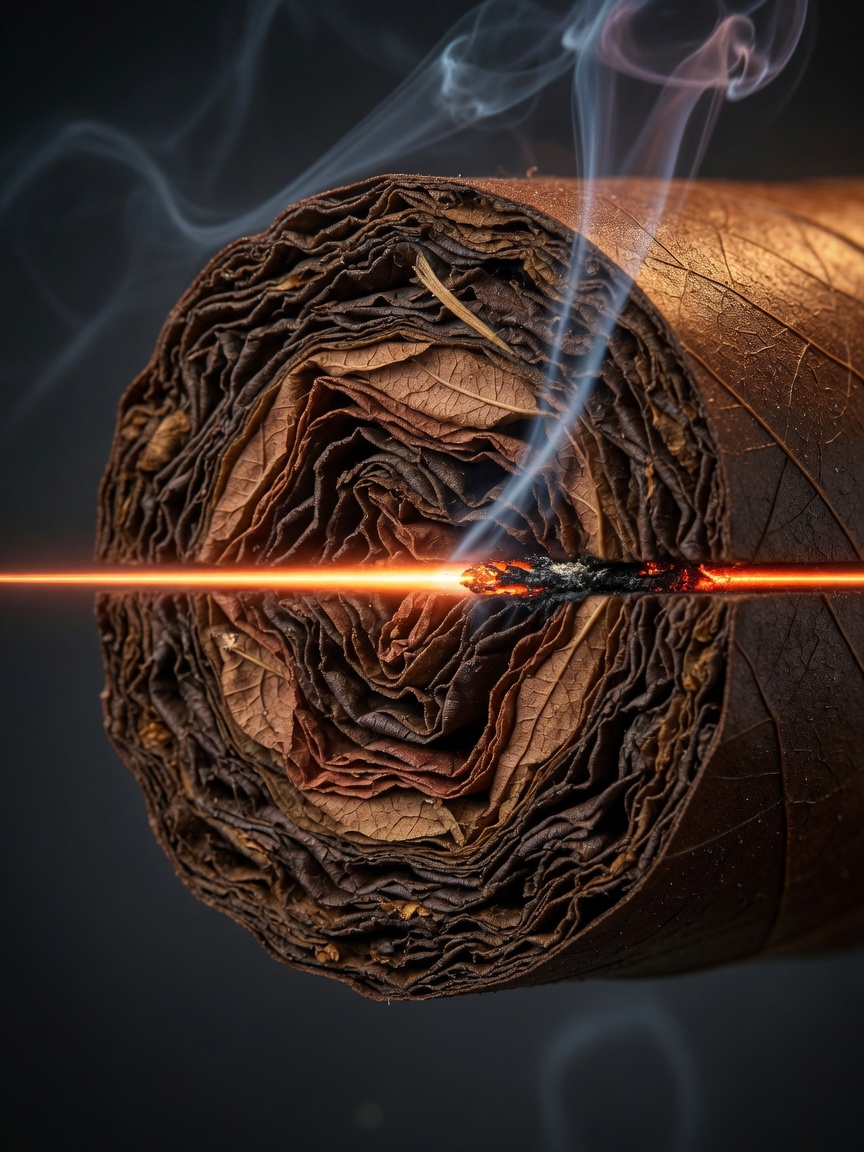
The two extremes of density imbalance
The high-density trap
Over-compression shrinks the voids, oxygen struggles to penetrate evenly, the burn line races along a tiny central gap, and the outer leaves sink into a half-extinguished state.
The low-density risk
Loose zones leave large cavities, excess oxygen pours in like wind, local temperature spikes and burn rate runs away, and flavor rapidly collapses with the runaway burn.
Chapter 2: The Art of Wrapper Tension Regulation — The Boundary of Heat and Fluid
Chapter lead: how wrapper tension constrains heat and fluid, determining the path and shape of the burn.
If the filler is the "heart" of a cigar, determining the supply of energy, then the wrapper is the "skin" and "shell." It carries aesthetic value and, on the physical level, plays the key role of a combustion regulator. Wrapper tension — the uniform pressure applied to press the outer leaf tightly against the core during rolling — is a core technical indicator of whether a cigar can achieve "steady breathing."
2.1 The Microscopic Influence of Tension on Heat Distribution
During combustion, heat transfer is accomplished mainly through conduction and convection. The wrapper is not only a heat barrier but also a director of heat distribution.
Over-Tight Tension: "Hot Spots" and "Suffocation" from Over-Compression
When wrapper tension is too high, it produces an inward squeezing effect that not only increases the overall pressure on the core (binder and filler) but also alters the microscopic pore structure of the leaf surface.
From a thermodynamic standpoint, extremely high tension significantly raises draw resistance. When the smoker tries to inhale, the restricted air flow causes a sharp rise in the local pressure gradient. This "tight" state often leads to two phenomena:
First, local overheating. Because air flow is blocked, the heat generated by combustion cannot be carried away quickly through normal convection, causing the local temperature to soar and producing a spicy, tarry taste.
Second, uneven burning. Extremely high tension may over-stretch the wrapper in certain spots, creating weak points invisible to the naked eye. These weak points deform physically earlier than other areas when heated, causing the burn line to "race" through those regions.
Over-Loose Tension: Structural Failure and "Runaway Combustion"
Conversely, insufficient tension degrades the structural integrity of the cigar. If the wrapper cannot wrap the core tightly and evenly, the cigar easily becomes structurally loose when heated, allowing air to enter through unintended paths such as gaps. This disrupts the designed aerodynamic path, causes unstable combustion, and can even lead to physical collapse or severe "air leakage" during smoking.
2.2 Uneven Tension: The Culprit Behind "Canoeing"
Among the defects that most trouble torcedores in premium cigar manufacturing is "canoeing" — the burn line presents an irregular, one-side-high, one-side-low state around the circumference of the cigar. Although uneven filler density is one of the triggers, microscopic unevenness of wrapper tension is often the direct driver of this phenomenon.
Imagine that during rolling, because of differences in the leaf's veins or thickness, the torcedor applies tiny, asymmetric tension in certain areas. This microscopic tension difference is amplified enormously during combustion:
- High-tension zones: tighter compression blocks oxygen entry, so the burn rate is relatively slow, appearing as "low."
- Low-tension zones: the structure is relatively loose, oxygen flows in more freely, so the burn accelerates, appearing as "high."
This "asymmetric distribution of heat and oxygen" caused by uneven tension makes the burn line drift like a boat rowed on water — a dynamic, unstable sway. This is why top torcedores must, through extremely fine hand feel, ensure that the pressure applied by every spiral of wrapper remains absolutely symmetrical around the circumference.
Chapter 3: The Synergistic Effect — The "Resonance" of Density and Tension
Chapter lead: how density and tension resonate in synergy, jointly drawing the cigar's combustion profile.
To understand a cigar's perfect combustion performance, one must never view density or tension in isolation. There is a profound physical synergistic effect between them, jointly determining the cigar's "combustion profile."
3.1 An In-Depth Analysis of Combustion Modes
Through different combinations of density and tension, we can derive several typical combustion modes:
- The Goldilocks Mode:
- Characteristics: moderate filler density + even, elastic wrapper tension.
- Performance: elegant draw (Medium-Firm Draw), a straight and stable burn line, even heat release, moderate smoke temperature with well-defined flavor layers.
- The Plugged/Tunneling Mode:
- Characteristics: high-density filler + over-tight wrapper tension.
- Performance: extremely high draw resistance, very slow burning, prone to "tunneling." The burn front advances rapidly through the center while the outer leaves cannot effectively participate in combustion due to oxygen deprivation.
- The Racing/Canoeing Mode:
- Characteristics: low-density filler + uneven tension.
- Performance: extremely fast burn, severe burn-line drift, hot and dry smoke, greatly shortened burn time.
3.2 The Mathematical Logic of Burn Time
A cigar's burn time is essentially the ratio of "total fuel" to the "rate of consumption per unit time."
Note: the combustion rate ṁ is dually modulated by density (controlling oxygen flux) and tension (controlling the burn path and heat distribution).
Here, ṁ_combustion (the combustion rate) is co-modulated by density (which controls oxygen flux) and tension (which controls the burn path and heat distribution). High density with moderate tension, by limiting oxygen flux and stabilizing the burn path, effectively prolongs burn time, ensuring that every gram of tobacco releases its complex chemical components within the intended time window.
Chapter 4: A Practical Guide — Mastery from the Manufacturing Side to the Smoking Side
Chapter lead: from roll-and-squeeze to smoking cadence, mastering hands-on inspection and remedial techniques.
Having understood the technical logic of density and tension, the greater value for practitioners and connoisseurs lies in turning these theories into practical inspection and response measures.
4.1 Professional Inspection: The "Finger Language" of Torcedores and Connoisseurs
Before a cigar leaves the factory, and before a connoisseur lights it, a basic physical inspection is essential.
The Roll and Squeeze Test:
This is the most intuitive way to check construction quality. The connoisseur should gently roll the cigar on its surface while applying light but even pressure.
- Look for "Hard Spots": if a local area feels abnormally hard, it usually means the filler density there is too high or there is an untreated stem. This foreshadows excessive draw resistance or tunneling.
- Look for "Soft Spots": if a local area collapses or feels abnormally soft, it means insufficient filler density there. This foreshadows "canoeing" or an overly fast burn.
- Look for "Springiness": a perfect cigar, when pressed, shows an even, timely rebound, indicating that density and tension have reached an ideal balance.
4.2 "Emergency Rescue" During Smoking
Even top manufacturers inevitably encounter burning issues caused by environmental changes or extremely subtle construction deviations. As a connoisseur, mastering a few "remedial techniques" can save an experience that might otherwise have failed.
- For "canoeing": if the burn line is noticeably higher on one side, try rotating the cigar slightly so the lower side faces the flame, using heat redistribution to correct the burn path.
- For "tunneling" or excessive draw resistance: if drawing feels abnormally difficult, gently "massage" or squeeze the hard-spot area with your fingers, trying to micro-adjust the internal filler arrangement and create tiny gaps.
- For overly fast burning: control it by adjusting the smoking cadence. Slowing the puffing frequency and maintaining an even, slow draw helps stabilize the combustion temperature.
4.3 The Synergistic Role of Environmental Variables: Humidity and Temperature
We cannot ignore how the environment dynamically reshapes physical parameters.
The ideal storage environment (typically 65-70% RH, at constant temperature) is not only for preserving the flavor of the leaves but also for maintaining the stability of their physical structure.
- High humidity: swells the leaves, increasing physical density and draw resistance.
- Low humidity: makes the leaves brittle, lowering tension and causing the burn line to become extremely unstable and fast.
Conclusion: The Beauty of Craftsmanship and the Balance of Combustion
The burning of a cigar is an "ordered consumption" carried out under precise control. Filler density sets the keynote of energy, while wrapper tension gives combustion its form.
When we talk about the quality of a cigar, we are not only talking about its region, vintage, or aroma, but also about the art of balance between density and tension hidden in its construction. It is this extreme mastery of microscopic physical parameters that enables every cigar, at every lighting, to release — at the most stable rhythm — all the charm that nature has bestowed upon tobacco.