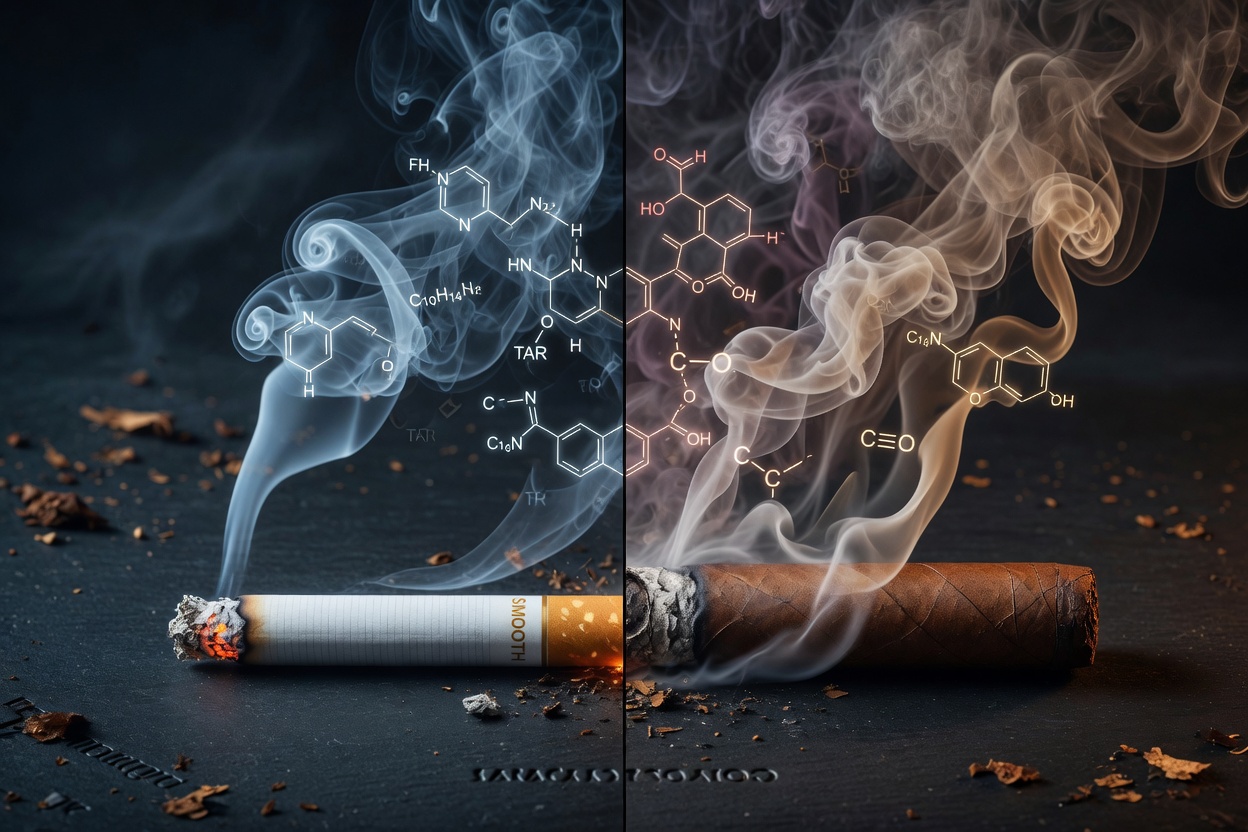
Total nicotine, tar particles, carbon monoxide, and other harmful substances — the chemical differences between cigarettes and cigars go far beyond "one is harsh, one is refined."
From Mayo Clinic to exposure studies: cigars are often the "heavier" side.
A comparison table answers the real action question: not "which is safer," but "what am I actually inhaling."
Core Chemical Differences Between Cigarettes and Cigars
On a Friday evening in November 2023, I sat for nearly two hours at a cigar bar near the Nanshan Science Park in Shenzhen. A man at the next table who had "switched from cigarettes to cigars" kept insisting: "I don't inhale into my lungs now — I just swirl the smoke in my mouth and blow it out, so it's much cleaner than smoking." That evening the bar offered a medium-sized handmade cigar, and the staff said it would burn for roughly 45–60 minutes. I happened to have a simple personal CO breath tester with me (unit ppm, not medical grade, only good for rough comparisons), and I recorded readings before he lit up, about 20 minutes after, and when he finished; I also noted that he only "tasted" this one cigar all night and did not smoke any cigarettes. The result gave him pause: his breath CO reading at the end was clearly higher than the rise I had previously recorded in similar settings after "smoking 1–2 regular filter cigarettes." I did not jump to conclusions that night, but I began seriously comparing public medical and exposure research — is the difference between cigarettes and cigars in "core chemical composition" a matter of "different magnitudes," or an "illusion created by different routes of exposure"?
Below, I break this down by nicotine, tar, carbon monoxide, and other key harmful substances. The data come from common statements by Mayo Clinic, exposure studies, and public-health agencies; the personal anecdotes serve only to show how often "feeling safe" and "actual exposure" diverge.
1. Nicotine: the total load often differs by an order of magnitude, while the absorption route is underappreciated
Cigarette side (common published ranges)
- A machine-made cigarette contains nicotine on the order of a few milligrams in its tobacco; the nicotine delivered in the smoke and absorbable by the smoker commonly falls in the range of about 0.1–2 mg per cigarette (varies greatly by brand and measurement method).
- After being drawn into the mouth and lungs, plasma nicotine can rise within minutes; the common "pick-me-up / relief-from-withdrawal" feedback loop among smokers depends precisely on maintaining this.
Cigar side
- Mayo Clinic and other institutions repeatedly emphasize: the tobacco needed to make one full-size cigar could roughly make an entire pack of cigarettes.
- Hence the total nicotine reserve of a single cigar is often summarized as "roughly equal to a pack of cigarettes"; popular science commonly cites figures of tens to over a hundred milligrams per cigar (varying enormously from small cigars to large handmade ones).
- The key point: even without deep inhalation, nicotine can still enter the blood through the oral and nasal mucosa. Holding smoke in the mouth and blowing it out is not the same as "zero absorption."
My view
Many people treat "lung inhalation vs. mouth-holding" as a safety switch. In reality this is only a switch of delivery route: cigarettes lean toward rapid lung absorption in frequent small doses; large cigars lean toward a large single tobacco load + prolonged mucosal exposure. Dependence risk does not automatically drop because "I'm just savoring it." If your intention is harm reduction or quitting, switching from cigarettes to cigars means taking on another high-nicotine-load product rather than leaving the addiction loop.
A real pitfall I ran into
In March 2024, I helped a friend pick an "anti-quitting transitional cigar" at a tobacco and liquor store in Tianhe, Guangzhou. The clerk recommended small cigarillos, saying they "feel closer to cigarettes and are easier to quit." I checked the tobacco weight and recommended smoking time on the packaging (about 10–20 minutes) and did the math on the spot: if you "savor" 3–4 small cigars a day, the accumulated tobacco weight can easily approach or exceed the total of 15–20 cigarettes a day. My friend's problem at the time was not "will I inhale into the lungs," but the total nicotine intake had widened without him knowing it.
2. Tar: not just a number on the pack, but a particle mass of combustion products
What tar is
Tar is a complex mixture produced by tobacco organic matter under oxygen-starved/incomplete combustion, containing polycyclic aromatic hydrocarbons, phenols, and more; among them, benzo[a]pyrene and others are clearly linked to cancer risk. On the cigarette side, delivered tar per cigarette ranges from single-digit milligrams to a dozen or dozens of milligrams depending on the product; monitoring studies show brands across different markets can vary widely.
Why cigars are often "dirtier"
- Cigars generally have no filter or very weak filtration, and their draw resistance and combustion dynamics differ from filtered cigarettes.
- Fermentation changes the chemical profile of the leaf; public-health materials note that among cigar-related combustion products, tar and several toxic substances can be more concentrated than in ordinary cigarettes.
- Mayo Clinic states plainly: cigar smoke contains more tar than cigarette smoke; cigar smokers may also be exposed to higher levels of other toxicants.
Per-unit exposure vs. per-cigar exposure
Laboratory comparisons (including historical tar/nicotine/CO yield studies) show that when normalized "per liter of smoke" or "per gram of tobacco," the ranking across cigar sizes and cigarettes changes — small cigars can sometimes deliver very high tar/nicotine/CO per unit of smoke, while large cigars have a different accounting for sidestream and total emissions because of their volume and draw style. What matters more to the user is:
- How long did you smoke?
- How many grams of tobacco did you smoke?
- Was there a filter or ventilation holes diluting the smoke?
- Did you inhale into the lungs or mainly hold it in the mouth?
Personal judgment
The most common self-comfort in the tar debate is: "I blow smoke rings, I don't inhale, so tar stays low." The oral, throat, tongue, and esophageal mucosae are equally in long-term contact with tar and related carcinogens. Institutions such as Taiwan's Health Promotion Administration emphasize that cigars are more readily linked to risks in the mouth, tongue, throat, and esophagus — upper aerodigestive sites — which matches the "mouth-holding-first" usage pattern. This is not scaremongering; it is the logic of exposure sites.
3. Carbon monoxide: the "counterintuitive rise" I measured in cigar scenarios
Mechanism (brief)
Carbon monoxide has an affinity for hemoglobin far higher than oxygen (commonly stated at roughly 200–300 times in the literature and popular science). Once inhaled, it weakens oxygen-carrying capacity and adds to cardiovascular load. Common statements on the cigarette side include: each cigarette can produce about 20–30 ml of CO (condition-dependent); in a closed room, a single cigarette is enough to raise the carboxyhemoglobin-related indicators of others in the room.
A hard comparison in exposure research
A human exposure study of cigarettes vs. cigarillos (searchable on NCBI/PMC) provides a very practical comparison framework:
- Plasma nicotine rise: cigarette and cigarillo conditions can be close;
- Breath CO rise: the cigarillo condition was significantly higher (in that study, the CO rise after cigarillo could reach several times the cigarette condition; see the mean comparison in the paper — for example, in one dataset the COex rise for cigarillo was clearly above cigarettes).
This matches the everyday observation that "cigars burn longer, produce denser smoke, and have worse ventilation and filtration."
My field notes (not laboratory precision)
| Scenario | Time/place | Rough observation |
|---|---|---|
| 1–2 filter cigarettes | 2023, open space outside an office building in Shenzhen | Breath CO rose; subsided fairly quickly |
| Medium cigar, mostly mouth-held, about 50 min | Nov 2023, cigar bar in Nanshan | Breath CO rose more clearly at the end and lasted longer |
| 2 small cigars in a row | Mar 2024, indoor room in Guangzhou (mediocre ventilation) | Non-smoking companions complained of "stuffiness and headache"; the air was noticeably harsher |
The tester's precision is limited, but I used the same device and a similar time window for before/after comparisons, and the trends agree with the direction of public research: do not assume "no lung inhalation = small CO problem". As burn time lengthens, sidestream smoke and ambient CO pile up together.
4. Other harmful substances: TSNAs, heavy metals, and "one shared toxin list"
The chemical list of tobacco smoke is often summarized as thousands of known chemicals (4000+ or 7000+ are common figures in popular-science and public-health materials, depending on the counting method), including multiple toxicants and carcinogens.
Points that need separate naming on the cigar side
- Tobacco-specific nitrosamines (TSNAs)
Fermentation can produce high concentrations of TSNAs (e.g., NNN, NNK), named by health authorities in several countries as risk factors strongly linked to cancer. This is the direct debunking point of the illusion that "a refined cigar process = chemically cleaner": fermentation improves flavor but does not clear away carcinogenic precursors.
- Ammonia, cadmium, etc.
Some comparative materials note that in cigar smoke, irritants such as ammonia can be significantly higher than in cigarettes, and heavy metals such as cadmium are also cited as "several times" higher in some comparisons. The exact multiples vary by product and measurement method; the direction is: irritancy and part of the heavy-metal exposure do not disappear because of the "premium positioning."
- Sidestream smoke and secondhand-smoke totals
Large cigars burn long, and sidestream smoke emissions in total mass are often far higher than a single cigarette. Indoor-environment studies note that the particulate and CO emissions of large cigars can be several times those of cigarettes (per stick); even normalized by tobacco mass, the scene risk still depends on whether you are in an enclosed space and whether children share the room.
- Biomarkers
Research cited in public health (e.g., a retelling of work by Chen et al., 2014) shows that cigar-only smokers can have urine levels of certain nitrosamine markers and serum cotinine (a nicotine metabolite) far above non-smokers; with dual use of cigars + cigarettes, the indicators can rise another order of magnitude. Dual use is, in my view, the most dangerous everyday pattern — it keeps the high-frequency lung absorption of cigarettes while adding the prolonged mucosal exposure of cigars.
5. A comparison table: stop asking "which one is safer" — the wrong question
| Dimension | Cigarette (mainly machine-made) | Cigar (especially full-size) | Real meaning for the user |
|---|---|---|---|
| Tobacco per stick | about 0.5–1 g | several grams to over a dozen grams | Cigar single-session tobacco load is large |
| Nicotine | delivered in smoke about mg-level per stick | total reserve can ≈ one pack | mouth-holding also absorbs into blood |
| Tar | filtered and ventilated by design, still carcinogenic | often higher, weakly filtered | oral-pharyngeal exposure more prominent |
| CO | high-frequency short rises | long burn, peak can be higher | indoor and cardiovascular burden |
| Pacing | 5–10 min per stick, many times a day | 30–90 min per stick | long single-session exposure window |
| Common myths | "low tar = low risk" | "no lung inhalation = safe / can quit" | both are wrong |
My clear personal view:
- A cigar is not a harm-reduced version of a cigarette. The ingredient lists overlap heavily; the differences are mainly dose, burn duration, filtration, and inhalation method — not "one class of toxins is missing."
- "Switching to cigars to quit smoking" does not hold up in chemical-exposure logic. You may reduce the 20-times-a-day hand-to-mouth habit frequency, but you trade it for a single ultra-long burn and a high nicotine reserve; the oral-cancer risk narrative actually fits this usage pattern better.
- Dual use is worst. Cigarettes keep the plasma nicotine trough-peak going, cigars add the social/"ritual" dose; biomarker studies often show this group as the highest.
- If the goal is health, the truly effective move is stopping the combustion of tobacco; nicotine replacement therapy (patches, gum, sprays, etc.) and burning smoke belong to different exposure categories — that is the subject of another article, and it is not at all the same as "cigars are more natural so they are safer."
6. How I use these differences to make decisions (actionable)
In June 2024 I helped a friend keep a two-week record sheet with only four items: product type, start/end time, whether inhaling into the lungs, and next-morning breath and throat irritation (scored 0–10). After two weeks, the comparison:
- Cigarette-only week: moderate throat irritation, high frequency, noticeable tar staining on fingers.
- "Cigar-only, claimed no lung inhale" week: the irritation score did not drop consistently; morning dry mouth and mouth odor were actually worse; he himself admitted to unconsciously taking a few deep inhales during two evening drinking sessions.
This is not a randomized controlled trial, but it was enough to overturn his original slogan. What chemical-composition differences tell you is not "choose A or B"; it is: when you burn tobacco, you are paying the same class of toxin bill in different packaging; the cigar bill is often more whole, longer, and heavier.
If you are weighing the options:
- Drop the marketing line that "cigar = premium harm reduction";
- Estimate real exposure using grams of tobacco × minutes of burning × whether indoors, instead of comforting yourself with "I didn't inhale into my lungs";
- The quitting path should move toward zero combustion, not product switching.
The core difference between cigarettes and cigars in major chemical composition can be compressed into one sentence: the same harmful chemical family, in different dose packaging and exposure routes; cigars are often heavier — not lighter — in total nicotine, tar, and CO dimensions.
Machine-made cigarette side
Frequent small-dose lung absorption, filter and ventilation design mediate the smoke, typical pacing 5–10 min per stick.
Full-size cigar side
Single large tobacco load plus prolonged mucosal exposure, usually no filter, typical pacing 30–90 min per stick.
Field records are rough comparisons, not laboratory precision