How Air Circulation Parameters in a Cigar Aging Cabinet or Room Affect Combustion and Aroma Evolution
Air is not just a medium that fills space; it is an invisible participant in chemical reactions. Neglecting airflow can ruin cigars worth tens of thousands of dollars.
Managing VOCs is essentially about partial pressure control. Slow, sustained airflow maintains the concentration gradient that drives aroma molecules from leaf tissue outward.
The humidity gradient directly determines combustion stability. Gentle laminar flow eliminates humidity dead zones, ensuring every cigar burns consistently.
Building a 'breathing' aging environment requires four engineering principles: low-speed large-area circulation, multi-point monitoring, CO₂ monitoring, and humidity buffer design.
In the world of cigar aging, air is not merely a medium that fills the space; it is more like an invisible participant that constantly takes part in chemical reactions. Many enthusiasts, when setting up an aging environment, tend to focus all their attention on the digital readings of temperature and relative humidity (RH). They stare at those two fluctuating numbers, trying to lock in the perfect aging environment through precise humidifiers and climate control equipment. Yet I have seen too many cases where neglecting the dimension of "airflow" ruined cigars worth tens of thousands of dollars.
I recall that summer of 2018, when I was in a private studio in Miami, trying to establish a high-standard aging environment for a treasured collection of Cuban cigars. At the time, I designed a nearly sealed temperature- and humidity-controlled cabinet, and in pursuit of absolute stability, I went to great lengths to minimize the frequency of air exchange. I believed then that reducing the interference of outside air was the safest way to protect the cigars. Yet after only three months, when I opened that treasured batch of Cohibas, what I smelled was not the expected cream and leather notes, but an extremely subtle, unsettling mustiness resembling old book pages or mold.
The root of the problem was not temperature or humidity, but the "death" of the air.
When an aging space is in a state of extremely low air exchange frequency (ACH, air changes per hour), the air gradually becomes a static, lifeless mixture. At the microscopic level, during slow aging, biochemical reactions inside the leaf continuously release various volatile organic compounds (VOCs), including alcohols, esters, and some metabolic by-products. In normal air circulation, these substances are slowly carried away by the airflow, maintained at a low concentration gradient. But in my overly sealed cabinet, these volatiles kept accumulating in the air, forming a high-concentration "aroma saturation layer."
This saturation did not bring a richer aroma; on the contrary, it led to a certain degree of "taste dulling." More seriously, as cellular respiration continued, the concentration of carbon dioxide (CO2) in the local space rose significantly. Through a precision sensor, I found that the CO2 level at the bottom of the cabinet had reached as much as four times that of ordinary outdoor air. This high-CO2 environment altered the acid-base balance of the micro-environment, subtly affecting the degradation pathways of proteins and sugars in the leaf, ultimately producing that frustrating, moldy mustiness.
The "degree" of air circulation is extremely difficult to grasp. If the air exchange frequency is too high—for instance, ACH exceeding 1.0 or even reaching 2.0—you will find the aging environment becomes extremely unstable. Excessively frequent air exchange carries away too much moisture, causing the humidity gradient to be distributed unevenly across the space. In one experiment, I found that when using a high-volume circulation fan, the humidity at the top of the aging cabinet was a full 5% RH lower than at the bottom. The existence of this gradient causes the cigar leaves to absorb moisture unevenly, leaving some leaves overly moisturized while others sit at the edge of dryness. This inconsistency becomes fully evident in the subsequent combustion process.
When it comes to combustion, the influence of air circulation is even more direct. A well-aged cigar should have a highly uniform internal moisture distribution. If the air circulation design is improper, causing the cigar to develop a "wet-dry alternating" structure during aging, the stability of combustion collapses at the very moment of lighting. You will observe the cigar burning extremely unevenly: one side burns swiftly while the other goes out or smolders because its moisture content is too high. This unstable combustion not only produces a large amount of ash; more importantly, it alters the temperature of the smoke, disrupting the release rhythm of aroma substances.
In an ideal aging environment, I prefer to control the air exchange frequency between 0.1 and 0.3 ACH. This frequency is sufficient to allow the air in the aging space to undergo slow replacement, preventing abnormal accumulation of CO2 and VOCs, while still preserving humidity stability. In this process, the air flow pattern matters more than the wind speed itself. I do not favor violent, directional turbulence; I prefer a circulation system that produces slow, gentle laminar flow.
This gentle flow is like a tender hand continuously brushing over the surface of every cigar, ensuring that every inch of leaf comes into contact with fresh air of moderate humidity, thereby maintaining an extremely faint yet sustained concentration gradient. This is precisely the art of aroma evolution: it does not wait for maturity in some static state, but completes the transformation from green and astringent to mellow and rich in an extremely slow, extremely orderly flow.
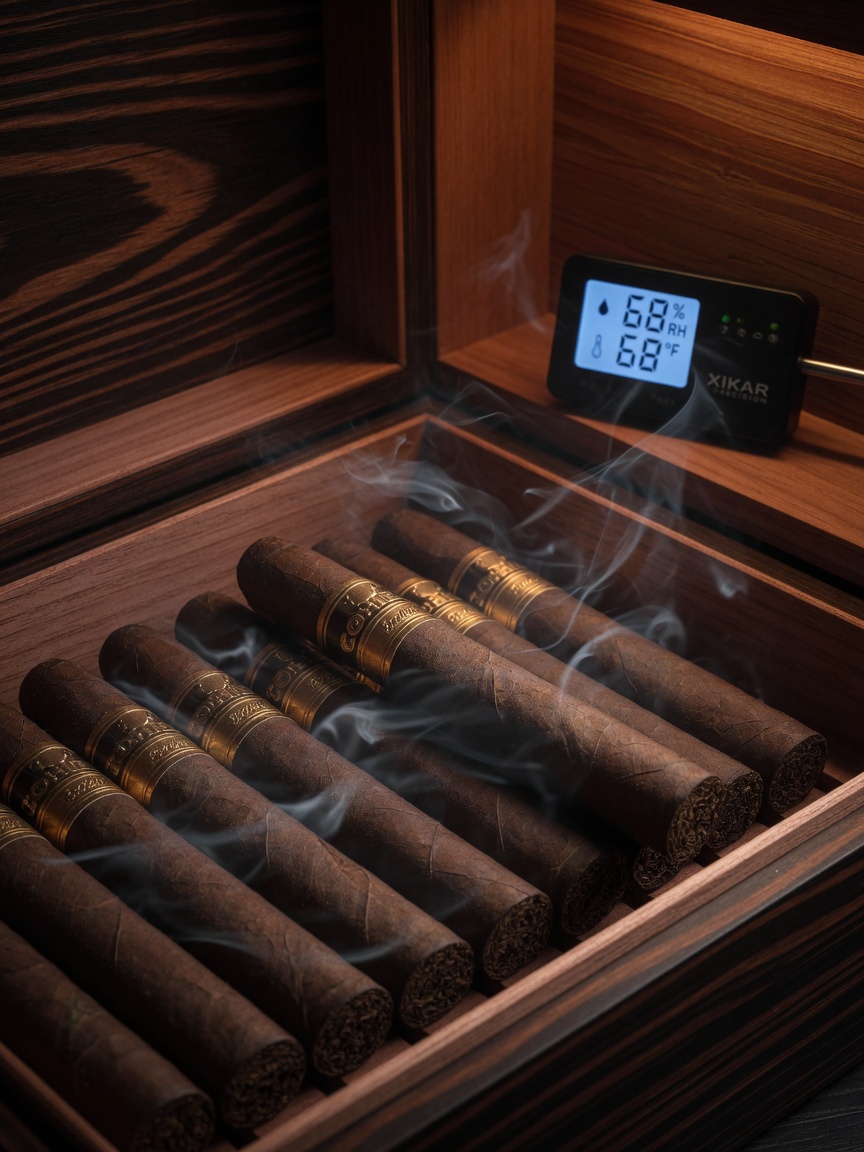
Microscopic Dynamics of Volatile Organic Compounds (VOCs) and Aroma Evolution
The aroma of a cigar is not a single substance but a complex chemical matrix. During aging, enzymatic reactions and slow oxidation within the leaf generate hundreds of volatile substances. Among them, esters are responsible for fruity notes, terpenes provide woody or herbal aromas, and certain aldehydes and phenols constitute the complex tobacco undertone.
The essence of air circulation lies in managing the "partial pressure" of these substances. According to Henry's law, the solubility of a solute in a liquid is proportional to its partial pressure in the gas. If the air in an aging space is static, the partial pressure of volatiles at the leaf surface quickly rises, thereby suppressing the continued release of volatiles from inside the leaf. This is like being in a small room full of perfume scent—it becomes hard to smell any new aroma. By maintaining a low level of ACH, we are in effect sustaining a continuous "suction effect," allowing aroma molecules to migrate smoothly from the leaf tissue along the concentration gradient into the air, where they are evenly distributed by moderate flow.
The Physical Link Between the Humidity Gradient and Combustion Stability
Humidity is not merely a question of being "wet or dry"; it directly determines the physical structural stability of the cigar. During aging, the migration speed of water molecules is governed by the porosity of the leaf tissue and the humidity gradient. If air circulation is poor, "humidity dead zones" appear inside the aging cabinet, causing cigars in certain positions to suffer cell wall softening—or even mold—due to locally high humidity, while cigars in other positions experience excessive moisture evaporation because of stagnant air.
When a cigar is lit, heat drives moisture to vaporize rapidly. If the moisture within the leaf tissue is unevenly distributed, heat conduction becomes skewed. Regions with higher moisture content absorb a large amount of heat for vaporization, causing the local combustion temperature to drop and producing a "cool smoke" phenomenon, which severely undermines aroma release. Conversely, overly dry regions burn too quickly and produce bitter, scorched flavors. Therefore, minimizing the humidity gradient in the space through gentle laminar flow is the technical core that ensures every cigar achieves consistent combustion performance.
Practical Engineering Guide: How to Build a "Breathing" Aging Environment
For advanced enthusiasts or professional institutions, the following engineering principles should be followed when building an aging environment:
1. Low-speed, large-area circulation: avoid concentrated high-speed fans. The ideal design uses distributed, low-RPM micro fans, or achieves slow air replacement by controlling the opening of vents. The goal is to achieve a "roaming" air flow rather than an "impact" one.
2. Multi-point monitoring: do not rely on a single sensor. Place a high-precision humidity and temperature logger at the top, middle, and bottom of the aging cabinet. Through the fluctuation patterns of the data, you can intuitively see whether air circulation has effectively eliminated dead zones.
3. Carbon dioxide monitoring: for large aging rooms, introducing CO2 monitoring is necessary. If CO2 levels remain above 1000 ppm for a long time, consider introducing a very small amount of external air through a micro fresh-air system, or increasing the air exchange frequency.
4. Humidity buffer design: combining active humidification with passive buffering (such as high-quality humidity control boxes), along with slow air flow, can achieve more robust humidity control than relying solely on a humidifier.
2. Multi-point monitoring: do not rely on a single sensor. Place a high-precision humidity and temperature logger at the top, middle, and bottom of the aging cabinet. Through the fluctuation patterns of the data, you can intuitively see whether the air circulation has effectively eliminated dead zones.
3. Carbon dioxide monitoring: for large aging rooms, introducing CO2 monitoring is necessary. If CO2 levels remain above 1000 ppm for a long time, consider introducing a very small amount of external air through a micro fresh-air system, or increasing the air exchange frequency.
4. Humidity buffer design: combining active humidification with passive buffering (such as high-quality humidity control boxes), along with slow air flow, can achieve more robust humidity control than relying solely on a humidifier.
If you are now planning your own cigar room or aging cabinet, do not settle for simply buying an expensive humidifier. Go study your ventilation system, observe the path air takes within the space. Think about how, when you turn off the lights late at night, that invisible air travels among your cigars. Only when you can sense the presence of that "breath" have you truly mastered the essence of aging.
Low Air Exchange (0.1–0.3 ACH)
- Slow air replacement prevents abnormal accumulation of CO₂ and VOCs
- Maintains humidity stability with minimal gradient across the space
- Aroma molecules migrate smoothly along concentration gradients for uniform aging
High Air Exchange (≥1.0–2.0 ACH)
- Frequent air exchange causes uneven humidity distribution and dead zones
- Carries away excessive moisture, destabilizing the aging environment
- Produces cool smoke or extinguish during combustion, disrupting aroma release
Choosing 0.1–0.3 ACH with gentle laminar flow is the optimal balance in practice