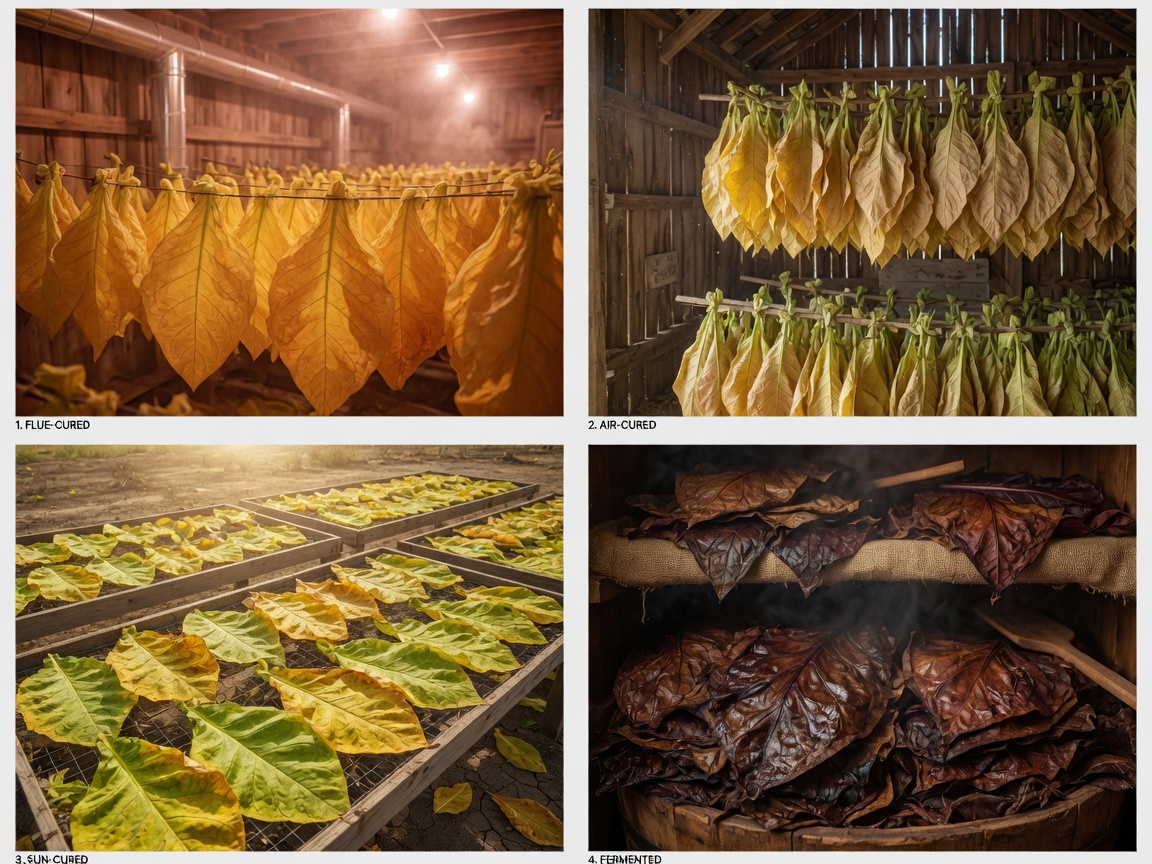
Flue-cured, Air-cured, Sun-cured, and Fermented Tobacco: A Complete Process Comparison
Why do tobacco leaves harvested from the same field end up so different — some yellow and sweet, ideal as the backbone of flue-cured cigarettes, others almost sugar-free with a pronounced kick, some small-leaf varieties rich in aromatic spice, and othersmellow after heap fermentation, suitable for cigars? The answer is not in marketing slogans but in processing technique: how temperature climbs, how humidity is controlled, how fast moisture is lost, and whether secondary fermentation occurs — these directly rewrite the "chemical ledger" of sugars, nitrogen, alkaloids, phenols, pigments, and aroma precursors.
This article systematically compares four paths often discussed in parallel:
**Curing and fermentation are not at the same level.** Curing turns high-moisture fresh leaves into storable, processable raw tobacco; fermentation comes after, using temperature, humidity, and stacking to actively accelerate biochemical coordination.
**"Fermented tobacco" is not a fourth genetic variety alongside flue-cured**, but a process-result label: most common for cigar leaves, some dark air/sun-cured types, and reprocessed leaf blends.
**Process changes compositional structure and sensory usability, not healthiness.** Any combustion or high-concentration tobacco exposure still carries clear health risks; this article makes no harm-reduction claims.
Comparison of four tobacco processing methods: Flue-cured, Air-cured, Sun-cured, and Fermented
35–38°C
Typical yellowing temperature for flue-cured
65–70°C
Stem drying temperature range for flue-cured
5–8 天
Complete flue-curing cycle
4–8 周
Typical air-curing cycle
38–55°C
Common fermentation temperature range
60–70% RH
Common relative humidity for fermentation
高糖
High reducing sugars — Flue-cured hallmark
极低糖
Very low reducing sugars — Air-cured hallmark
I. Concept Map: What Curing, Fermentation, and Aging Each Do
Stage
Core Question
Time Scale (Order of Magnitude)
Intervention Intensity
**Curing**
Moisture loss, color change, fix basic chemical profile
**Flue-/air-/sun-curing decides "what chemical face this leaf will roughly have"; fermentation and aging decide "whether that face is harmonious and usable."**
Two easily confused concepts:
**Flue-cured**: Indirect hot air/flue heating, **the leaf does not directly contact flame or smoke**.
**Fire-cured**: Direct flame/smoke contact, with a different style and chemical path — not covered here, but note that "flue-cured" is not "smoke-cured."
II. Flue-cured: Short Cycle, Strong Temperature Control, Goal is "Preserve Sugar & Fix Color"
1. Process Objective
The core contradiction in flue-curing is:
Degrade chlorophyll, reveal yellow color (**yellowing**);
Maximize conversion of starch to soluble sugars, and **keep the sugars**;
Raise temperature and lower humidity at the right time to **fix** color and chemistry (**leaf drying/color fixing**);
Finally dry the stem moisture (**stem drying**) for storage and threshing/redrying.
In industrial and regional practice, bulk curing barns/hot air duct systems allow dry-bulb temperature and wet-bulb temperature (or relative humidity) to be controlled in stages. Therefore, flue-curing has the highest degree of parameterization among the four paths.
2. Typical Process (Three-Stage Framework)
Actual curves vary by variety, stalk position, fresh leaf quality, and barn type, but the logic is highly consistent:
(1) Yellowing
**Temperature (dry bulb)**: Typically starts at about **35–38°C**, gradually reaching around **40°C** (literature and regional textbooks commonly reference about 100°F ≈ 38°C as a reference range for yellowing).
**Humidity**: Kept **high**, wet-bulb close to dry-bulb or high relative humidity, to prevent premature drying that would cause "green curing."
**Time**: On the order of **1–2 days** (depending on leaf condition).
**Chemical focus**: Chlorophyll degradation; amylase active, **starch → reducing sugars**; cells still need to maintain some metabolic activity.
(2) Leaf Drying / Color Fixing
**Temperature**: Stepped increase, commonly advancing to the **50–55°C** range (around 130°F is often used as a leaf-drying reference).
**Humidity**: Gradually **significantly lowered**, forcing rapid leaf moisture loss, inhibiting further browning and excessive respiratory consumption.
**Purpose**: "Lock in" the formed lemon-yellow to orange-yellow color and **reduce continued sugar consumption**.
**Risk**: Premature fixing → green harshness, starch residue; too late or humidityout of control → spotting, steaming, dark color, sugar loss.
(3) Stem Drying
**Temperature**: Continues to rise, commonly reaching **65–70°C** (around 160°F being a common reference upper zone).
**Reducing sugars: High** (one of the most distinctive labels of flue-cured)
**Nicotine: Medium** (varies widely by position, fertilization, variety)
**Total nitrogen/protein: Relatively low** (especially when compared with Burley-type air-cured)
**Sugar-nicotine ratio: Generally more balanced**, supporting "sweetness, toasted aroma, relatively full smoke"
**Appearance**: Mainly lemon-yellow to orange-yellow (determined by grade and process)
**Use**: Main body of Chinese-style flue-cured cigarettes; also used as a sweet-aroma backbone in blends
III. Air-cured: Long Cycle, Slow Moisture Loss, Goal is "Consume Sugar, Highlight Nitrogen"
1. Process Objective
Air-curing hangs tobacco leaves in well-ventilated barns, relying mainly on ambient air to slowly remove moisture. Typical representatives are Burley and various dark/light air-cured types. Contrary to flue-cured, it does not seek to "lock in high sugar with high temperature," but instead allows over a longer period:
More complete respiration and enzymatic conversion;
**Sugar is largely consumed**;
Nitrogen metabolism pathways become more prominent, forming a raw material base character of "kick, dryness, nut/cocoa/roasty tendencies."
2. Typical Process
**Harvesting**: Can be whole stalk or stalk-cut; Burley etc. often combined with maturity management.
**Wilting and Hanging**: Leaves/whole plants suspended on barn tiers.
**Slow Yellowing - Browning - Stem Drying**: After chlorophyll degradation, color transitions from yellow to light brown, reddish brown, to dark brown (end color varies by type).
**Taking Down and Ordering**: After midrib is sufficiently dry, moderate re-damping for stacking and handling.
Cycle: Typically 4–8 weeks, can be longer under unfavorable conditions or with thick leaves (literature also cites ranges from three to twelve weeks).
3. Temperature, Humidity, and Ventilation
Air-curing is not "hands-off," but environmental management:
Factor
Common Management Logic
**Temperature**
Close to ambient; excessive heat accelerates undesirable color change and mold risk window changes
**Relative Humidity**
Must be high enough to allow color change/transformation to occur, yet low enough to **inhibit mold**; prolonged high humidity is the biggest enemy
**Ventilation**
Core: remove moisture vapor, break local dead zones, prevent "stewing"
**Rain and Dew Protection**
Barn structure and window timing determine success or failure
Unlike the "curve chart" of flue-cured, air-curing is more like: Use ventilation and microclimate to keep the drying rate within the narrow band of "good transformation without mold."
4. Final Composition and Style Tags (Trends)
**Reducing sugars: Extremely low, even approaching "sugar-free"** (consumed over long cycle)
**Nicotine and total nitrogen: Often high** (especially pronounced in Burley)
**Organic acids/pH and irritation structure**: Often bring stronger physiological satisfaction and different acid-base sensations in smoke
**Appearance**: Light brown, reddish brown to dark brown
**Use**: "Backbone and kick" material in blended cigarettes (often combined with casing); some chewing tobacco, dark products; also an upstream for types that undergo further fermentation
One-sentence mechanism: **Time sides with "sugar consumption, nitrogen display."**
IV. Sun-cured: Sunlight Dominated, Style Substances Highly Differentiated by Local Type
1. Process Objective
Sun-curing uses direct sunlight (often combined with nighttime retrieval, barn transitions, and other local practices) to complete moisture loss and color change. Its spectrum is broad:
**Oriental/Turkish type**: Small-leaf sun-cured around the Mediterranean and similar ecologies, industrially known for **aroma contribution**;
**Traditional Chinese Sun-cured Yellow / Sun-cured Red**: Color, sugar/nitrogen, and uses can vary greatly;
Other local sun-cured types.
Thus, "sun-cured" is first a curing method label, not a single chemical standard.
2. Typical Process (Summary)
**Harvesting at proper maturity** (timing for small-leaf types differs from large-leaf flue-cured).
**Stringing/laying out/rack drying**: Leaves spread or strung to receive sunlight.
**Sun-drying by day, retrieving by night or sun-drying with dew management** (varies by region): Using day-night temperature and humidity alternation to drive yellowing and color-fixing tendencies.
**After sufficient drying, heap for brief initial aging or direct sale**; some types then undergo fermentation/aging.
Cycle: From several days to several weeks, depending on leaf thickness, sunlight intensity, alternation of re-damping, and local procedures.
3. Temperature and Humidity Characteristics
Feature
Description
**Heat source**
Solar radiation; leaf surface temperature can be significantly higher than shelter temperature
**Humidity**
Often drops rapidly during the day, recovers at night; poor management easily causes green tobacco, dull color, or sunscald
**Controllability**
Lower than kiln, higher than "completely weather-dependent"; experience and microclimate are critical
**Difference from air-curing**
Air-curing emphasizes **indoor slow drying with shade and ventilation**; sun-curing emphasizes **direct light and outdoor heat-mass exchange**
Research and regional experience indicate that under sun-curing, resin-related, volatile/semi-volatile components, and specific neutral aroma substance profiles often become the focus of quality discussions, rather than simply replicating the "high-sugar narrative" of flue-cured.
4. Final Composition and Style Tags (by Subtype)
Subtype (Summary)
Sugar
Nicotine
Style Tendency
Common Role
**Oriental sun-cured**
Low-medium to medium (not flue-cured high-sugar logic)
Often low to medium
Spicy, fatty, expressive
"Accent" in blends, not necessarily high proportion
**Sun-cured Yellow**
Relatively more present
Medium variable
Can sometimes approach flue-cured usability discussions
Local use, some blend filler
**Sun-cured Red**
Often lower
Can be high
Strong, localized, dark color
Traditional products, specific leaf blends
Appearance: From light yellowish brown to deep reddish brown, purplish brown — an extremely wide range.
One-sentence mechanism: **The sun-curing path shapes a "differentiated style spectrum," not a single standard curve.**
V. Fermented: Secondary Process, Goal is "Reduce Irritation, Promote Harmony, Express Aroma"
1. How Does It Relate to the Previous Three?
Fermentation typically acts on already flue-/air-/sun-cured tobacco leaves (or semi-finished products with certain moisture content), through:
Controlling **moisture content**;
Controlling **temperature** (self-heating in heap or chamber heating);
Some dark air/sun-cured types heavily rely on fermentation to improve usability;
Flue-cured raw leaf more commonly goes through redrying and warehouse aging, but specific uses may also include fermentation/fermentation-like treatments;
**"Fermented tobacco" describes a processing state, not a fourth field variety mutually exclusive with flue-cured.**
2. Typical Process
**Re-damping/moisture conditioning**: Bring leaves to suitable water activity (too dry → reactions hard to start; too wet → mold and burning risk).
**Stacking or boxing/chamber loading**: Form a relatively stable microenvironment.
**Heating and maintenance**: Microbial respiration and oxidation generate heat, or external heat maintains the target temperature range.
**Monitoring and turning**: Prevent local overheating, oxygen deprivation, mold; ensure uniform fermentation.
**Cooling and drying termination**: Stop high-intensity transformation, fix stage results.
**Can be repeated in multiple rounds**, intensity and endpoint determined by target aroma profile and use.
Cycle: A single round is typically days to weeks; complete cigar leaf processing can take longer.
3. Temperature and Humidity Control (Order of Magnitude)
In published process and enthusiast/industry materials, chamber or accelerated fermentation commonly discusses ranges around:
**Temperature**: About **38–55°C** (100–130°F) as an "effective acceleration" reference zone;
**Relative humidity**: About **60–70%** is often mentioned to maintain enzyme and microbial activity while controlling mold risk.
Specific factory curves are core process parameters; here we only emphasize the logic:
Parameter
When Too Low
When Too High
**Temperature**
Slow transformation, like extended aging
Too fast, even burning the pile, abnormal ammonia odor, aroma drop after inflection point
**Humidity/Moisture**
Weak reactions
Mold, souring, local rot risk increases
**Oxygen/Turning**
Anaerobic off-odors, unevenness
Excessive drying or oxidation path changes
4. Final Composition Change Directions (Trends)
Fermentation is more like "rewriting the balance" than simple "flavor addition":
Component Direction
Common Trend (Summary)
**Starch / some macromolecules**
Further degradation
**Reducing sugars**
Often decrease or are consumed in Maillard and other reactions (depending on starting leaf type)
**Protein/amino acids**
Hydrolysis and retransformation; provide precursors for pyrazines and other baked aroma notes
**Nicotine**
Can show some degree of change/bound-state restructuring, but is not a "de-nicotinization process"
Maintain transformable humidity while preventing mold
Day dry, night wet alternation significant
Medium-high humidity to maintain activity
**Typical cycle**
About several days to just over a week
About 4–8 weeks (can be longer)
Several days to several weeks
Several days to several weeks / multiple rounds
**Sugar**
**High**
**Very low**
Type-differentiated (sun-yellow relatively high, sun-red often low)
Often further consumed/transformed
**Nicotine/total nitrogen**
Medium framework
**Often high**
Oriental: often low-medium; sun-red can be high
Mainly fine-tuning, focus on balance
**Pigment/appearance**
Yellow – orange-yellow
Light brown – dark brown
Yellowish brown – reddish brown/purplish brown
Often darker, more uniform
**Aroma logic**
Toasted, sweet, clean sweet backbone
Nut/cocoa/kick backbone
Spicy, fatty, local intense aroma
Mellowing, baked notes, harshness reduction
**Industrial role**
Flue-cigarette main body; sweet base in blends
Kick and filler backbone in blends
Accent: spice; local characteristic leaf
Key for cigars and dark leaf; usability upgrade
VII. Summary of Composition Difference Mechanisms: Four Causal Chains
1. Why Is Flue-cured "Sweet"?
Yellowing provides high humidity + suitable temperature for starch-to-sugar conversion; leaf drying rapidly loses moisture and raises temperature, "freezing" the sugar in the chemical ledger. The short cycle reduces the opportunity for sugar to be completely respired away.
2. Why Is Air-cured "Not Sweet but More Pungent"?
In weeks of slow drying, sugar is continuously metabolized; nitrogen metabolism and nicotine retention pathways are relatively prominent, forming a high-nitrogen, low-sugar framework. Ventilation to prevent mold is the bottom line; sugar consumption is the natural result of time.
3. Why Does Sun-cured Have "More Aroma Stories"?
Direct light, heat stress, day-night alternation, and small-leaf/local variety genetics overlap, making resins, essential oil character, and characteristic aroma substances easier to become the focus of discussion; sugar-nicotine can "resemble flue-cured a bit" or "resemble dark intense aroma" — must be discussed by subtype.
4. Why Can Fermentation "Change Temperament" but Not "Change Species"?
Fermentation deploys the microorganism-enzyme-Maillard network to reduce irritation and rawness, generate/reveal partial aroma notes, but the starting leaf type (flue-/air-/sun-cured) determines the upper limit of what style you can ferment toward. Low-sugar, high-nitrogen air-cured fermentation and high-sugar flue-cured warehouse aging are not the same flavor track.
VIII. Common Misconceptions
Misconception 1: Air-cured is the same as sun-cured.
No. Air-curing's main arena is the ventilated barn; sun-curing's main arena is sunlight. The drying dynamics and thermal-light environment differ, and the compositional endpoints differ as well.
Misconception 2: Fermented tobacco is a "fourth tobacco variety" alongside flue-cured.
Fermentation is a process step. The field first grows a certain type, then it is flue-/air-/sun-cured, and only then may it be fermented.
Misconception 3: Flue-cured means smoke-cured.
Flue-cured is indirect heating; direct smoke contact is the fire-cured system — don't confuse the concepts.
Misconception 4: The longer the fermentation/aging, the healthier.
Process optimization targets usability and sensory qualities, not the removal of health risks such as tar, carbon monoxide, or tobacco-specific nitrosamines. Discussions around dark leaf tobaccos and TSNAs further illustrate that process should not be mythologized as harm reduction.
Misconception 5: You can judge everything by color.
Yellow does not equal high sugar or safe/good smoking; dark does not equal high alkalinity. Position, fertilization, variety, disease spots, and process errors can all deceive.
Misconception 6: Home enthusiasts can replicate industrial quality by following "online curves."
Industrial success relies on fresh leaf quality, equipment uniformity, temperature/humidity measurement, and experience feedback loops. This article provides a conceptual framework, not a copy-paste manual.
Flue-cured vs Air-cured vs Sun-cured vs Fermented
The four process paths differ fundamentally in starting point, control logic, and endpoint. Understanding these differences is the foundation for reading tobacco materials.
IX. Conclusion
Distill the four paths into a mental map:
Phenomenon You Want to Understand
Which Process Logic to Look at First
Why is this tobacco sweet, yellow, with clear toasted aroma
**Flue-cured**: short cycle preserves sugar and fixes color
Why is this tobacco strong, dry, almost not sweet
**Air-cured**: long cycle consumes sugar, displays nitrogen
Why does a small amount of this tobacco give prominent "Oriental/local aroma"
**Sun-cured**: sunlight path + type differentiation
Why are similarly dark leaves sometimes harsh, sometimes smooth
**Fermentation**: secondary coordination, changes completion not origin
Flue-cured, air-cured, and sun-cured answer: how fresh leaves become raw tobacco, and what the first face of sugar-nitrogen-alkaloid-aroma precursors looks like.
Fermentation answers: whether that face can be made more harmonious and usable.
Understanding this is about grasping the underlying logic of raw material and product differences — not to provide a health endorsement for any tobacco product. If your concern is reducing tobacco exposure, the truly effective direction remains stopping tobacco use as early and completely as possible; process knowledge can help you see through the rhetoric of "this processing method is healthier," not provide another comforting consumption justification.
⚠ Notes
Curing and fermentation are not at the same level
Flue-cured uses indirect heat, not smoke
Fermentation cannot change the chemical origin of the leaf type