Part One: The Invisible Battlefield — The Thermodynamic Game Inside the Pilón
This chapter reveals the invisible thermodynamic game inside the pile: heat arises from microbial activity, yet is constrained by structure and oxygen diffusion.
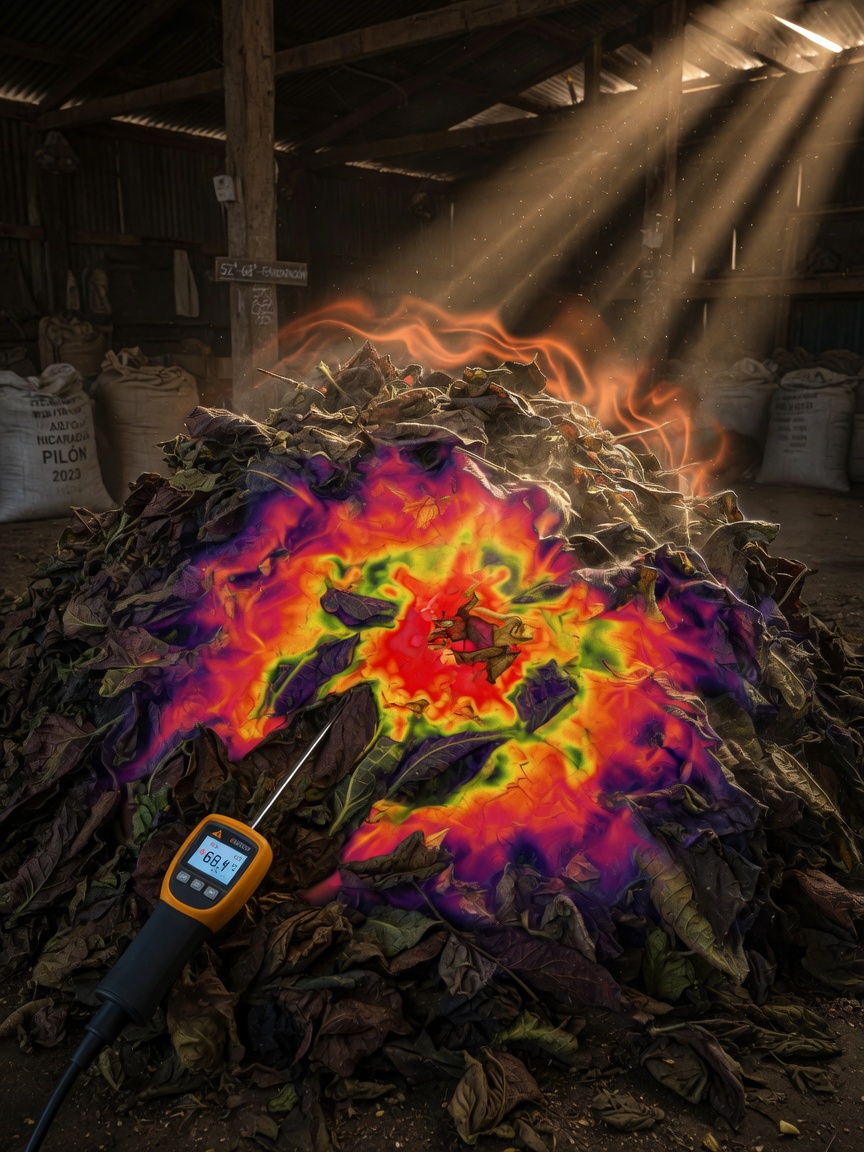
It was a humid late night in 2014 in Estelí, Nicaragua. The air was thick with a dense scent blending earth, fermenting sugars, and faint ammonia — the classic aroma of tobacco fermentation. Standing beside that massive Pilón (fermentation pile), my infrared thermometer showed the surface temperature of the pile holding steady at around 45°C, yet the data I was getting from the deep probes told a different story: the core temperature was rising at an eerie 1.5°C per hour.
In that moment, what I felt was not the bustle of work but a reverence bordering on fear. In cigar production, a Pilón is not merely a container for storing tobacco leaves; it is a vast, living bioreactor driven by biochemical reactions. Every stacking of leaves, every cubic meter of volume change, silently rewrites the internal thermodynamic equations. If mishandled, this heat generated by microbes and enzymatic reactions can transform in an instant from the "engine" that sustains fermentation into the "killer" that destroys quality.
To understand why height and volume are so critical, we must first dissect the energy source behind fermentation. Tobacco leaf fermentation is essentially a violent exothermic process (Exothermic Process). When leaves are stacked under suitable humidity and temperature, microbes — such as bacteria and yeast — along with the leaves' own enzymes begin working frantically, breaking down organic matter and releasing energy. This energy release follows a dangerous feedback loop: temperature rises → microbial activity intensifies → heat production accelerates → temperature rises further.
→ denotes causal progression: rising temperature and microbial activity amplify each other
This accumulation of heat is not uniformly distributed; it is tightly constrained by the physical structure and the rate of oxygen diffusion. Inside a Pilón, heat transfer occurs mainly through conduction (Conduction) and weak convection (Convection). However, the thermal conductivity of the tobacco leaf itself is extremely low, meaning heat can barely escape from the core of the pile. Thus we face a central contradiction: how to find that extremely narrow equilibrium between ensuring the oxygen supply needed for microbial activity and limiting excessive heat accumulation.
Part Two: The Vertical Variable — How Height Shapes the Thermodynamic Landscape
This chapter focuses on the vertical dimension: how stack height reshapes the internal thermal environment through pressure effects and temperature gradients, amplifying the risk of runaway.
On the production floor, stack height (Stack Height) is often the first physical variable that decides the success or failure of fermentation. Many novice operators are accustomed to stacking leaves as high as possible to save space, but this practice is extremely dangerous from a thermodynamic standpoint.
First is the pressure effect (Pressure Effect). As stack height increases, the vertical pressure borne by the bottom leaves grows exponentially. This pressure is not merely mechanical; it alters the physical form of the leaves at the microscopic level. In high-pressure zones, the porosity (Porosity) of the leaves drops significantly, and the tiny gaps that once supported airflow are squeezed closed. This means that at the base of a tall Pilón, the oxygen diffusion path is greatly lengthened and its resistance increases.
Restricted oxygen supply directly shifts the local environment from aerobic (Aerobic) to anaerobic (Anaerobic). Although anaerobic fermentation is necessary at certain stages, excessive and uncontrolled anaerobic conditions cause abnormal accumulation of organic acids (such as acetic acid), which not only damages the aromatic components of the leaves but, more importantly, changes the pattern of fermentation heat production, making local hotspots (Hotspots) far harder to cool through natural air convection.
Second is the vertical temperature gradient (Temperature Gradient). In a fermentation pile 4 meters high, the thermal environments of the bottom and the top are completely different. The bottom, squeezed by the weight above, suffers from poor heat conduction and difficult oxygen replenishment, easily forming a "heat trap." The top, in contact with air, dissipates heat relatively quickly. This height difference creates an extremely steep vertical temperature gradient inside the pile. If we cannot smooth this gradient through precise control of stack height, then in the later stages of fermentation we may discover that the leaves at the top of the pile have already stabilized while the leaves at the bottom risk "scorching" from accumulated heat.
This vertical imbalance is essentially because height lengthens the path of heat generation while simultaneously blocking the path of heat dissipation through the compression effect. Therefore, controlling stack height is not merely a space management problem; it is a thermodynamic management problem.
Part Three: The Mass Variable — Volume and the Challenge of Thermal Inertia
This chapter turns to the mass dimension: why large-volume stacking creates enormous thermal inertia, making cooling and early warning far more difficult.
If height determines the "vertical distribution" of heat, then volume (Volume) determines its "total amount and persistence." When discussing the scale of a Pilón, we cannot simply look at how many square meters it occupies; we must also pay attention to its volume-to-surface-area ratio (Surface Area to Volume Ratio, S/V).
From a physics standpoint, heat dissipation occurs mainly at the surface of the pile. For a huge fermentation pile, its surface area is extremely small relative to its internal mass (Mass). This means that as the pile volume increases, the heat exchange capacity per unit volume through the surface declines sharply. This is why large-scale, high-volume stacking produces enormous "thermal inertia" (Thermal Inertia).
Thermal inertia is an extremely tricky concept. When a large Pilón of 500 cubic meters begins to heat up, it is like a heavy truck speeding along with no brakes. Because of its enormous thermal mass, even if you immediately cut off external heat input or increase ventilation, the heat accumulated inside the pile will not dissipate at once. This energy lag means that when you see a temperature anomaly on your sensors, the real crisis may have already taken shape hours earlier, and the current reading is merely a harbinger of disaster.
Furthermore, large-volume stacking brings a hidden risk: the failure of internal circulation. In smaller piles, thermal convection can drive airflow relatively effectively; but inside an oversized pile, because the heat conduction path is too long, the central zone easily falls into a "heat stagnation" state. In this state, the core temperature keeps climbing due to the lack of effective convective cooling until it breaks through the critical threshold the leaves can tolerate. For managers, this means you are no longer dealing with a simple biological fermentation process, but with a complex dynamical system of high predictive difficulty.
Height: The Controller of Vertical Distribution
Volume: The Decider of Total Quantity and Persistence
Height compresses the path of oxygen breathing; volume locks in the memory of heat — together they decide the thermodynamic fate inside the pile.
Part Four: A Real-Word Case — The 2018 Estelí "Thermal Runaway" Incident
This chapter uses the 2018 Estelí thermal runaway incident to show the real destructive power of height and volume acting together.
To understand more vividly the destructive power of height and volume working together, I want to share a real case that occurred in the summer of 2018. That year, Nicaragua was enduring an abnormally hot and humid season, posing a nearly brutal challenge to Pilón management.
At that time, we were handling a batch of about 600 cubic meters of tobacco leaves. To improve efficiency, this batch was stacked into a giant Pilón nearly 5 meters high. On day 12 of fermentation, everything seemed normal — until the early morning of a Wednesday.
According to our real-time monitoring logs at the time, the core temperature of the pile soared from 52°C to 66°C in just 6 hours. Such a rate is absolutely impossible in a normal fermentation curve. Through emergency deep thermal imaging analysis, we found that the heat was not rising uniformly; instead, an extremely intense "thermal core" had formed in the height zone of 2.5 to 3.5 meters at the center of the pile.
The investigation showed that because the stack height was too high (5 meters), the compaction of the bottom exceeded the expected porosity threshold, causing oxygen to enter far slower than microbes consumed it. At the same time, because the total mass was enormous, the generated heat was locked firmly in the center of the pile, unable to escape through the surface. Worse still, it was the period of continuous rain, and rising ambient humidity further reduced the evaporative cooling efficiency of the leaf surfaces.
We took emergency measures: first, "layered cooling" — mechanically cutting the pile open from the middle to reduce volume and increase exposed surface area; then forced ventilation. But it was too late. Because the core had already entered a vicious cycle of extreme high temperature, the aromatic components of that batch — especially those critical esters — suffered severe degradation and oxidation under high temperatures, and even a slight scorched smell appeared. In the end, 18% of that batch could not enter the premium cigar supply chain due to quality downgrade, directly causing huge economic losses.
The lesson of this case is profound: in the face of height and volume, any empirical "close enough" is extremely expensive. We must harness this powerful biochemical force with precise mathematical models and real-time data feedback.
Part Five: Engineered Perfect Stacking — Safety and Operating Guidelines
This chapter provides engineered stacking and monitoring standards, turning thermodynamic logic into an actionable safety operating guide.
Based on the thermodynamic logic above, we must establish an almost dogmatic set of stacking and monitoring standards in actual production. This is not to limit production efficiency, but to protect our most core asset.
First, the height red-line principle. For most medium-density tobacco leaves, the recommended maximum stack height for a single Pilón should not exceed 3.5 meters. If the process requires higher-density stacking, it must be paired with a mechanical forced ventilation system, using ventilation pipes arranged inside the pile to artificially intervene in oxygen diffusion and heat removal.
Second, optimize the S/V ratio. Rather than building a single ultra-large, monolithic giant pile, it is better to split it into multiple medium-sized independent piles. By increasing the total surface area, we can significantly improve heat exchange efficiency and reduce the risk of thermal inertia. This "distributed management" increases logistics costs, but its returns in thermodynamic safety are unparalleled.
Third, a three-dimensional monitoring system. Monitoring cannot be limited to the surface. A professional monitoring system must include at least three levels of probes: bottom probes (monitoring pressure and anaerobic risk), core-zone probes (monitoring thermal core formation), and top probes (monitoring environmental influence). At the same time, the probes should be arranged in a helical ascending distribution to cover the entire vertical gradient.
Finally, coordinated management of moisture and temperature. Moisture is the fuel of fermentation and the carrier of heat. In high-humidity seasons, the moisture content of incoming leaves must be strictly controlled, and close attention must be paid to how ambient humidity reduces the pile's heat dissipation capacity.
Part Six: Conclusion — Finding Balance in Controlled Heat
This chapter concludes: find balance within controlled heat; anticipation matters more than remediation.
Cigar fermentation is an art of balance. We try to find that extremely subtle boundary between the life energy microbes need and the destructive power of physical limits.
Through a deep understanding of height and volume, we understand: height controls the breathing of oxygen, while volume determines the memory of heat. An excellent manager should not merely stare at the numbers on the thermometer, but should also sketch in the mind that invisible, violently shifting thermodynamic landscape. Only when we can truly predict the flow trajectory of that heat have we truly mastered the essence of fermentation.