Aging Time and Flavor Evolution — Differences Between Short-Term and Long-Term Aging
- First be clear which stretch of time you are waiting on: curing, fermentation, warehouse aging, and finished rest have entirely different goals.
- From the sick period of 0–3 months to 5+ years: the time nodes, flavor keywords, and clear rules for each stage.
- Decide which gear to use by goal, product type, and scenario: short-term is correction and usability, long-term is a style investment in material of a specific constitution.
- Six chemical paths behind flavor change: nitrogen decline, Maillard, pigment and terpene degradation, acid-profile shifts, sugar and nicotine drift, and microbial succession.
- The five steps of the minimal viable comparison method, plus four typical failures: humidity runaway, over-drying, mis-locking aromatics, and opening too early.
- Three questions every 6 months: is stimulation still falling, are new layers appearing, and are you willing to pay another year of cabinet space for the increment.
- Time and flavor form a curve that is steep first, then gentle, and possibly declining: new arrivals rest first, judge at 6–12 months, decide stay-or-go at 18–24 months, and talk years only by constitution.
In November 2020, I put a tin of Virginia flake opened that August into a glass jar in Hangzhou, laid in two 65% two-way humidity packs, and wrote "opening date + 6-month re-review" on the label. Before the plum rains in May of the following year, I reopened the jar. On the first draw, that "fresh grass + green apple peel" note in the nasal passages had clearly receded, and the middle of my tongue had gained a bit of honey and toasted bread edge. At the time I wrote a very categorical sentence: short-term aging settles "whether it is smooth enough to smoke," and only long-term aging lets you talk about "whether it is worth waiting another round."
In the following years I stepped on more pitfalls: I locked up a heavily topped aromatic pipe tobacco as "the older the better" for nearly three years, and the top note collapsed into sugary water; I chain-smoked a box of strong cigars that had arrived only three weeks earlier, and the ammonia and rawness dried out my sinuses for two days straight. Time itself has no position; it merely pushes the chemical ledger in a certain direction under fixed moisture, temperature, and sealing conditions. How fast it pushes and at which page it should stop depends on the raw material and your target flavor, not on the consumer rhetoric that "the more years, the more premium."
Below I break short-term and long-term apart according to the time windows I have repeatedly compared myself. Industrial leaf conditioning and personal cellar aging do not move at exactly the same speed, but the sense of stages carries over.
Short-term aging (about 3–12 months)
Correction and usability: turn "un-smokeable" into "smokeable every day," earning cleanliness, smoothness, and lower stimulation.
Long-term aging (about 18 months to years)
A style investment in material of a specific constitution: earning integration, finish, and depth, at the cost of time, cabinet space, and the risk of peaking over.
I. First, be clear: which stretch of "time" are you waiting on
Many people mix four things together, which wrecks all their time judgment:
| Stage | Rough Intensity | Typical Cycle | Main Goal |
|---|---|---|---|
| Curing (flue-cure/air-cure/sun-cure) | High | Days to weeks | Fix color and basic chemistry; storable and processable |
| Fermentation / bulking | High | Days to months | Rapidly suppress ammonia and green notes; generate aroma precursors |
| Warehouse aging / maturation | Medium-low | Months to years | Slow harmonization, softening, integration |
| Finished / product rest | Low | Weeks to years | Moisture balance + residual volatile escape + inter-structure migration |
The "short-term / long-term aging" in this article defaults to the slow line of warehouse aging + finished rest. Fermentation is a step the factory has already done for you; if you pile on high heat and high humidity at home, that is another set of risks entirely and is not covered by the time rules here.
One more thing must be said up front: aging changes sensory coordination and usability, and it will not turn tobacco into a health product. Discussing flavor timelines is not an endorsement of any tobacco product's health credentials.
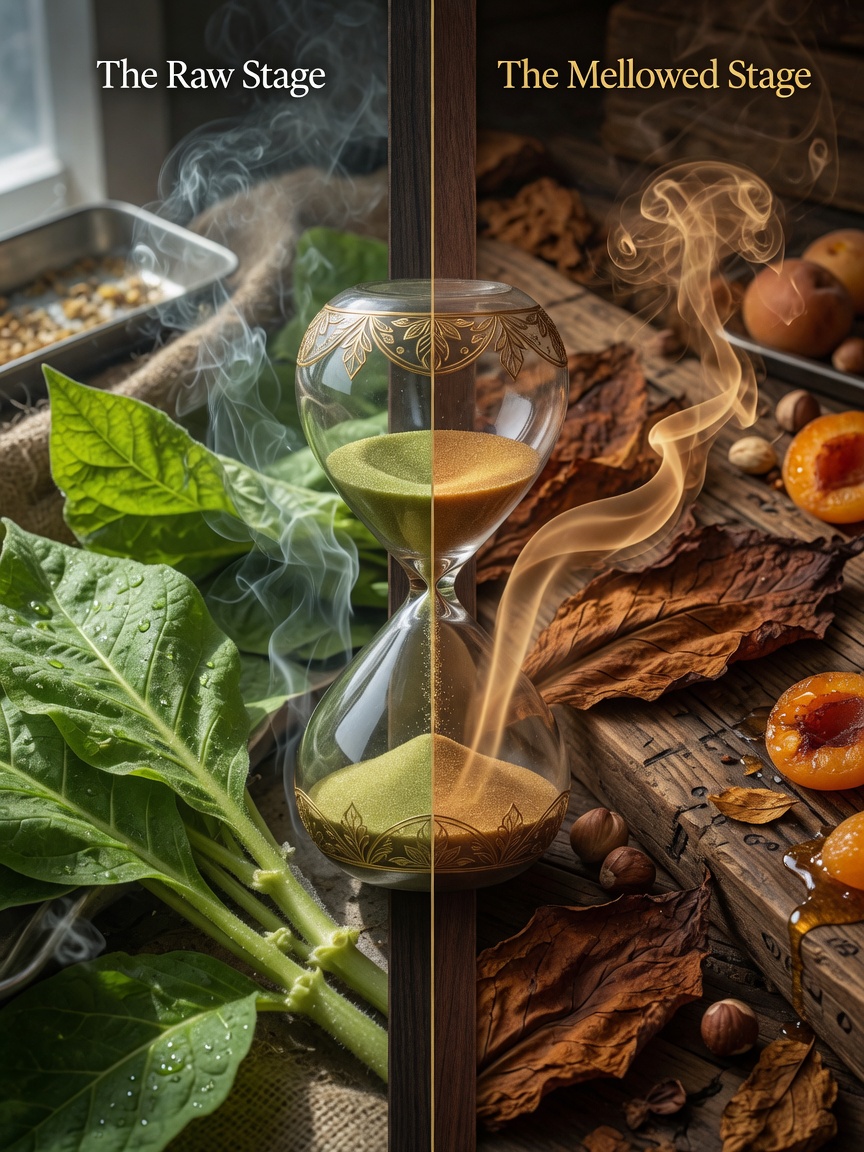
II. The timeline: from "raw" to "ripe" to "flat"
The months below are nodes that keep recurring in my personal notes, and they line up with the common claim in public sources that "major changes mostly occur within 12–18 months" and "most grades should not be stretched indefinitely," but they are not a laboratory ruler. If your cabinet stays around 24°C all year, the curve shifts left overall; if it stays around 16°C and on the dry side, the curve shifts right overall.
1. 0–3 months: the sick period / channel-not-yet-stable period
Flavor keywords: green, sharp, biting, ammonia, mixed, fragmented.
Newly arrived cigars may not have completed factory rest; freshly opened tobacco has moisture and volatiles re-finding their balance after transport jostling. Chemically, this stage is still active: irritant nitrogen-containing small molecules and some volatile aldehydes and ketones keep escaping or transforming, and moisture redistributes between the leaf and the filler/wrapper.
My practice:
- In March 2022 in Beijing, a box of Nicaraguan Robustos arrived; on the same day, a cold draw nasal sniff showed obvious toilet-like ammonia. I kept them alone in a rest box at 65% RH, about 20°C, and opened one cigar at day 10, day 45, and day 90 for comparison. By day 45, most of the ammonia was gone; only at day 90 did the clean entry of cocoa and black pepper appear in the first third.
- Same for pipe tobacco: after opening a new tin, I split off 30–50 g into a small jar as a "smoke now" sample, sealed the mother jar back up, and waited at least 6–8 weeks before the first formal note, to avoid mis-recording "opening shock" as "this blend is just harsh."
Clear opinion:
The 0–3 month window is not the arena for "tasting the style"; it is for stopping the bleeding and calibrating expectations. Unless you genuinely like raw green stimulation (some people do), do not pass a final judgment on a cigar in this window.
2. 3–12 months: the main battlefield of short-term aging
Flavor keywords: smooth, clean, softened edges, layers beginning to show, but complexity often not enough yet.
Industry and research share a very practical consensus: a large part of the main effect of leaf aging is completed within roughly the 12–18 month window; in finer chemical tracking, sampling at 0, 6, 12, 18, and 24 months shows bacterial communities and substrates such as sugars and cellulose succeeding stage by stage, which on the palate corresponds to declining harshness and rising softness. In controlled-temperature aging trials, cut tobacco/lamina also commonly shows total sugar, reducing sugar, and nicotine declining over time, while coordination indicators such as the two-sugar ratio and the nitrogen-alkaloid ratio shift — translated into tongue language, it means "less sweet-harsh, less harsh, starting to cohere."
My own comparison numbers (2021–2022, around the Hangzhou→Shanghai move):
| Sample | Conditions | 3 months | 8 months | 12 months |
|---|---|---|---|---|
| Virginia flake A | glass jar + 65% pack, 18–22°C | green notes still obvious | honey emerges, throat bite roughly halved (subjective) | round entry, tail still slightly thin |
| English mixture B (Virginia+Oriental+some Latakia) | same | smoke and earth still fighting | seam lines softening | usable as an "everyday mature version" |
| Heavily topped aromatic C | same | top note strongest | flavoring starts feeling dull and flat | no longer worth waiting |
What short-term aging solves:
- Turning "un-smokeable" into "smokeable every day";
- Letting the components of a recipe start marrying, instead of each singing its own song;
- For cigars: getting past ammonia and rawness, with steadier burning.
What it cannot solve:
- Thin, hollow, bland raw material itself;
- The "artificial peak" of topped products — time more often decays the top note than refines it into high-grade aging;
- Real depth (leather, minerals, aged honey, dried fruit cores) usually cannot be discussed before crossing 12 months.
Clear opinion:
If your goal is clean, smooth, low-stimulation, short-term aging (I usually park at 6–12 months) gives the best cost-performance. Adding more time beyond that, the marginal return starts to depend on the raw material type rather than "it will always get better if I wait longer."
3. 12–24 months: the turning band from short to long
Flavor keywords: integration, thickness, longer finish; some samples show their "first real complexity."
In public and industry experience, 12–18 months is repeatedly cited: the bulk of aging action completes here; some taste panels give higher total scores around 18 months (aroma quality, fineness, and improvements in harshness and irritation). There are also grade differences: middle leaf takes about 2 years, upper leaf can take about 3 years to be more suitable for certain maturation judgments — which shows "a year and a half" is not a magic number but the statistical peak zone for most conventional flue-cured-style materials.
In June 2023, in Suzhou, I blind-tested 14-month vs 22-month samples of the same batch of Virginia flake:
- 14 months: sweet, clean, "newly ripe," caramel in the middle, short finish.
- 22 months: sweetness did not rise but pulled back slightly, yet the middle-to-late section gained a layer of dry grass and nut husk, the smoke clung more to the tongue, and the cold ash was whiter.
The same day I compared a 2019 tinned English blend: at 22 months the "new tire rubber" note of Latakia had clearly receded into campfire ash and woodiness, and the Virginia's sweet-sour held the smoke together.
The decision significance of the turning band:
- Industrial raw-material purchasing and blending: many people fix their style in the 1.5–2 year window;
- Personal cellar aging: this is your fork between "consume now" and "lock for another 1–3 years."
My rule is simple: review once at 12–18 months; if it is still climbing at 18–24 months (layers increasing, irritation still falling, no hollowing), only then does it enter the long-term queue; if it has plateaued and you like the current state, move it to the everyday cabinet — do not martyr yourself for a year number.
4. 2–5 years: the maturity and plateau of long-term aging
Flavor keywords: round, deep, slow, integrated; the slope of change flattens noticeably.
Among enthusiasts (especially pipe smokers) there is a rough consensus: change is perceptible in about six months, and 1–5 years is often the band where things "really start to shine," after which they can still improve but more slowly. Virginia, with its high sugar, responds most visibly to long aging; English blends improve, especially when Virginia proportion is high; burley has low sugar, so long aging mostly brings softness and woodiness rather than a honey explosion; most aromatics do not gain from long aging.
Cigars as finished products behave the same: mild, small-ring cigars often reach a plateau in a few years; strong, tightly structured, oily large-ring cigars can go longer. My long-term cabinet leans toward 17–19°C, 63–66% RH — slightly cooler and drier than the everyday cabinet, slowing reactions and lowering mold and insect risk.
During the 2024 Spring Festival in Shanghai, I opened a jar of pure Virginia sealed at the end of 2019 (about 4 years+):
Cold sniff already showed aged honey, dried apricot, light malt, almost no green. Mid-smoke showed a faint "red wine barrel edge" fermentation note (subjective description), with a clean tail. The same day I opened a jar of aromatic cherry bought in 2021: the top note was only thin saccharin, and the base leaf was dry and woody — the same "long-term," one upgraded, one written off.
Clear opinion:
Long-term aging is not a reward for every product; it is an option for material whose structure, sugar or oils or core aroma skeleton can survive oxidation and volatilization intact. What you buy is "age-worthy constitution," not "time magic."
5. 5+ years and over-aging: how two seemingly contradictory experiences both hold
On one side, industrial maturation tracking often reminds: aging time for each grade generally should not be stretched indefinitely; common experience is most grades should not exceed about 3 years, otherwise aroma may be lost.
On the other side, some pipe circles keep high-sugar Virginia for twenty or thirty years and still say it is improving, only possibly "peaking over" much later.
Neither needs to eliminate the other; the key differences are:
- Different objects: reconstituted/redried leaf storage targets cigarette-blend usability and stable aroma, and too long may lose aroma and tie up capital; personal cellar aging of pipe tobacco/cigars pursues extreme personal taste and tolerates longer plateaus and slower decline.
- Different sealing and moisture: tinplate cans/high-barrier long-term sealing differ from open, repeatedly warehoused leaf in volatilization and oxidation paths.
- Different end-point definitions: industry fears "aroma quantity decline and style drift"; enthusiasts may count "slightly lighter but more integrated" as success.
My over-aging alarm signals (consider stopping if two or more appear):
- Cold sniff turns "empty," like dry cardboard or old tea dust, no oiliness;
- The first and middle sections of the smoke are flat, the tail is short, only bitter wood remains;
- Cigar wrapper oil visibly shrinks, the smoke tastes like it was boiled;
- In notes taken two times six months apart, there is only loss and no new layers.
"The older the better" is, for me, a false rule. The real rule is: consuming near the plateau beats gritting your teeth through years in the decline zone.
III. Short-term vs long-term: how I choose, rather than memorize pros and cons
1. Short-term aging (about 3–12 months) — when I use only this gear
- Goal: everyday smoothness, not cellar showpiece years;
- Products: topped cigarettes, mild light cigars, blends already well fermented;
- Scenarios: arrival with ammonia, greenness, unstable burning, needing rest but not "a gift to your five-years-later self";
- Budget and inventory: lots of tobacco, fast turnover; locking too long means occupying cabinet space and money.
When short-term is done right, the biggest gains are stimulation reduction and cleanliness. If you expect dried fruit cores and minerals of 4-year aging to appear at 8 months, you will be disappointed.
2. Long-term aging (about 18 months to years) — when I am willing to lock the cabinet
- Raw material: high-sugar Virginia, well-structured pure leaf or high-Virginia blends, oily medium-full or stronger cigars;
- Current state: smooth at 12–18 months but still feeling "thin" or "parts not welded together";
- Storage conditions hold up: stable temperature and humidity, reliable sealing, pest protection, not a balcony cardboard box;
- Mindset: accept that change slows, accept that 3 years may only be a little better than 2.
When long-term is done right, the biggest gains are integration, finish, and depth. The costs are time, cabinet space, and the risk of "peaking over."
3. A rough rule I use myself (you can copy and modify it)
| Type | Minimum meaningful rest | My usual open/settle window | Worth long-term lock? |
|---|---|---|---|
| Heavily topped aromatic pipe tobacco | 2–4 weeks jar balance | consume within 1–6 months | basically no |
| Burley-dominant | 1–2 months | 6–18 months | limited, seek softness not honey |
| English (with Latakia) | 1–3 months | 12–36 months | depending on Virginia share, yes |
| High-sugar Virginia | 2–3 months | 18 months–5+ years | long-term first |
| Mild cigars | 30–90 days | 1–3 years | depends on personal taste |
| Strong/high-oil cigars | 90 days–half a year | 2–5 years or longer | yes, conditions must be stable |
| Industrial cigarette products | — | fixed at factory | personal long aging has minimal value |
One-sentence stance:
Short-term aging is correction and usability; long-term aging is a style investment in materials of a specific constitution. Reading the "correction tool" as an "investment myth," or sentencing an "investment variety" to death after only two weeks of rest, both misread time.
IV. Behind the time: flavor changes, and the ledger changes too
No need to memorize reactions, but you should know why the tongue follows the months.
- Nitrogen and irritation-related compounds decline
Some research paths show nitrogen compounds can decline significantly after aging; the felt result is weaker throat bite, nasal sting, and ammonia. This is the first thing you earn in the short-term window.
- Sugar–amino acid network and Maillard / browning
Starch and protein are slowly split apart by enzymes and microorganisms; reducing sugars and amino acids move under mild conditions toward bakery, nut, cocoa, caramel impressions. High-sugar leaf is more sensitive to this path — which is why Virginia has so many long-age stories.
- Pigment and terpene degradation
Carotenoids move toward neutral aroma directions such as damascenone, ionone, and megastigmatrienone; cembranoids also participate in tobacco-character aroma. In long-aged samples, "fruit/flower/wood, aged sweetness" sometimes comes from here, not from a new dose of flavoring.
- Organic acid profile changes
In studies on oriental tobacco and others, total organic acids can trend down, but individual acids have different fates. Sourness moves from "sharp acid" to "brightness integrated into the whole," with a cleaner aftertaste.
- Conventional indicators such as sugar and nicotine shift over time
In artificial or natural aging tracking, total sugar, reducing sugar, and nicotine commonly decline over time and some ratios rise — corresponding to "less pungent, less thin-narrow sweetness," not "always sweeter is always better."
- Microbial community succession
Sampling across 0–24 months shows dominant flora changing, functionally moving from preferring sugar-class degradation toward starch, cellulose, and other harder substrates. This explains why early change is fierce and later change slows: the easy-to-chew stuff gets chewed first.
Artificially accelerated aging (temperature control, water adjustment, even added enzymes/microbes) can compress the months, but the endpoint flavor may not equal the 24 months of natural maturation of the same batch. Personally, I trust: you can buy speed, but you cannot copy style 100%. Home conditions suit only "slow aging"; do not fantasize about reproducing clean natural maturation with high temperature next to a radiator.
V. Operation scene: comparison, record-keeping, and the pits I stepped in
1. Minimal viable comparison method (I have used it fixedly since 2021)
- On arrival or the day of opening the big jar: write down batch, date, temperature, humidity.
- Split into A sample (now) / B mid-term (6–12 months) / C long-term (18 months+).
- Unified tasting conditions: same time period, same glass of water, as similar utensils as possible; cigars as similar ring gauge and position as possible.
- Record only four items: cold sniff, first third, middle, tail + aftertaste, each in your own words, not forced onto someone else's flavor wheel.
- When the interval comes due, you must open it; no "waiting a bit more for ceremony" — ceremony is exactly what makes you miss the plateau.
2. 2021 Hangzhou plum rain: humidity distorted "time"
In June, the cabinet once climbed to 72–74% RH with temperature at 26°C. The planned "12-month Virginia" had its actual chemical rate accelerated, but accompanied by a musty wet-cardboard note. I was forced to take everything out and ease it back down to 65%. Result: the stimulation did drop, but the clean honey sweetness was polluted by dampness-driven off-notes, and the next half year was spent "washing the flavor" — time given away for free, and then some.
Lesson: talking about aging time must assume stable temperature and humidity. A fluctuating 12 months is not the same as a steady 12 months.
3. 2022 Beijing radiator season: excessive dryness exercised the long-term option early, as a loss
The living-room cabinet probe showed 58% RH, 24°C+, for two weeks; wrapper leaves cracked audibly. After slowly re-humidifying to 65%, burning recovered, but the oiliness and tail-section thickness did not fully return.
Lesson: drying-caused volatile loss and structural damage cannot be automatically repaired by "aging two more years." The long-term queue is more fragile against low humidity than the short-term queue, because you were counting on years for depth and the skeleton fell apart before the years arrived.
4. Treating an aromatic as long-term: top-note decay as "successful maturation"
A vanilla chocolate pipe tobacco from a friend was locked for nearly 32 months. On opening: the flavoring was hollow, the base leaf like moistened cardboard. He thought it would become "natural cocoa" — it did not.
Lesson: the top note is the present tense of a recipe's design. Short-term may harmonize it a bit more; long-term is mostly a decay curve. Do not apply Virginia's schedule to aromatics.
5. Opening too early: mistaking sickness for true character
A strong box that arrived just before the 2023 National Day was rested only 12 days before serving guests. All three tasters agreed: sharp, fishy, numbing tongue. Reopening the same box three months later, two of them changed their minds: "the skeleton is actually not bad."
Lesson: the lower bound of short rest is debatable, but for strong, newly made, ammonia-heavy samples, 90 days is often closer to the truth than 12 days.
VI. How to judge: still climbing, or already at the plateau
I use three questions, asked every 6 months:
- Is stimulation still falling? If irritation has plateaued across two consecutive tastings and is acceptable, the short-term task is done.
- Are new positive layers appearing? New dried fruit, woodiness, aged honey, minerals count as climbing; only "lighter and flatter" counts as descending.
- Do you still want to pay another year of cabinet space for the possible next increment? If the answer hesitates, move it to everyday consumption — inventory exists to be smoked, not to accompany the year printed on the label.
Strategy after the plateau: aging cabinet → everyday cabinet; humidity can rise slightly to 66–68%, temperature follows your opening frequency; stop "aging for aging's sake."
VII. Closing: my view of time
The relationship between aging time and flavor is not an endlessly rising slope; it is more like a curve that is steep at first, then gentle, and possibly declining at the end. Short-term aging (roughly weeks to 12 months) pulls tobacco from "awkward" to "usable," earning cleanliness and smoothness; long-term aging (roughly 18 months to years) has excess returns only for specific constitutions, earning integration and depth. The industrial experience that 12–18 months completes the main effect and most grades should not indefinitely exceed about three years, and the enthusiast story of locking Virginia for a generation, do not cancel each other out — they serve different end-points.
My current default actions are simple:
- New arrivals rest first; no rushed lifelong verdicts;
- 6–12 months: first serious judgment;
- 18–24 months: decide whether to stay in the long-term queue;
- Topped and thin-structure products: enjoy early;
- High sugar, high skeleton: only then talk about years.
Time is never free. You either trade months for flavor, or flavor for months. Knowing exactly what you are trading is far more useful than memorizing "the longer the aging, the better."