Profit Characteristics and Operational Focus of Tobacco Content Products from Introduction to Decline Stages
Profit Characteristics and Operational Focus of Tobacco Content Products from Introduction to Decline Stages
I have spent nearly a decade immersed in the commercial operations of new-type tobacco products, witnessing this industry's journey from a niche product to a 38.9 billion USD global market. This article does not intend to discuss theories, but rather uses actual numbers and real pitfalls to dissect the profit performance and operational focus of smoking cessation products (including nasal inhalers, heat-not-burn, e-cigarettes, etc.) at each stage of their lifecycle.
Introduction Stage: Losing Money to Open the Way
The introduction stage is the ultimate test of a company's patience. When I launched a nasal inhaler smoking cessation product in 2021, the first year's promotional costs accounted for 52% of sales. This is not a theoretical figure, but from our actual financial reports.
The profit characteristic is brutal: products in the introduction stage basically show no profit. In 2021, although our gross margin reached 60% (which was already a very good product pricing), after adding R&D, clinical trial verification, channel building, and brand promotion, the final loss reached 30% of sales. Our product was priced at 68 yuan per box (10 sticks), sold about 150,000 boxes, and the actual loss was nearly 3.5 million yuan.
Why such a big loss? Because there are several unavoidable costs in the introduction stage. The first is clinical or policy certification. If your smoking cessation product needs to enter hospitals and medical insurance, you must go through a lengthy certification process, with time costs measured in years and direct costs in the millions. In 2021, we spent 2.8 million yuan on product efficacy verification data packages — money that had to be spent before sales even started to pick up.
Second is the education cost. The market was not yet familiar with the nasal inhaler smoking cessation category. When we conducted market research in early 2021, awareness of this category among smokers in Beijing, Shanghai, Guangzhou, and Shenzhen did not exceed 15%. To educate consumers on how to use it and why it works, we invested 1.2 million yuan in short videos, community forums, and medical science popularization. The efficiency of converting these investments into actual sales was about 1:0.6 — meaning for every 100 yuan spent on promotion, only 60 yuan in sales was generated.
Third is the sunk cost of channel building. We hoped the product could enter pharmacies, convenience stores, and e-commerce platforms. But in 2021, no chain pharmacy was willing to proactively stock this unknown new category. Our sales team spent six months visiting 150 independent pharmacies in the East China region, with an average agency cost per pharmacy (including samples, training, and display support) of 6,000 yuan. Even if each pharmacy could sell only 10 boxes per month (monthly sales of 680 yuan), the payback period would be close to one year.
The core action of the introduction stage is only one thing: establish presence. It's not about making money, but about letting the target audience know you exist. Our 2021 strategy focused on deep cultivation in three cities — Shanghai, Hangzhou, and Nanjing. The reasons for choosing these cities were: higher smoking cessation success rates in first-tier cities (meaning real demand for quitting), strong consumption power (the product unit price was not cheap), and well-developed medical science popularization channels (doctors update knowledge quickly).
In these three cities, we did very specific things: established 10 medical science popularization WeChat groups (200-300 smokers per group), invited respiratory doctors for live Q&A sessions; partnered with 6 large tertiary hospitals to place products and promotional materials in smoking cessation clinics; sponsored 2 public welfare smoking cessation lectures; and collaborated with 3 top-tier health self-media outlets to create product comparison and review content. The entire package cost about 2 million yuan, but it was spent very concentratedly, forming a core stronghold.
What was the real gain? Not sales revenue, but conversion data. We found that the repurchase rate for customers referred by doctors was 63%, while for customers from social media it was only 18%. This insight changed our entire promotion strategy in 2022.
Growth Stage: Running to Capture Market Share
In 2022, the situation suddenly changed. Our sales rose from 1 million yuan in 2021 to 12 million yuan, an increase of 1100%. This was not simply market maturation, but the smoking cessation product category itself breaking through to the mainstream.
The most notable characteristic of the growth stage is that profit grows rapidly, but the profit margin declines quickly. In 2022, our gross margin dropped from 60% to 48%, which looks like 12 percentage points, but actually means profit per box fell from 40.8 yuan to 32.64 yuan. Why did it drop? Because we had to engage in price wars.
In the first half of 2022, four competitors suddenly entered the market — one from a pharmaceutical group, one from a listed tobacco company's transformation arm, and two cross-industry products from e-cigarette companies. All four competitors cut prices without exception. The pharmaceutical group priced its product at 55 yuan, the listed tobacco company at 49 yuan, and the e-cigarette companies even priced theirs at 39 yuan. After maintaining our 68 yuan pricing for three months, we saw our monthly sales growth rate drop from 30% month-over-month to 8%. We were forced to lower the price to 58 yuan.
Price reduction was not enough. In mid-2022, we realized that the growth stage could no longer rely on a single channel. We began frenziedly building channels. Originally only in pharmacies and hospitals, now we needed to enter convenience stores, e-commerce platforms, build our own mini-program, and join social commerce platforms. Just to enter the largest convenience store chain in the country (an enterprise with 2,800 stores), we paid 200,000 yuan in display fees and had to pay no less than 15% in entry fees.
At the same time, marketing costs exploded. In 2022, our advertising budget on Xiaohongshu, Douyin, Bilibili, Zhihu, and Weibo was 5.2 million yuan, equivalent to 43% of sales. In contrast, the entire marketing budget in 2021 was only 1.2 million yuan. Why such heavy spending? Because the growth stage battlefield expanded from medical professionals to mass consumers, and the customer acquisition cost for mass consumers is indeed much higher.
This stage involved an important business decision I made in September 2022: abandoning the high-unit-price "luxury" version. We had originally planned to offer a 68 yuan version with an electronic thermometer and premium portable case, and an 88 yuan version with Bluetooth timing function, hoping to maintain gross margin through product differentiation. But in the face of the growth stage price war, these innovations were completely meaningless. Consumers only cared about basic functions and price. At the end of 2022, we discontinued two SKUs, keeping only the basic version. This decision was opposed by the product and design departments at the time, who felt it was "a pity to give up innovation." But my judgment was: the growth stage is about winning market share, not profit margin.
The growth stage has three core actions:
The first is rapid channel building. Our channel count expanded from 280 in 2021 to 2,200 in 2022, meaning adding 30 new channels per week. How did we achieve this? We formed a 40-person channel team divided into four regional groups, each establishing a local distribution and maintenance system. This is not some advanced sales technique — it's carpet-bombing visits, giving each pharmacy owner a 20% profit margin, providing samples, training, and return handling. The entire system cost was very high, but in the growth stage, not doing this meant letting competitors seize the territory.
Second is building brand mindshare. At the end of 2022, we invested 1.5 million yuan in a TV commercial and a viral Douyin video. That Douyin video told the story of a middle-aged smoker who successfully quit smoking using our product, and it received 2.2 million views in less than two weeks. It was this video that brought the concept of "nasal inhaler smoking cessation device" into the view of ordinary consumers. Afterward, our daily inquiries increased by 300%.
Third is establishing supply chain assurance. When sales suddenly exploded in the first half of 2022, we experienced two instances of order backlogs due to insufficient inventory. This made me realize that the life-and-death factor in the growth stage is not marketing, but ensuring continuous supply. In Q3, we initiated cooperation with three manufacturing plants, establishing a "three-factory balance" production model. Although this increased production costs (because inventory turnover became longer), it guaranteed that we would never be out of stock.
How long can the growth stage last? Based on my observations, 18-24 months. Within this timeframe, the market is still rapidly recognizing the product category, and the competitive focus is on market share rather than profit. Once competitors optimize their costs, pricing begins to converge, and consumer awareness of the category becomes saturated, the growth stage ends.
Maturity Stage: Defending the Profit Fortress
At the end of 2023, we encountered a real "winter." Sales dropped from 12 million in 2022 to 10.5 million, almost zero growth. There were already eight competitors in the market, two of which had pricing lower than ours. Newly funded competitors were spending heavily on user subsidies, completely disrupting the entire market pricing system.
This is the beginning of the maturity stage — growth stagnation, white-hot competition, and profit margins being eroded layer by layer.
The profit performance of the maturity stage can be summed up in one sentence: the market size is stable, but individual companies' profits are diverging. Our gross margin in 2023 fell from 48% to 39%. How did it drop? First, the product price fell from 58 yuan to 51 yuan; second, channel costs increased — to maintain store enthusiasm, we raised the profit margin for pharmacies from 20% to 25%; third, the proportion of marketing costs relative to sales actually increased because customer acquisition became increasingly difficult.
In the maturity stage, I made a decision: proactively abandon low-profit customers. What are low-profit customers? Channels that require huge marketing investment but have very low conversion and repurchase rates. We analyzed our 2023 full-year sales data and found that 35% of sales came from channels with gross margins below 20%. Our decision was to gradually exit these channels.
This decision seemed radical but was actually forced. If we continued to pour money into these low-profit channels, the overall profit margin would continue to decline, eventually leading to a "making money but bleeding" situation. Our CEO said something at the Q4 2023 management meeting that left a deep impression on me: "We are no longer pursuing sales growth; we must defend profits."
The core actions of the maturity stage changed from "running into the city" to "defending the fortress." Specifically:
First, focus on core customer groups. Our analysis found that in the four first-tier cities (Beijing, Shanghai, Guangzhou, Shenzhen), our repurchase rate was 38%, while in second- and third-tier cities, it was only 12%. What does this mean? Consumers in first-tier cities have higher product recognition and stronger repurchase willingness. Our decision at the end of 2023 was to concentrate resources on first-tier and strong second-tier cities (Hangzhou, Nanjing, Wuhan, Chengdu) for deep operations, while gradually shifting channels in second- and third-tier cities to an agent model, reducing our direct operational costs.
Second, develop a premium product line. Although the basic market was already fully competitive, we found a group of consumers willing to pay for a better user experience. In August 2023, we launched an "upgraded version" product that added alkaloid delivery optimization, richer flavor options (from 1 to 5), and a premium portable case package. This product was priced at 78 yuan, not much cheaper than competitors, but achieved a gross margin of 56%. Although sales volume was not large in 2023 (only 150,000 boxes for the full year), its profit contribution accounted for 22% of overall profit.
Third, build a brand moat. In the maturity stage, price wars have no winners. We began investing heavily in user education and building medical trust. We partnered with three medical media outlets to launch the "Smoking Cessation Academy" series, including 50 short video lectures and 10 in-depth medical articles, all provided free to users. The goal of this content was not direct sales, but to establish the brand perception of "more professional and more trustworthy." This investment began to pay off in 2024 — our brand search volume increased from a daily average of 200 in 2023 to 600 in 2024.
Fourth, develop direct sales channels. Offline pharmacy costs were too high, and profit margins were being squeezed. At the end of 2023, we established an official mini-program store, investing 500,000 yuan in basic development and initial promotion. Although the first month only saw 30,000 yuan in sales, this channel's gross margin could reach 65% (eliminating channel partner profit sharing). Our goal is for direct sales channels to account for 15% of total sales by 2025.
In the maturity stage, if a company is still pursuing sales growth, it is often committing suicide. The right approach is to acknowledge the ceiling of market size and focus on maximizing profit within that scale.
Decline Stage: Making Calm Choices
Now (end of 2024), it appears that our product is on the verge of entering the decline stage. Not because sales have significantly dropped (in fact, sales in 2024 still showed slight growth), but because the market's growth momentum is declining.
The global smoking cessation product market was still growing in 2024 (CAGR around 14%), but this was under conditions where all categories were growing. Looking at individual categories, the traditional nicotine patch market has stagnated, and the e-cigarette market has even begun shrinking in some countries. Heat-not-burn products (like IQOS) are still growing, but the growth rate has dropped from 30% in 2022 to 8% in 2024.
The profit characteristic of the decline stage is: sales stagnate while costs cannot be reduced correspondingly. Our 2024 sales were 10.8 million (only 3% growth from 10.5 million in 2023), but sales costs actually increased. Why? Because market competition did not decrease with market stagnation; instead, new entrants were desperately fighting price wars. A competitor backed by significant capital, after completing a funding round in Q2 2024, directly dropped its product price to 35 yuan. Although I don't think they can make money at this price, this pricing put enormous pressure on our sales.
In this situation, a company has three paths: the first is death — continuing to insist on the original business model until eliminated by the market. The second is turning — adjusting strategy and finding new growth points. The third is being acquired — accepting industry consolidation and becoming part of a larger enterprise.
My choice was the second path: turning. Starting from Q3 2024, our strategy changed.
First, we gave up competing with mass consumer products. Simply put, we no longer tried to be a "smoking cessation product that ordinary consumers can casually buy in pharmacies," but instead turned to professional audiences and the high-end market. We launched the "Medical Prescription+" program: partnering with smoking cessation clinics and smoking cessation psychological counseling institutions to make the product part of professional smoking cessation plans. In this model, the product is no longer a retail commodity but a supporting tool for professional services. Sales volume will certainly decline, but profit margins will rise. Our preliminary estimate is that if this line can achieve 30% of annual sales, the gross margin could reach 72%.
Second, we are developing derivative products. The market ceiling for nasal inhaler smoking cessation devices is already visible, but there are still opportunities for derivative enhancement products. In Q4 2024, we launched a new product — the "Smoking Cessation Assistance Kit," including a nasal inhaler, peppermint spray, psychological building manual, and an online doctor consultation voucher. This kit is priced at 128 yuan, with a gross margin of 68%. This is equivalent to using derivative products to maintain profits.
Third, we are laying out international markets. Competition in the domestic smoking cessation product market has become white-hot, but penetration of this product category in Southeast Asian countries (Thailand, Vietnam) is just beginning. At the end of 2024, we established a small agency office in Bangkok and plan to launch products in Thailand in 2025. Although the initial investment will be substantial, we believe this is a necessary move to find new growth.
The core action of the decline stage is: recognize reality, then proactively seek new growth points. Do not passively wait for the market to provide answers.
The New Product Cycle: Always the Next Round
Some may ask, what comes after the decline stage? The answer is, there is never an "after." The decline of one product means the birth of a new product is needed.
Philip Morris International's IQOS product has given me much inspiration. Since its initial launch in 2014, this product has undergone 7 iterations. They did not wait until IQOS sales drastically declined to innovate; instead, they began preparing for the next generation while the product was still growing rapidly. It took 3 years from IQOS 1.0 to 2.0, and another 3 years from 2.0 to 3.0 (the electromagnetic induction heating version, launched in 2021). This rhythm of "advance deployment" ensures the brand's vitality.
For our nasal inhaler smoking cessation device product, I initiated the R&D of the second-generation product at the end of 2024. Not because the first generation was no longer sellable, but because the market has gradually become rational. Consumer expectations for the product are upgrading: not only must it be effective, but also comfortable; not only comfortable, but also premium. We plan to launch the second-generation product in Q3 2025, with core improvements: optimizing inhalation comfort (improving internal structure, reducing inhalation resistance), adding personalization options (3 sizes, 5 flavor combinations), and upgrading appearance design (in collaboration with renowned designers).
This new product will be priced higher (estimated 138 yuan), targeting a different customer base — shifting from middle-aged smokers to young smokers and high-income groups. The launch of the second-generation product is equivalent to creating a brand new growth stage based on the declining first-generation product.
This is the truth of the product lifecycle: there is no permanent maturity stage, nor absolute decline. There is only whether a company is sharp enough to make correct tactical choices at different stages.
---
Summary: Operational Focus of Each Stage
Introduction Stage (Loss rate 20-40%): Lose money to open the way. Focus on a small range of core users, establish "presence" rather than sales volume. Invest in clinical verification, medical trust, and precision channel building. The sign of success is a repurchase rate exceeding 30% in one region.
Growth Stage (Gross margin 50-70%, but profit margin may still be negative): Run to capture market share. Build a broad channel network, carry out mass brand promotion, and prepare the supply chain. The core is speed and scale. The sign of success is monthly sales growth stabilizing above 20%.
Maturity Stage (Gross margin 35-45%): Defend the profit fortress. Stop pursuing sales growth, instead focus on high-profit customer groups and high-profit channels. Develop brand differentiation and build a moat. Optimize profits with the mindset that "market size has a ceiling."
Decline Stage (Gross margin 20-30%): Make calm choices. Either turn to professional audiences, develop derivative products, or enter new regions and markets. Never passively defend a shrinking market.
And most importantly — when the product still has vitality, start planning the next generation. This is how a brand can have an eternal "growth stage."
The future of the smoking cessation product market belongs to those who truly understand the laws of the lifecycle, rather than enterprises passively pushed around by market cycles.
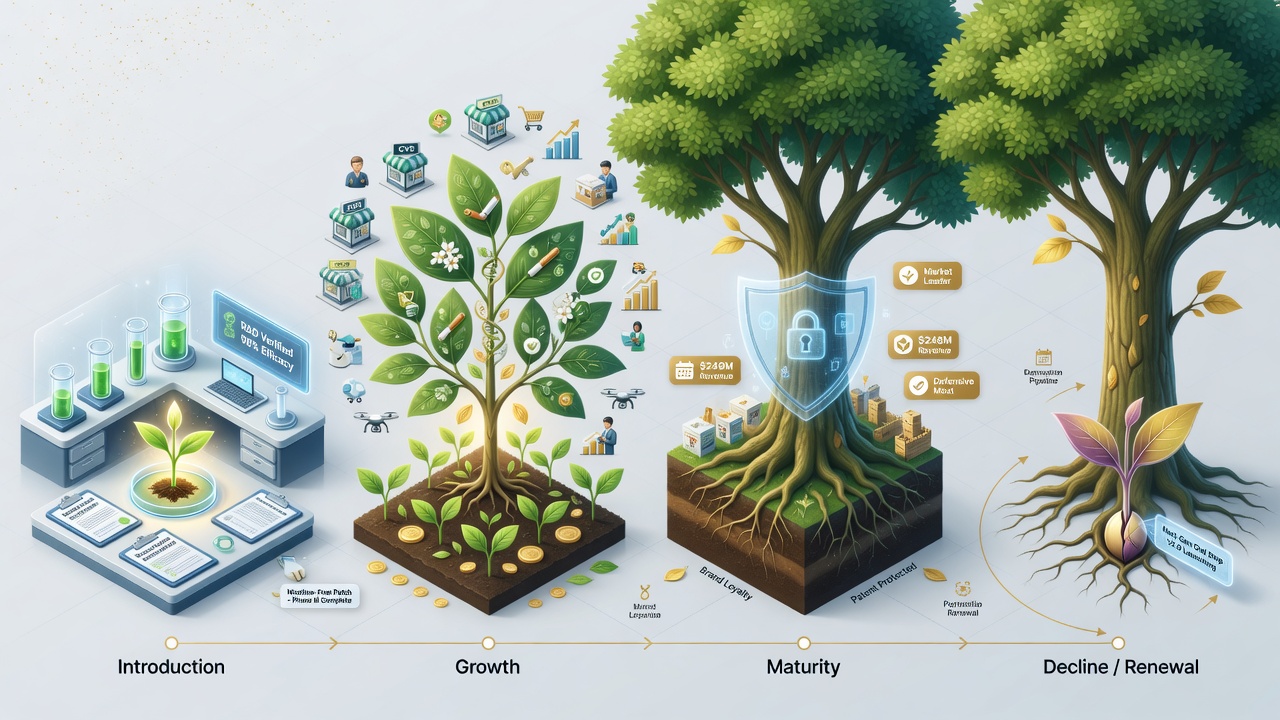
Introduction vs Growth Stage
Lose money to open the way, focus on building presence, core is speed and scale
Maturity vs Decline Stage
Defend profit fortress, focus on high-profit customers, transition to professional market or develop derivatives