The Decisive Role of Technical Parameter Control in the Tobacco Color-Fixing Stage on Color, Aroma, and Combustion Uniformity
In the long cycle of tobacco curing, if the "drying stage" is the physical labor that determines moisture removal efficiency, then the "color-fixing stage" is the artistic creation that determines the soul of the final product. Many novice curing technicians often mistakenly believe that color-fixing is merely about maintaining a constant high-temperature environment to let the leaves slowly turn yellow. This cognitivedeviation often becomes the root cause of large batches of tobacco leaves exhibiting dull color, weak aroma, and even uneven combustion.
In my more than twenty years of research on tobacco curing technology, I have witnessed countless heavy losses caused by improper parameter control during the color-fixing stage. The essence of the color-fixing stage is a complex biochemical transformation process involving the cessation of enzymatic reactions within the leaves, the Maillard reaction between sugars and amino acids at specific temperatures, and the physical setting of the cellulose structure. Controlling the temperature gradient, humidity fluctuations, and air circulation during this stage is essentially orchestrating a microscopic chemical reaction.
Core Parameters of the Color-Fixing Stage: More Than Just Temperature
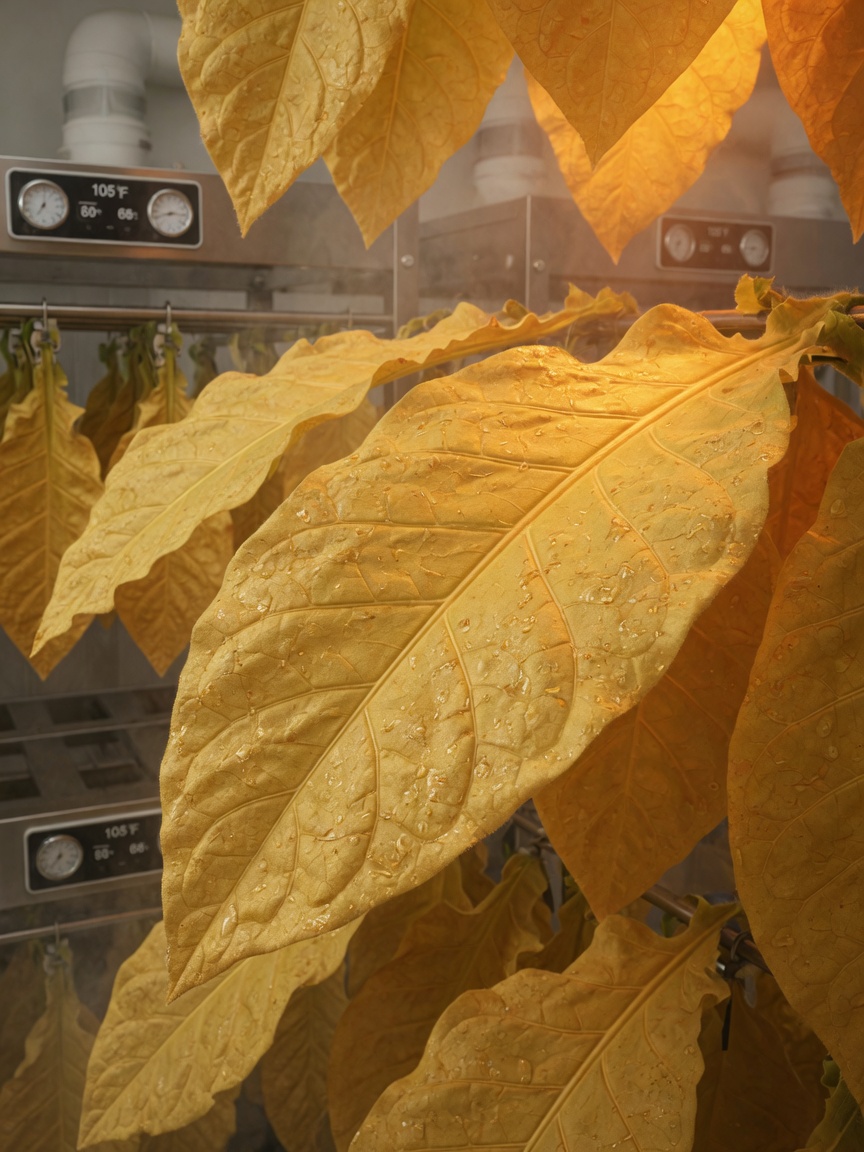
1. Precise Control of Temperature Gradient: The "Scale" That Determines Color
Temperature control during the color-fixing stage is not about being "high," but about being "stable" and having the right "gradient." Before entering the color-fixing stage, the leaves have already completed most of their moisture removal, making the cellular structure fragile and heat-sensitive.
If we apply a high-temperature shock directly during the color-fixing stage, it will cause drastic changes in the thermodynamic properties of the leaf surface. From a microscopic perspective, excessively high instantaneous temperatures cause an abnormal surge in polyphenol oxidase activity in the leaf surface, followed by rapid inactivation due to overheating. Thisout-of-control reaction causes the leaf color to display an unnatural "scorched black" or "dark brown" rather than the desired "golden yellow" or "bright yellow."
Truly high-level control should follow an extremely precise temperature curve. We need to design a gentle rising curve based on the sugar content and leaf thickness of different tobacco varieties. For example, in the early color-fixing stage, the temperature should be maintained between 55°C – 60°C, using relatively low temperatures to induce slow enzymatic reactions, allowing the color to transition smoothly frombluish-green to light yellow. Then, at a rate not exceeding 2°C – 3°C per hour, slowly raise to the final color-fixing temperature (typically between 65°C – 70°C). This "stepped" heating gives the chemical substances inside the leaves time to reorganize, ensuring color uniformity.
2. Humidity Control: Preventing "Structural Disaster"
Humidity is the "lubricant" of the color-fixing stage and the most easily overlooked variable. During the color-fixing process, the moisture content of the leaves should be maintained within an extremely narrow range.
If humidity control is too high, the steam pressure inside the leaves cannot be discharged in time, causing the leaf tissue to become "soft and collapsed." This not only affects subsequent stripping but, more seriously, excessive humidity hinders the Maillard reaction, causing the color to become lighter and paler, and may even result in "green" color that cannot be fully eliminated.
Conversely, if humidity control is too low — the so-called "dry burning" — the surface moisture of the leaves will be lost too quickly, forming a hard "dry shell." This dry shell obstructs the migration of deep internal moisture and volatile substances within the leaf, leading to a "wet inside, dry outside" phenomenon. This structural imbalance is the direct cause of uneven combustion: during burning, the surface layer carbonizes rapidly while the inner layer still retains residual moisture, producing large amounts of irritating smoke and an unstable combustion state.
3. Ventilation and Air Circulation: The Medium for Heat and Material Exchange
Many curing barns excessively reduce ventilation during the color-fixing stage to preserve heat, which is a major misconception.
The color-fixing stage involves not only heat exchange but also the exchange of volatile substances (such as esters and aldehydes) with the outside air. If air circulation is poor,localized heat accumulation and high concentrations of chemical substances inside the curing barn will directly interfere with leaf metabolism. Good ventilation not only ensures uniform heat distribution, preventing "local overheating," but also uses air flow to carry away certain unfavorable metabolic byproducts produced during the color-fixing process, thereby creating a relatively pure chemical environment for aroma formation.
The Decisive Effect of Parameters on Quality: From Micro-Chemistry to Macro-Sensory
If parameter control is the means, then color, aroma, and combustion performance are the final "exam papers." As technicians, we must understand how parameter variations cross the microscopic molecular level and ultimately manifest in the sensory indicators of the tobacco leaves.
1. The "Chemical Scale" of Color: Maillard Reaction and Pigment Degradation
The formation of tobacco leaf color is essentially a precise game concerning pigment degradation and sugar reactions. During the color-fixing stage, chlorophyll in the leaves begins to degrade — the first step in the transition frombluish-green to yellow. However, the depth and hue of the color (whethertending toward golden yellow or dark brown) depend entirely on the extent of the Maillard reaction.
The Maillard reaction is a non-enzymatic reaction between reducing sugars and amino acids under heating conditions. During the color-fixing stage, minor temperature fluctuations exponentially affect the reaction rate. If temperature is properly controlled, the reaction proceeds slowly and uniformly, producing moderate amounts of melanoidins that give the tobacco leaves a bright golden-yellowcoloring. But if the temperature curve has abnormal spikes, the reaction rapidlyout-of-control, leading to excessive browning, making the leaf color heavy, murky, and lacking that transparent quality. This "overdone" color gives a sensory impression of staleness and lack of freshness.
2. The "Balancing Art" of Aroma: Ester Synthesis and Off-Flavor Suppression
Aroma is the most elusive aspect of tobacco leaves and the one most dependent on the color-fixing process. An excellent color-fixing process must promote the transformation of aroma precursor substances while suppressing the production of harmful compounds.
Under ideal temperature and humidity conditions, enzymatic reactions within the leaves guide the conversion of sugars into various aromatic ester compounds. These esters are the core source of tobacco aroma. If we can maintain the osmotic pressure balance inside the leaf cells through precise humidity control, we can maximally protect these volatile aroma components.
Conversely, if humidity during the color-fixing stage is too high or ventilation insufficient, anaerobic metabolism occurs inside the leaves, leading to a large accumulation of volatile acids andcertain unpleasant aldehydes. This not only masks thethe expected aroma but also produces off-flavors similar to "moldiness" or "raw green smell." For high-end tobacco leaves, such aroma "defects" are fatal, directly reducing the commercial value of the product.
3. The "Physical Foundation" of Combustion: Setting of Cell Structure
Many people think combustion uniformity is merely a physical issue, but during the color-fixing stage, it is actually a biochemical problem. The temperature and moisture loss rate during the color-fixing stage determine the hardness and integrity of the leaf cell walls.
If moisture removal during the color-fixing process is too drastic, the cell walls undergouneven contraction and rupture, forming micro-cracks. This micro-structural discontinuity causes flamedancing and fluctuations in burning rate during combustion. Additionally, uneven moisture distribution leads to differences in heat transfer during burning. A perfectly cured tobacco leaf has a highly uniform and stable internal structure, ensuring that when lit, the smoke is released smoothly and persistently withoutirregular fluctuations.
"Pitfalls" in Practice: Bloody Lessons
InIn long-term production practice, I havesummarized two verytypical failure cases that still serve as cautionary examples when training new employees.
Case 1: The Scorching Disaster Caused by "Flash Heat"
It was the autumn of 2017. A tobacco factory was processing a batch of high-sugar premium tobacco leaves. Due to a transientmalfunction in a temperature control sensor in the curing barn, amassive "step" appeared in the temperature curve during the early color-fixing stage.
The process that should have been slowly heating suddenly sawlocalized temperatures spike from 58°C to 82°C in just 15 minutes. Since this batch of tobacco leaves had extremely high sugar content, this high temperature directly triggeredviolent caramelization.
The result was devastating: the entire batch displayed extremely uneven dark brown surfaces, withscorched black spots even appearing on some leaf edges. In sensory evaluation, this batch was judged as "dark color, bitter taste," completely losing its original delicate aroma. The lesson from this incident is: Temperature control during the color-fixing stage cannot tolerate any "sudden attacks." Any sensorabnormal or reckless operation will, under the catalysis of the Maillard reaction, turn into a quality disaster.
Case 2: "Aroma Loss" Caused by Humidity Imbalance
Another case occurred during acontinuous rainy season. The ventilation system of the workshop experienced efficiency degradation during the mid-color-fixing stage, causing the relative humidity inside the curing barn to remain above 75% for an extended period, unable to drop to the ideal range.
Due to the excessive humidity, the chemical transformation inside the leaves was "dragged down." Moisture could not be effectively discharged through the intercellular spaces, preventing the timely volatilization of metabolic byproducts inside the leaves and also inhibiting ester formation.
In the end, although the color of this batch looked relatively uniform, itsuffered a disastrous sensory evaluation for aroma. The smoke was very "flat," lacking layering, and even carried a lingering "raw green odor." More seriously, due to the moisture-affected cell structure, the tobacco leaves exhibited extremely poor combustion uniformity in subsequentfinished product processing. This case tells us: Humidity control is not for "moisture retention," but for "metabolic balance."
Deep Reflection: The Leap from "Experience-Driven" to "Data-Driven"
Looking back on my twenty-year career, Ideeply feel that that curing technology is undergoing a transformation.
In the past, we relied on the noses of "old smokers" and the feel of "old masters." We judged temperature by observing leaf color changes and decided on ventilation by smelling the smoke. This empiricism was somewhat effective, but when facing modern high-standard, large-scale industrial production, it proves toocrude and uncontrollable.
The current trend is "data-driven." Precision sensors, real-time monitoring of temperature-humidity curves, and prediction algorithms based on big data models are gradually replacingvague sensations. But I also want to remind the younger generation of technicians: Data is cold, but tobacco leaves are alive.
Don't blindly worship the numbers on the dashboard; instead, understand the physicochemical meaning behind the numbers. When you see the temperature rise by 2°C, your mind should not only register a number but should visualize the dynamic process of intensified Maillard reaction in the leaves, cell wall moisture loss, and changes in ester synthesis.
Only by combining this reverence for the underlying laws with modern precision controlmethods can we truly master this art of "fire and leaf."
Conclusion
The color-fixing stage is not the end of the curing process but the starting point of qualityelevation. It requires us not only to have absolute control over heat but also to have a deep insight into the laws of chemical reactions. Every minute adjustment of parameters, every degree of temperature fluctuation, is redefining the soul of the tobacco leaf.
Parameter Control Comparison
Steady gradient heating (correct approach)
High-temperature shock (incorrect approach)