Where Should Tobacco Content Account Profits Be Prioritized?
**Key conclusions on the table:**
At 9 PM on June 18, 2024, in a 30-square-meter studio in Yuhang, Hangzhou. I spread the month's distributable profit across Excel: after deducting ad spend, outsourced editing, WeChat payment fees, and refunds, the book balance was **28,600 RMB**.
Three people at the table argued into three factions:
In the end, the money was split 4:3:3 — 11,000 for content upgrade, 9,000 for trial new hire budget, and 8,600 for new product sampling and first batch. Three months later in review: the content side brought **incremental gross profit of about 17,000 RMB** (after deducting reinvestment costs); the new hire side contributed nearly **−4,000 RMB** (salary + onboarding friction losses); the new product side had gross profit of **+3,000 RMB**, but still weighed down by 5,000 RMB in unsold inventory and overtime customer service costs.
After that, I set an iron rule for the account: **When there's profit, first ask "is the unit not making money, or is the unit making money but capacity is insufficient"; the former is not allowed to hire first, the latter is not allowed to recklessly open new SKUs.**
Below I'll explain "content upgrade / team expansion / new product development" in the order I actually stepped through them.
I. My Default Priority (Conditional, Not Inspirational Ranking)
| Diagnostic Signal (Last 30 Days) | Priority Investment | What to Defer |
|---|---|---|
| Views/reads are okay, but DM rate, consultation rate, conversion rate keep declining | **Content Upgrade** | Full-time hiring, new SKUs |
| Single content converts steadily, but you personally spend >15 hours/week on delivery, orders start slipping | **Team Expansion (freelance/outsource first)** | Large new product lines |
| Main product repurchase and negative reviews are controlled, users repeatedly ask "do you have ××" and you can quote and deliver with documentation | **New Product Development (small batch)** | Mass hiring |
| Profit relies mainly on accidental viral hits, volatility >50% | **Content Upgrade + Topic Assetization** | Any fixed labor costs |
| Compliance reviews are frequent, content repeatedly taken down | **Content Compliance & Script Upgrade** | Stockpiling new products |
The startup circle often talks about "reinvesting profits first into the highest-leverage, verifiable-recovery link." For tobacco content accounts, the highest leverage is usually **squeezing more conversions out of the same batch of traffic**, rather than filling up headcount and shelf space first. The logic of step-by-step expansion is similar: first have a repeatable profit unit, then scale; incubating service businesses as "company headcount" too early will lock up cash flow.
The default action I oppose is: **make money → hire → open matrix → roll out SKUs.** That's using profits to buy the feeling of "looking like a business."
II. Content Upgrade: Why It Should Usually Come First
1. What Content Upgrade Actually Buys
It's not buying a more expensive microphone, nor the mysticism of "being better at writing titles." The content upgrade I define, sorted by recovery speed:
In November 2023 in Nanshan, Shenzhen, I helped review an oral health account: monthly profit was about **12,000 RMB**, and the owner wanted to spend 8,000 on a camera kit. I had him deconstruct the last 20 pieces of content that brought DMs — **pieces without a "self-checkable specific symptom" in the first 3 seconds had an average DM rate about 40% lower.** Later, with **3,500 RMB**, we did three things: hired someone to break down the high-conversion script into 12 modules; filmed 8 comparison clips of "smoke stains/gums/quit day N"; unified the DM auto-reply question tiers. At T+45 days, monthly consultations went from about 90 to 140, conversion rate didn't drop, and the incremental gross profit covered that 3,500 with room to spare.
The camera came later. **Lens clarity doesn't solve "why the user should click on you."**
2. My Own "Content Reinvestment" Ledger
In August 2024, the main account posted 5 times a week, with monthly distributable profit of about **31,000 RMB**. I mandated locking **35% of the month's profit (about 10,800 RMB)** into the content upgrade pool, roughly itemized as:
| Item | Amount | Acceptance Criteria (30 days) |
|---|---|---|
| High-conversion script deconstruction + 15 new templates | 2,800 | DM rate ≥ 1.2x old average |
| 2 "search-oriented" long-tail columns (quit smoking oral timeline, etc.) | 3,200 | Natural inbound proportion increases |
| Cover/title batch testing (including small-scale heating) | 1,800 | Find 2 reusable openings |
| Compliance wording & risk-word replacement template | 1,500 | Takedown/restriction frequency decreases |
| Flexible reserve | 1,500 | — |
Not every item hit. In the heating experiment, **600 RMB** was almost wasted — the topic chosen was a story-oriented piece with "strong emotional resonance, weak purchase intent." But the two search-oriented pieces combined brought about **23 effective consultations** across video accounts + private domain, of which 7 closed (order values 299–899 RMB), with gross profit roughly **2,200+**, plus tail inbound over the next 60 days. More valuable was the template: in September I reused the same structure, and the marginal cost was close to just the editing fee.
**The profit logic of content upgrade is: amortize one-time production cost across multiple reuses.** Team salaries can't be amortized across "reuse"; they evaporate by the natural month.
3. Pitfalls of Content Upgrade
In public discussions, health/cessation social media interventions have always emphasized interaction quality and information credibility, not mere exposure. If you use profits to buy traffic but not to buy "credible structure," you're working for the platform.
III. Team Expansion: It's Expensive, and Expensive in Its "Irreversibility"
1. When Is It Time to Hire?
I only allow profits to go into "headcount or quasi-headcount" when all four conditions are met simultaneously:
In March 2024 in Hangzhou, I prematurely hired an "operations assistant" with a monthly total cost of about **7.5k–8.5k RMB** (including probation communication costs). The content conversion wasn't stable at the time, and the assistant's daily routine became: changing titles, monitoring the dashboard, going back and forth to clarify my unclear requirements. Two months later, the number of content pieces had increased, but **effective consultations had barely budged**, and I had an extra 40 minutes of daily management tax. When settling after departure, I roughly calculated the sunk cost: **salary + my management time converted + rework, easily over 20,000 RMB**, and the output was a bunch of spreadsheets that "looked like things were running."
That lesson, written in one sentence: **Hiring when conversion rate hasn't been validated is paying a salary to noise.**
2. The Right Way to Buy Team Capacity
For early-stage tobacco content accounts, a more reasonable "human efficiency purchase" is usually:
| Role | Recommended Form | Share of Profit I'd Pay (Monthly) | Acceptance |
|---|---|---|---|
| Editor | Per-piece outsourcing | 10%–18% of profit | 48-hour delivery, ≤2 rounds of revision |
| Cover designer | Package pricing | 3%–6% | CTR/clicks don't decline |
| Private domain CS | Night part-time + script library | 8%–15% | Connection rate, clear effective consultation definition |
| Full-time operator | **Last resort** | Fixed cost > 25% of recent 3-month avg profit is dangerous | Can independently do weekly reviews of "what to stop, what to add" |
Someone in the industry summarized when doing matrix: account expansion often comes with content capability expansion, which is harder than "registering a few more accounts." If you haven't turned a single account's content into an asset yet, hiring to roll out a matrix is just copying one person's chaos into three people's chaos.
3. The Interlock Between Team and Content
At a weekly meeting in January 2025, I set a rule: any full-time HC must come with an estimate of "how much verifiable gross profit would this quarter lose if we don't hire"; if you can't write it down, postpone. Sounds harsh, but it loses less money than "hire first and see."
IV. New Product Development: It's Like a Profit Amplifier, Also Like a Cash Flow Shredder
1. When Is a New Product Worth Launching?
I require a new product proposal to hit at least **3 of these**:
In September 2024, we tried a "low-price traffic-driving consumable." Sampling + first batch was about **8,600 RMB**. The first two weeks, content-driven sales were okay; from week three, customer service got entangled by "usage expectations" — users interpreted it as something that "works faster," and we could only do compliant auxiliary information expression. Returns and explanation costs shaved off a big chunk of gross profit. In the end, the net contribution of this batch barely broke even, and **the time cost disrupted two weeks of topic planning in October.**
The hidden taxes of new product development in this track are:
So my attitude now is very clear: **New products are leverage after "trust and conversion are already running," not a ritual of "proving I'm progressing because I have money."**
2. Direct Comparison: New Product vs. Content Upgrade
For the same **10,000 RMB** in profit, I've tried both approaches:
| Approach | Common 30–60 Day Result | What You Lose When It Fails |
|---|---|---|
| 10K into content structure/templates/search-oriented | Conversion rate or natural inbound improves, assets reusable | Mostly production costs, no inventory |
| 10K into first new product batch | May lift AOV and GMV | Inventory, after-sales, content scheduling, team attention |
If your conversion rate still "runs on luck," launching a new product is like adding water to a leaking bucket. Common business discussions also remind: once revenue starts appearing, reinvestment should lean toward "product improvement and verifiable small-scale growth experiments," not jumping straight to heavy assets. For content accounts, "product improvement" is first **the content product and the delivery product**, and only second the second and third physical items on the shelf.
3. The New Product Rhythm I Endorse
V. How to Rank the Three: My Practical Decision Tree
Reduce the question to one sentence:
**First ask: is it "can't sell," or "can sell but can't keep up," or "can sell and keep up but the product range is too narrow"?**
Profit arrives
│
├─ Conversion/consultation rate weak, or volatile, relying on viral hits ──────────► Content Upgrade (First Priority)
│
├─ Conversion stable, but your weekly delivery/editing/private domain > threshold ─► Outsource/freelance expansion (Second)
│         └─ SOP runs 4–6 weeks ──────────────────────────────► Then consider quasi-full-time
│
└─ Main product stable, demand clear, capital redundant ────────► New product small batch (Third)
└─ Sales and after-sales meet standards ─────► Then add inventory and headcount
Reference Split of Monthly Distributable Profit (Small to Medium Accounts)
This is the "default plate" I used from H2 2024 to early 2025, adjustable by stage:
| Bucket | Suggested % | Notes |
|---|---|---|
| Cash safety cushion | First fill to 2–3 months fixed expenses | Don't talk expansion before this is filled |
| Content upgrade | 25%–40% | Scripts, testing, compliance, necessary equipment |
| Growth experiments (small distribution/cooperation) | 10%–20% | Must set stop-loss |
| Labor (outsource first) | 15%–30% | Strict on fixed headcount |
| New products | 0%–20% | No signal = 0 |
| Owner discretionary/learning | Remainder | Don't bet 100% of profit into business ego |
In early stages, if the goal is to polish the unit, **content + small distribution** often has more leverage than stacking team — this aligns with the practical experience of "reinvest first in marketing and verifiable growth," except for tobacco content accounts, "marketing" is first of all the content itself.
VI. Three Real Slices (For Your Reference)
Slice A: Hired When Shouldn't Have (March 2024, Hangzhou)
Slice B: Upgraded Content When Should Have Opened New Product (Sept 2024, Yuhang warehouse + studio)
Slice C: Got the Order Right (Aug–Oct 2024)
I'm not against teams, nor against new products. I'm against **using profits to buy placebo for anxiety**: hiring proves "I'm growing," launching new products proves "I have supply chain," only refusing to admit that "the content still isn't good enough to sell."
VII. 7-Day Self-Check: Which Bucket Should This Week's Profit Go Into
**Day 1**: Calculate "distributable profit" — don't use GMV. Deduct refunds, platform fees, goods, outsourcing, your own hourly delivery cost.
**Day 2**: Pull the last 30 days of content, mark the proportion of pieces that "brought effective consultations." Below 20%, content upgrade is priority, stop hiring discussions.
**Day 3**: Count your personal hours on editing/CS/delivery. Two consecutive weeks >15 hours/week and methods already documented, then start outsourcing.
**Day 4**: Put user verbatim demands into a table. Similar demands <10 times/month, new product budget = 0.
**Day 5**: Write "30-day recovery targets" for each of the three directions; if you can't write numbers for a direction, it's not allowed to spend money.
**Day 6**: Make a draft of the month's reinvestment plan using this article's split table, find someone who understands numbers to pick it apart.
**Day 7**: Approve only one main direction to use the big budget; the other two get at most small experiments that won't hurt the bones.
Final Position
Profits from tobacco content accounts should **first go to improving "per-traffic conversion efficiency" and "reusable content assets"** — for most small to medium stages, that's **content upgrade** (including structure, topic library, compliant expression, verifiable small distribution), not headcount, not warehouse.
**Team expansion** is a second-stage tool: used to copy already-validated actions, not to find actions.
**New product development** is a third-stage lever: used to expand AOV and fulfillment mix, provided that the main linkage isn't leaking.
If you can only remember one sentence:
**First make one piece of content stably earn money, then let more people and more products amplify it; reverse it, and profits turn into payroll and inventory sheets — the books look busy, the pockets are empty.**
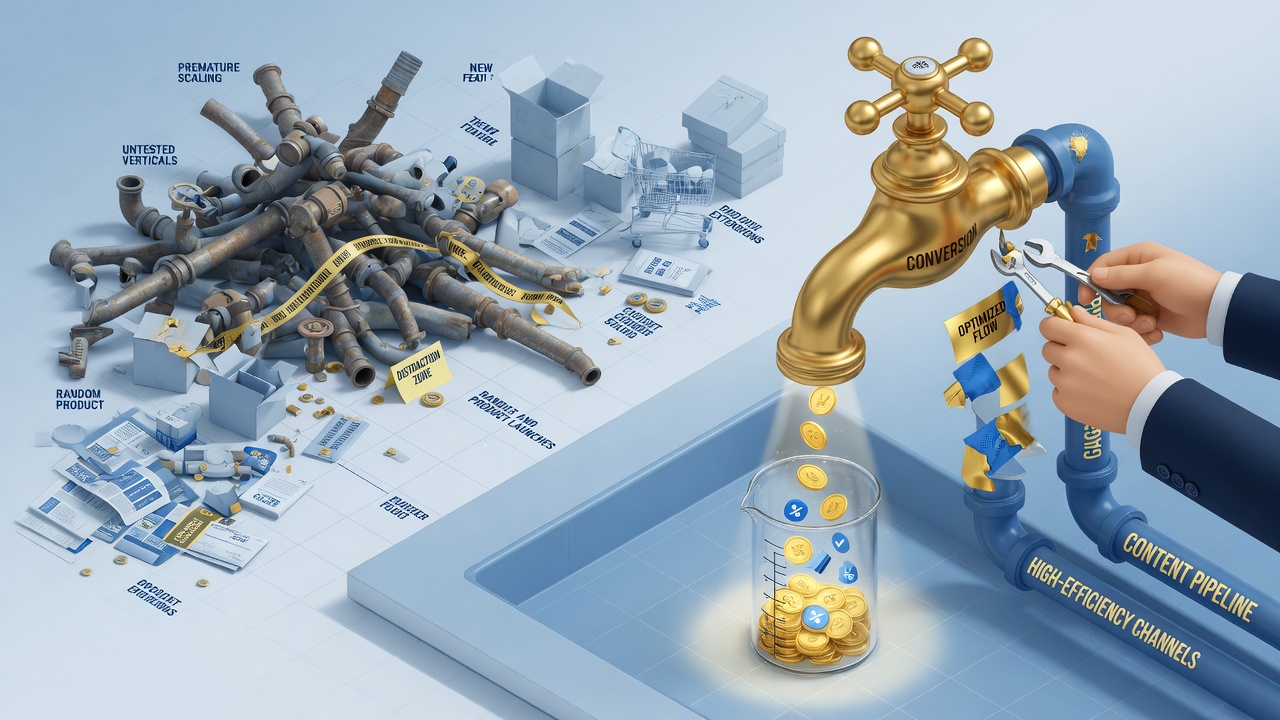
Next time profit hits your account, don't ask "shouldn't we look more like a company?" First ask: "Am I fixing the faucet, or am I connecting more pipes to a leaking house?"
Content Upgrade 10K
Conversion rate or natural inbound improves, assets reusable, no inventory risk
New Product First Batch 10K
May lift AOV and GMV, but with inventory, after-sales, and scheduling risks
* Data based on actual 2024 operational review. Adjust ratios per your stage.