Molding is not a "squeeze" but a precise physical interplay of pressure, time, and humidity.
Cigar Molding: The Precise Interplay of Pressure, Time, and Humidity
Too much or too little pressure leaves hidden risks: low pressure springs back, high pressure cracks the leaves.
Humidity determines the plasticity of the leaves; 70%–75% is the best range from experience.
Time "freezes" the shape; 24–72 hours is the standard resting period.
Only when the three converge can a firm yet breathable burn channel be built.
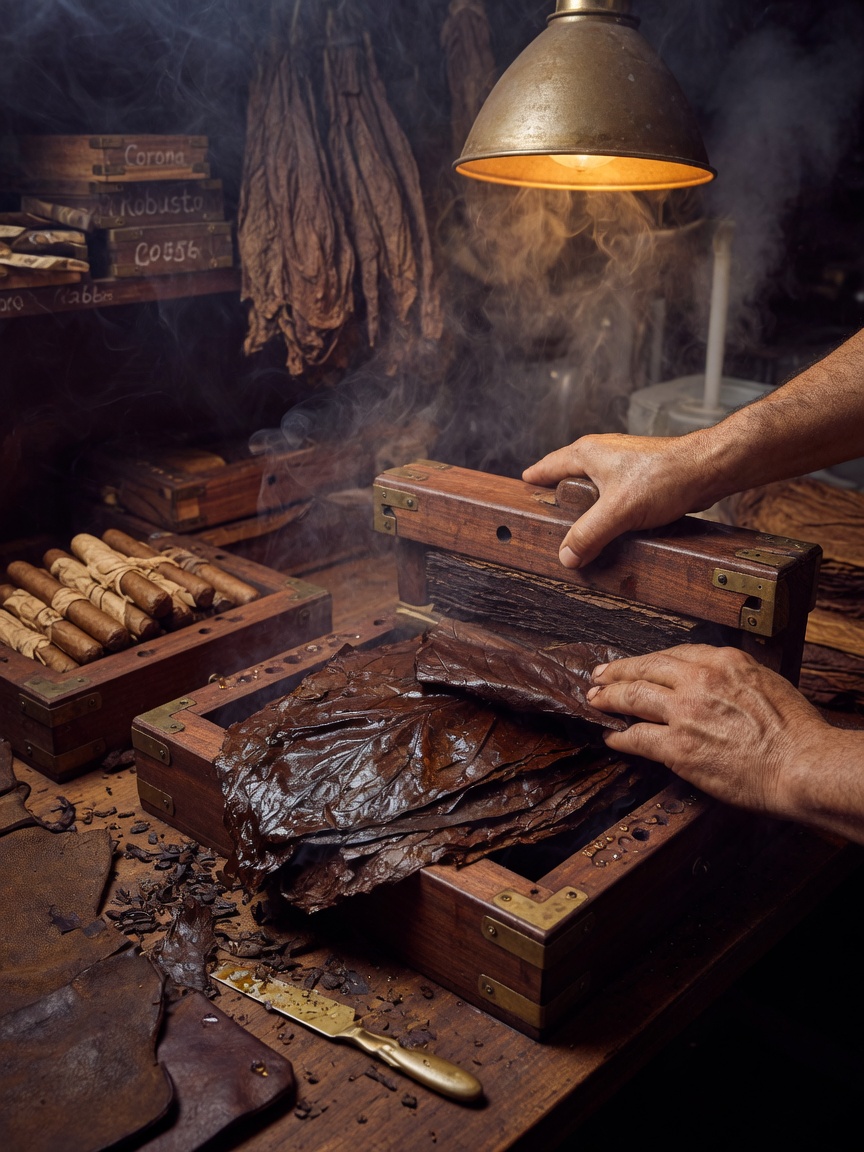
In a sweltering molding workshop in Estelí, I once witnessed a batch of premium cigars worth tens of thousands of dollars "deform" inside the molds because of a tiny fluctuation in humidity. For cigar manufacturing, molding is by no means a simple "squeeze"—it is a precise physical interplay of pressure, time, and humidity. If rolling gives a cigar its soul, then molding gives it its skeleton.
Pressure: More Than Just Shaping the Form
Many people mistakenly believe that the more pressure applied during molding, the more regular the cigar will be. This is an extremely dangerous misconception.
In my experience, the core goal of molding is to make the tobacco leaves, constrained by the mold, reach a preset ring gauge and compactness through physical compression. The ideal pressure range usually needs to be adjusted dynamically according to the moisture content of the leaves, but a common reference value is: with the mold closed, apply roughly 15-25 PSI of pressure.
If the pressure is too low (below 10 PSI), the cigar will "spring back" during the drying process, causing the ring gauge to shrink. The final product looks loose and weak, and is highly prone to "hollow" burn tunnels during combustion. Conversely, if the pressure exceeds 35 PSI, especially with young leaves that have high moisture content, excessive mechanical stress will directly damage the microscopic structure of the leaf fibers, producing visible cracks, and may even compact the tobacco tissue so much that it causes what is called a "plugged burn"—the smoke cannot pass through, and combustion becomes extremely difficult.
Humidity: The "Lubricant" That Determines Elasticity
If pressure is the "force," then humidity is the "measure." Humidity determines the plasticity of the tobacco leaves.
During molding, the ambient relative humidity (RH) must remain stable within 70% - 75%. This is the value of experience. When humidity stays in this range, the leaves exhibit perfect elasticity: they conform to the shape of the mold and hold their form after the pressure is released.
I remember one summer in 2022, when a failure in the air-conditioning system sent the workshop humidity down to 62%. We were molding a batch of large-format cigars at the time. Because the humidity was too low, the leaves lost their flexibility and became fragile and "brittle." When we tried to add more pressure to maintain the shape, the result was disastrous: the leaves were not compacted—they simply shattered. Even if the shape was later restored by re-humidifying, the internal burn channel of the cigar had already been broken apart by the fractured fibers, making even combustion impossible.
Time: The Process That "Freezes" the Shape
Molding is not completed in an instant; it is a long process of physical settling.
The molding time depends on the maturity of the tobacco leaves and the stability of the environment. For a standard process, the leaves typically need to rest in the mold for 24 to 72 hours. During this period, moisture migrates microscopically between the leaf layers, and pressure is transmitted layer by layer, until every leaf finally "remembers" the shape of the mold.
If the time is insufficient (for example, demolding after only 12 hours), the internal tension of the leaves has not been fully released. Once removed from the mold, due to the "elastic memory" effect, the cigar will expand rapidly, resulting in an uneven ring gauge. I once tried to shorten the cycle to improve efficiency, and the result was that the burn channel of that batch of cigars became extremely unstable: some places burned very fast, while others nearly went out.
The Convergence of the Three: Building the Perfect Burn Channel
The perfect burn channel is the product of an agreement among pressure, time, and humidity.
A successful molding process should produce an internal structure that is firm yet breathable. Pressure ensures compactness, time ensures the stability of the shape, and humidity ensures the integrity of the fibers.
When these three parameters fit together perfectly, the tobacco fibers form a uniform structure with micropores. This structure allows air to flow steadily through the gaps between the leaves during combustion, ensuring that the smoke passes through the entire cigar smoothly and continuously. This determines not only the speed of combustion, but also the concentration and layering of the smoke in the mouth.
As a practitioner, I have always held to one principle: better slow than chaotic. When it comes to molding, any "efficiency gain" that tries to challenge the laws of physics will ultimately pay a heavy price in the cigar's burning performance.
Harm of too little pressure
Spring-back shrinks the ring gauge, the product looks loose, hollow tunnels form, and smoke is uneven.
Harm of too much pressure
The microscopic fiber structure is damaged, cracks appear; the tissue becomes too compact, causing a plugged burn that barely combusts.