Core Technical Parameter Differences Among Burley, Oriental, Flue-Cured and Sun/Air-Cured Tobacco in Cultivation and Processing
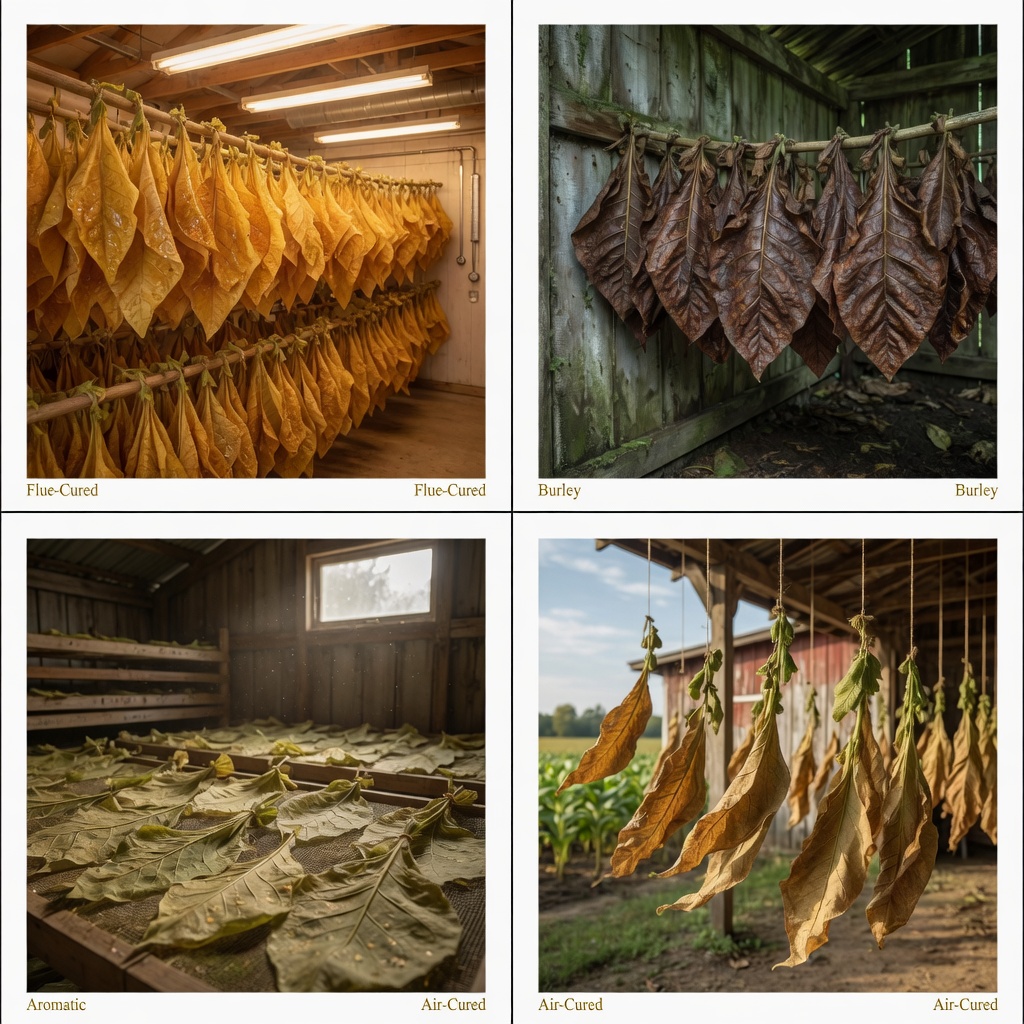
1. Understanding Four Technical Routes from "Tobacco as It Grows"
Start from “tobacco as it grows” to clarify the technical route of each of the four types
In tobacco production practice, burley, oriental, flue-cured and sun/air-cured tobaccos are not simply different varieties — they represent four entirely different systems of material formation.
Flue-cured tobacco pursues sugar accumulation, aroma balance and stable combustion; burley emphasizes high nitrogen, high nicotine and smoking-body support; oriental tobacco centers on the accumulation of aroma precursors; sun/air-cured tobacco relies more on natural curing to develop its distinctive style.
Public studies show that different tobacco types differ markedly in nicotine, sugar and volatile components — for example, burley generally shows higher nicotine and total nitrogen, sun-cured yellow tobacco shows higher total and reducing sugars, while flue-cured tobacco is relatively balanced in chemical composition.
2. Core Parameter Comparison at the Cultivation Stage
Four core cultivation parameters compared: plant spacing, row spacing, plants per mu, leaves kept and nitrogen demand
| Item | Flue-cured | Burley | Oriental | Sun/Air-cured |
|---|---|---|---|---|
| Plant spacing | 45-55 cm | 50-60 cm | 35-45 cm | 50-70 cm |
| Row spacing | 110-120 cm | 110-130 cm | 80-100 cm | 100-130 cm |
| Plants per mu | 1000-1200 | 900-1100 | 1200-1600 | 800-1200 |
| Leaves kept | 18-22 | 20-24 | 12-18 | 15-25 |
| Nitrogen demand | Medium | High | Low to medium | Varies by variety |
From my experience, the biggest problem for many growers is not knowing how to grow, but failing to understand that the targets differ.
For example, if flue-cured tobacco is planted too densely, the leaves become thinner and sugar content drops; but if oriental tobacco is managed at flue-cured density, the aroma concentration may actually decline.
3. Topping Height and Leaf-Keeping Strategy Differences
How topping height and leaf count shape the chemical direction of the leaf
Topping is a key node that determines the chemical composition of the leaf.
Flue-cured tobacco is usually topped around the budding stage to control plant height and leaf area, giving the middle and upper leaves sufficient nutrition.
Typical parameters:
- Flue-cured: keep 18-22 leaves
- Burley: keep 20-24 leaves
- Oriental: keep 12-18 leaves
- Sun/Air-cured: adjusted according to use
Because burley needs higher nicotine and a stronger body, nitrogen cannot be over-controlled as with flue-cured tobacco, or it loses its own value. Relevant process research also uses 20-24 leaves as the quality-control parameter for burley.
4. Differences in Processing and Curing Technology
Four curing routes: precise human control for flue-cured, air-curing and aging for burley, low-temperature slow curing for oriental, and environmental dependence for sun/air-cured
4.1 Flue-cured: Precision Human Control
Flue-cured tobacco is cured in a closed barn.
Typical process:
Yellowing stage: temperature 35-38℃, humidity 85%-95%, duration 36-60 hours
Leaf-drying stage: temperature 38-48℃, humidity gradually decreasing
Stem-drying stage: temperature 65-70℃
Flue-cured tobacco fears two problems most:
First, too-rapid temperature rise causes green veins; second, too-fast humidity drop loses aroma substances.
In actual production, many so-called "premium leaf" failures are not because the field was bad, but because temperature and humidity changed too sharply within 2-3 hours during the leaf-drying stage.
4.2 Burley: Emphasis on Air-Curing and Aging
Burley is usually air-cured naturally in a barn.
Characteristics:
- Relatively high humidity in the early stage
- Controlled slow moisture loss of the leaves
- Extended conversion time for nitrogen compounds
After maturation, burley has higher nicotine and total nitrogen and lower sugar, so processing focuses more on reducing harshness and improving aroma.
4.3 Oriental: Low-Temperature Slow Curing for Aroma
Oriental tobacco emphasizes:
- Thin leaves
- Abundant aroma precursors
- Preservation of volatile substances
It is usually processed with:
- A 30-40℃ environment
- Long, slow drying
- Avoiding high temperature that destroys aromatic substances
Oriental tobacco does not chase "big strength" but aroma layering.
4.4 Sun/Air-Cured: Relying on the Environment to Complete Conversion
Sun/air-cured tobacco is clearly affected by:
- Temperature
- Wind speed
- Sunlight
- Humidity
The same variety cured in Yunnan and in Shandong may end up with completely different styles.
5. Final Chemical Composition Differences
Final chemical differences: nicotine, total sugar, total nitrogen and typical traits
| Type | Nicotine | Total sugar | Total nitrogen | Main feature |
|---|---|---|---|---|
| Flue-cured | 1.5%-3.5% | 15%-25% | Medium | Sugar-nicotine balance |
| Burley | Above 3%-5% | Low | High | Strong body, strong flavor absorption |
| Oriental | 1%-3% | Medium | Medium | Prominent aroma |
| Sun/Air-cured | Highly variable | Low-medium to medium | Highly variable | Special style |
Different studies show that burley has markedly higher nicotine and total nitrogen, while flue-cured and oriental tobacco have richer volatile components.
Flue-cured route: sugar-nicotine balance
Medium nitrogen, 18-22 leaves kept; soft smoke and stable combustion — the base layer of a cigarette blend
Burley route: high nitrogen, high nicotine
20-24 leaves kept, nitrogen cannot be over-controlled; strong body and pronounced support, but harshness is harder to control
6. Impact on Combustion Performance
Combustion behavior depends on sugar-nicotine ratio, leaf thickness, fiber structure and mineral proportions
The final combustion performance of the leaf essentially depends on:
1. Sugar-nicotine ratio
2. Leaf thickness
3. Fiber structure
4. Mineral proportions
5. Moisture-loss state during processing
Because flue-cured tobacco has higher sugar, its smoke is usually softer.
Because burley has high nicotine and nitrogen compounds, it delivers noticeable strength when burned, but harshness is harder to control.
Oriental tobacco's combustion contribution comes mainly from aroma substances.
Sun/air-cured tobacco depends on the special style formed by the curing environment.
7. My Practical Judgment: Future Processing Value Lies in Parameter Combinations, Not a Single Variety
Future processing value lies in parameter-combination management, not a single variety
In the past, many believed "a good cigarette is a good variety," but in actual production, what determines quality is a whole set of parameters.
With the same burley variety:
- Nitrogen fertilizer increased by 10%
- Two more leaves kept
- Curing time extended by 7 days
The final nicotine, harshness and aroma all change markedly.
I believe the real competition in modern tobacco production is parameter-management capability.
Future top producers will not simply chase high yield; they will adjust the leaf through density, fertilizer, topping and temperature-humidity control to the position the cigarette formula requires.
There is no absolute superiority among the four types:
Flue-cured provides the base; burley provides strength; oriental provides aroma; sun/air-cured provides style.
A truly mature processing system lets each type play to its own parameter advantages.
Citations: the parameters in this article are drawn from public research and industry sources (turn0search series)