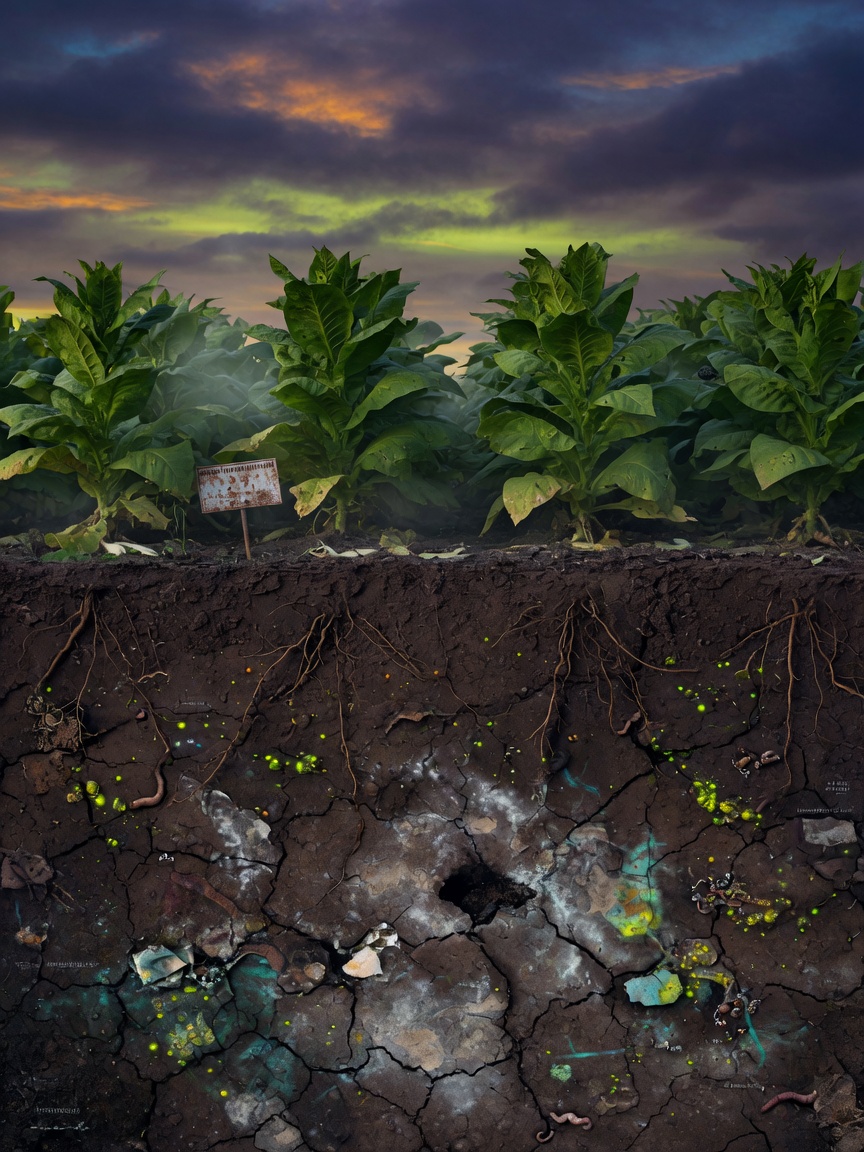
Long-Term Effects of Tobacco Cultivation on Soil: Nutrient Depletion, Acidification, and Heavy Metal Accumulation
In mid-July 2021, in a tobacco-growing township in southern Guizhou's Qiannan Prefecture, the rain had just stopped after three consecutive days of downpour. I went down to a sloping field where flue-cured tobacco had been continuously cropped for the fourth year, together with people from the local agrotechnical station. A handheld pH meter inserted into the 0–20 cm plough layer read between 4.9–5.2; an adjacent field under two-year rotation (tobacco–rapeseed–corn) mostly read 5.6–5.9 at the same depth. A farmer casually remarked: "The tobacco can still grow, it's just that it eats more fertilizer every year, and the lower leaves tend to yellow unevenly." That remark is more direct than any slogan — tobacco does not "cultivate the soil away"; rather, on a path of high input, high removal, and high acidification risk, it gradually wears down the soil's buffering capacity.
I. Setting the Boundaries Clearly First
- Soil problems ≠ a substitute narrative for smoke-related health issues. Soil acidification and rising cadmium availability concern the sustainability of producing areas and the safety boundaries of raw materials; the core health risk of smoking still comes from combustion and inhalation, and does not disappear just because "the soil is well managed."
- The trend is regional in scale, not a verdict on every individual field. Parent material, rainfall, irrigation water, phosphate fertilizer batches, and whether rotation is practiced can make two neighboring villages differ greatly. What follows uses directions that recur repeatedly in public surveys and cultivated-soil science.
- "Measured available nutrients are not low" can still be pathological. In continuously cropped fields it is common to see: the laboratory report shows phosphorus and potassium not low, even high, yet the tobacco plants absorb poorly, root systems are shallow, and leaf yellowing is disorderly — depletion sometimes appears as an empty warehouse, sometimes as a blocked pipeline with fertilizer still being poured in.
- Remediation technologies exist; their diffusion is another matter. Lime, biochar, green manure incorporation, and organic substitution work in trials; whether they can be sustained for five consecutive years under purchase-price and per-mu income pressure is the real constraint.
II. What This Crop Asks of the Soil
Flue-cured and air-cured tobaccos have several stable "appetites" in the field, which determine the direction long-term cultivation pushes the soil.
1. High Potassium Demand, Staged Nitrogen Needs, and High Harvest Removal
For tobacco leaves to have \"identity\" and combustibility, potassium is one of the key elements. From transplanting to the end of harvest, most nutrients leave the field with the leaves and stalks; if stalks are not returned to the field or composted back, it amounts to withdrawing a \"nutrient cash withdrawal\" from this layer of soil every year.
| Removal/consumption trait | Field meaning | Long-term soil consequence tendency |
|---|---|---|
| High potassium demand | Potassium occupies a large share in special fertilizers and topdressing; the soil potassium pool is drained first | Available potassium declines or depends on sustained high potassium input; cation balance is rewritten |
| Nitrogen must be \"enough but not excessive\" | Early vigorous growth, late nitrogen control to promote maturity | Over-application of ammonium nitrogen/urea → nitrification produces acid, lush overgrowth, shallow roots |
| Phosphorus often \"habitually basally applied\" | Compound fertilizer applied all at once | Available phosphorus accumulates; impurity metals in phosphate fertilizer accumulate year after year |
| Organic materials often insufficient | Organic fertilizer sources are tight and labor is expensive in tobacco areas | Organic matter and aggregates deteriorate; the capacity to buffer acid and immobilize metals weakens |
| Continuous-cropping preference | Suitable tobacco land is limited, orders are stable | Continuous-cropping obstacles, simplified microbial community structure, rising soil-borne disease and autotoxicity risk |
2. Roots and Rhizosphere: Not Just "Eating," but Also Reshaping the Environment
Tobacco roots secrete organic acids and other substances; under continuous cropping, this superimposes selective pressure on the soil biological community. In tobacco-planting soils with about four years of continuous cropping, many studies observe an overall downward pH trend, a shift in the stoichiometry of carbon–nitrogen–phosphorus-related microbes and enzymes, and deteriorating physical and chemical properties — "long-term effects" are not an abstract concept but a trajectory that can be measured within 3–5 growing seasons.
In my own sampling records I have repeatedly written the same type of note: surface soil becomes sticky or powdery when dry, earthworms are scarce, and the soil crusts easily after rain. These are not laboratory indicators, but they are the first "soil character" a farmer touches.
III. Nutrient Depletion: Not Just "Fertilizer Deficiency," but "Skewed Proportions"
1. Continuous Cropping Twists \"Balance\" into \"One-Sidedness\"
In long-term continuous-cropping trials and production-area monitoring, one high-frequency result is that tobacco plants' absorption capacity for nitrogen, phosphorus, and potassium declines with the number of continuous-cropping years. Some studies give an order-of-magnitude concept — nitrogen, phosphorus, and potassium uptake of continuously cropped tobacco plants can be greatly reduced compared with the first season (reductions differ across trials; some reports put the reduction in N, P, K uptake at roughly half or more of the magnitude). Behind the yield and quality fluctuations lie deteriorating root systems and rhizosphere environments — not merely some number on the soil test report dropping to zero.
What is even more twisted: available phosphorus and potassium in the soil sometimes do not decline monotonically; they can even rise due to years of fertilization, while utilization efficiency falls. Deng Yangchun and others, as well as subsequent conservation-oriented reviews, have pointed out similar phenomena — available nutrients \"pile up in the soil,\" yet the tobacco plants cannot access or use them well. So the farmer's instinctive reaction is \"add one more bag,\" and acidification, salinity, and ion antagonism worsen accordingly.
2. What a Real Fertilization Operation Looks Like (and Where the Problem Lies)
Take the common practice for flue-cured tobacco on southwestern mountain land as an example (formulas vary by region, but the logic is similar):
- 7–10 days before transplanting: ridging, basal application of special tobacco compound fertilizer (the common N-P₂O₅-K₂O ratio leans toward controlled nitrogen and increased potassium) plus some farmyard manure or commercial organic fertilizer.
- Rosette–vigorous growth stage: hole application or band application of topdressing, still mainly nitrogen and potassium.
- Around topping: nitrogen control depending on growth vigor; potassium may be supplemented again.
- After harvest: most tobacco stalks are removed from the field as fuel or waste; the proportion of green manure and straw returned to the field is unstable in contract tobacco areas.
A specific problem I encountered during interviews around Qujing in 2019:
- Farmers privately applied extra urea for \"nice color and vigorous growth,\" with the result that upper leaves stayed lush green, turning yellow (curing) became difficult, and the next season the soil pH was dragged down further along the ammonium-nitrogen pathway.
- In some years organic fertilizer supply was interrupted, and basal application relied almost entirely on chemical fertilizer, accelerating cation leaching in the rainy season.
- On poor sloping upper land, even after applying potassium fertilizer the leaves still showed \"burnt leaf margins and insufficient body\" — it is not that the fertilizer prescription was not written, but acidity, drought, and shallow roots combined so that potassium could not enter the plant's effective circulation.
3. The Three Faces of Depletion
| Type | Surface phenomenon | Soil substance |
|---|---|---|
| True depletion | Available potassium and some secondary/micronutrients stay persistently low | Removal > return, storage capacity shrinks |
| False abundance | Laboratory shows phosphorus and potassium not low, even high | Fertilizer accumulation + absorption barriers, apparent nutrients "idle" |
| Structural decline | Crusting, poor water retention, shallow roots | Organic matter and aggregates destroyed, harder to restore in one year than any single element |
When talking about "nutrient depletion caused by tobacco cultivation," if one only scolds that "growing tobacco eats up soil fertility," one misses the second face — high-input continuous cropping can equally manufacture a poverty of "fertile-but-not-fertile".
IV. Acidification: The Most Widespread, and Most Easily Masked by Fertilizer, Wound in Tobacco-Planting Soils
1. How Large a Share of Acidic Tobacco Fields in Public Data
In tobacco-planting-soil research, the second national soil survey and its related compilations are repeatedly cited: about 2.4% of China's tobacco-planting soils have a pH below 4.5, and about 18.6% fall between 4.5–5.5. On these strongly acidic to acidic soils, iron, aluminum, and heavy metal activity is high, root uptake is suppressed, and tobacco leaf quality and yield are both harder to stabilize.
Fertility evaluations in northern tobacco-planting areas such as Tieling, Liaoning, also state it plainly: maintaining aroma and yield requires inputs of multiple fertilizers, and nutrient imbalance and acidification are accompanying phenomena, not the slip of an occasional farmer.
On the four-year continuously cropped field I measured in Qiannan, the 4.9–5.2 reading fell exactly in that dangerous comfort zone of \"already acidic, but not yet extreme strong acidity\" — the tobacco can still be grown, so nobody is in a hurry to fix it, but a crack has already opened for aluminum toxicity and cadmium activity.
2. Where Does Acidification Come From (Mechanism Matters More Than Slogans)
- Physiologically acidic fertilizers and ammonium nitrogen: the nitrification of ammonium releases H⁺; a long-term nitrogen bias is one of the main engines of acidification in tobacco areas.
- Rhizosphere proton release after cation uptake by crops: high yields remove Ca²⁺, Mg²⁺, K⁺, etc., reducing soil base cations.
- Rainfall leaching: southern tobacco areas have high annual rainfall, and base cations are leached out of the root zone.
- Poor organic matter management: the buffering system weakens, and under the same acid input the pH falls faster.
- Continuous cropping: reduces the "breathing space" provided by legume green manures, rapeseed, etc. for acidity and structure.
Once acidification forms, it cascades:
| Chain link | What happens |
|---|---|
| Roots | Elongation inhibited, absorption area declines |
| Nutrients | Phosphorus fixation forms change; calcium, magnesium, potassium availability falls; molybdenum and others are affected |
| Toxic elements | Al³⁺ activity rises; available Cd and other heavy metals rise |
| Microbes | Bacterial activity often suppressed; fungal proportion and disease pattern change |
| Tobacco leaves | Uneven growth, disordered maturation, quality chemistry spectrum shifts; metal uptake risk rises |
3. Remediation Is Being Done, but Often as "Protecting the Current Season"
In acidic tobacco field trials, calcareous materials, dolomite powder, organic fertilizer, biochar, peptide fertilizers, and others have all been tried, with a very practical goal: raise the pH a little, rescue the root systems, stabilize yield and quality. The problem: lime must be even, moderate, and continuously monitored; overdose or uneven spreading causes localized over-alkalinity and new micronutrient problems. Under the rhythm of contract production, "secure this year's purchase" often outweighs "the five-year soil curve." So acidification is like a chronic disease — when it flares up you take medicine, but you keep living the same lifestyle in between.
V. Heavy Metals: Accumulate in the Soil, Become Active in Acidity, Head into the Tobacco Leaf
1. Why Cadmium Is Singled Out
Cadmium (Cd) is highly toxic and biologically mobile in soil, is hard to degrade, and accumulates. Tobacco has a strong ability to absorb cadmium and translocate it to the leaves — this means: on the same moderately polluted soil, tobacco is more likely than many crops to write cadmium into the harvestable parts. The metalloid arsenic, as well as chromium and lead, also have research chains showing detection in tobacco leaves, related to soil and agricultural-input sources.
The source is usually not a single \"tobacco farming created the cadmium,\" but rather:
- Parent material background (some areas are naturally high);
- Year-by-year input of impurities from phosphate fertilizer and other agricultural inputs;
- Atmospheric deposition and irrigation water;
- Acidification and low organic matter raise the available forms, so that \"the total may not soar, but the activity rises first.\"
I would rather rephrase it as: the intensive tobacco-planting system may not be the only source of cadmium, but it is often an accelerator on the path of cadmium into tobacco leaves — especially in acidic continuous-cropping fields.
2. Available Forms Trick People More Than Total Content
When two fields have similar total cadmium, if one has pH 5.0 and the other pH 6.2, the cadmium absorbable at the rhizosphere can differ by a level of quality-and-safety risk that a farmer can perceive.
A common logic in pot and field trials: biochar, organic fertilizer, and conditioners lower available cadmium and tobacco-leaf cadmium by raising pH and adding adsorption sites; tobacco-stalk charcoal and similar materials showed a good remediation trend in trials at about soil-mass 4% application level — note that this is under trial conditions, not a construction manual telling farmers to immediately fill in 4% charcoal.
3. The Dilemma at the Operational Level
- Keep growing tobacco to secure income vs rotation to lower risk and acidification;
- Use cheap phosphate fertilizer vs choose fertilizer sources with stricter heavy metal control (higher cost);
- Lime to lower cadmium activity vs over-liming altering micronutrients and style;
- The risk of tobacco leaves exceeding heavy metal limits puts pressure on industrial purchasing — sometimes more than "soil ethics" can push for improvement — this is ironic, and real.
Production-area materials and patent literature read around 2020 (conditioners for acidic and cadmium-polluted tobacco fields, for example) themselves show that the problem has already been acknowledged inside the industry, no longer a one-directional accusation from environmental NGOs.
VI. How the Three Types of Problems Twist Together (One Overall Picture)
Separating nutrients, acidification, and heavy metals helps readability; in the field they are one causal chain:
Continuous-cropping years stretch this chain longer. In Yunnan and elsewhere, continuous-cropping studies show that at about 4 years of continuous cropping, the physical and chemical properties of tobacco-planting soil often fall into a poorer range, with pH mostly fluctuating on the acidic side and trending down — consistent with the farmer saying I saw in Guizhou that \"the fourth year is the hardest to manage.\"
VII. My Clear View (Not Written as a Pros-and-Cons Table)
First, the long-term pressure of tobacco cultivation on soil is real, and it is measurable. Nutrient imbalance, acidification ratios, cadmium availability, and continuous-cropping obstacles are not emotional accusations but structures that recur repeatedly in soil science and production-area monitoring.
Second, blaming only the word \"tobacco\" is not precise. With the same tobacco crop, fields managed with rotation, organic fertility building, ammonium control, soil-test-based fertilization, and strict phosphate and irrigation management can have much flatter curves. The real opposite is \"the continuous-cropping-plus-chemical-fertilizer path under order production pressure\", not the plant-taxonomy species Nicotiana tabacum.
Third, industrial remediation is mostly \"protecting tobacco\" rather than \"returning the land.\" Conditioners, biochar, peptide fertilizers, and amendments mainly target the current season's root system and leaf quality; rebuilding soil organic matter, controlling watershed-scale diffuse pollution and metal inputs requires longer cycles and different evaluation indicators. As long as the purchase price only recognizes leaf grade and routine chemistry items, soil health remains an external cost.
Fourth, for people working on smoking cessation and harm-reduction communication, the value of this kind of article is not to scare people with \"smoking ruins the earth\" — that is too remote and too easy to rebut — but to honestly add one link: the raw material of one cigarette comes from a piece of land that is repeatedly overdrawn or carefully maintained; whether you choose to smoke is a health decision, and the producing area's soil ledger truly exists. Reducing demand at the consumption end is the cleanest cut for relieving the land; the agricultural end should at least stop pretending that \"tobacco fields are forever fertile.\"
Fifth, I oppose two extremes:
- Extreme one: every tobacco field is polluted, every one exceeds cadmium limits, and all are irreversible — ignoring management and background differences would destroy the credibility of public discussion.
- Extreme two: special fertilizers and conditioners mean there is no problem — using technological placebos to mask the statistical facts of continuous cropping and acidification.
VIII. If You Only Remember a Few Verifiable Anchors
| Anchor | Content |
|---|---|
| Acidic ratio | About 2.4% of tobacco-planting soils have pH<4.5, about 18.6% are in 4.5–5.5 (second-survey-related citations) |
| Continuous cropping | On the scale of about 3–5 years, absorption efficiency and physical-chemical-biological properties often clearly worsen; around 4 years is the most commonly described "worst segment" |
| Absorption decline | Continuously cropped tobacco plants' N, P, K uptake can be greatly reduced vs. the first season (trial reports up to roughly half) |
| Paradox | Available nutrients can accumulate and rise while utilization falls, luring further fertilization |
| Cadmium | Highly mobile, tobacco readily accumulates it; acidification raises available forms; biochar/lime etc. can lower activity (trial conditions) |
| Field feel | Continuously cropped acidic soil pH often sits around 5; "increasingly fertilizer-hungry and unevenly yellowing" is the farmer-language version of the same mechanism |
IX. What Can and Cannot Be Done (Giving Producing-Area Logic, Not a Planting Prescription)
Directions that are relatively well verified:
Rotation and green-manure incorporation (note: some green manures also lower pH in the short term, so they must be matched); nitrogen control, especially ammonium control, with balanced potassium and secondary/micronutrients; sustained return of organic materials; cautious use of lime/dolomite on acidic fields with pH monitoring; choosing phosphate fertilizer and irrigation sources with better heavy metal control; biochar and conditioners as tools, not miracle cures.
Where reality gets stuck:
Land rent and labor, organic fertilizer costs, concentration of contracted area, short-term yield assessments, and the slow rebuilding of organic matter on sloped farmland. Between the "significant improvement" of a technical paper and "whether I dare to invest again next year" at the field edge, there is an entire cash ledger in between.
X. Conclusion
The long-term effects of tobacco cultivation on soil can be summed up in three sentences:
- Removal and imbalanced fertilization create nutrient depletion or a imbalance of the type \"fertilizer present but soil fertility absent\";
- Ammonium nitrogen, leaching, and base-cation loss push large numbers of tobacco fields into the acidic range, weakening roots and microbes;
- Acidification + agricultural-input background + tobacco's accumulation traits turn the story of heavy metals, especially cadmium, from \"total content\" into \"available forms and leaf load.\"
That continuously cropped field with soil pH around 5 after the rain in 2021 still delivered its tobacco that year. At the moment of delivery, the soil ledger was not crossed out; it was just turned to the next season. Writing this clearly is not to add a moral filter to cigarettes, but to give the word \"raw material\" its weight again — it was, and still is, a layer of soil that has thickness, can acidify, can tire, and can store metals.
Disclaimer: this article is agricultural-environment and soil science popularization, written comprehensively based on public research trends, common conclusions of production-area monitoring, and field observations; it does not constitute pollution identification, planting-technology contracts, or legal evidence for any plot of land. For specific fields, refer to statutory monitoring and local agrotechnical guidance. Smoking is harmful to your health.
Four-year continuous-cropping slope (measured 4.9–5.2)
pH falls into the dangerous comfort zone: tobacco still grows, but aluminum toxicity and cadmium activity begin to rise.
Two-year rotation field (measured 5.6–5.9)
Mostly in the weakly acidic range at the same depth: rotation gives acidity and structure room to "breathe."
Note: the anchor data in this article come from public surveys and common citations in cultivated-soil science; for specific fields, refer to statutory monitoring.