How to Measure Cigar Fill Density with Simple Technical Methods and Predict Burn Performance
In the sensory evaluation system of cigars, we often obsess over finding that subtle hint of earthy notes, leather, or nutty aromas. However, all sensory experiences are built upon a physical foundation — burn stability. And the core variable that determines this stability is often hidden in the most basic and hardest-to-standardize step of the rolling process: Fill Density.
I have encountered frustrating situations many times at tasting events: an expensive top-tier cigar performs perfectly in the first ten minutes after lighting, but then falls into a painful "burning quagmire" — either the burn head becomes abnormally fierce, producing a harsh burnt bitterness, or the smoke becomes extremely weak, as if drawing through a clogged straw. This phenomenon is not accidental; it is essentially physics sending you a warning: the fill density of this cigar has a problem.
1. Physical Essence: The Game Between Density and Oxygen Dynamics
To understand density, you should not simply see it as "tight" or "loose," but rather as a dynamic fluid channel.
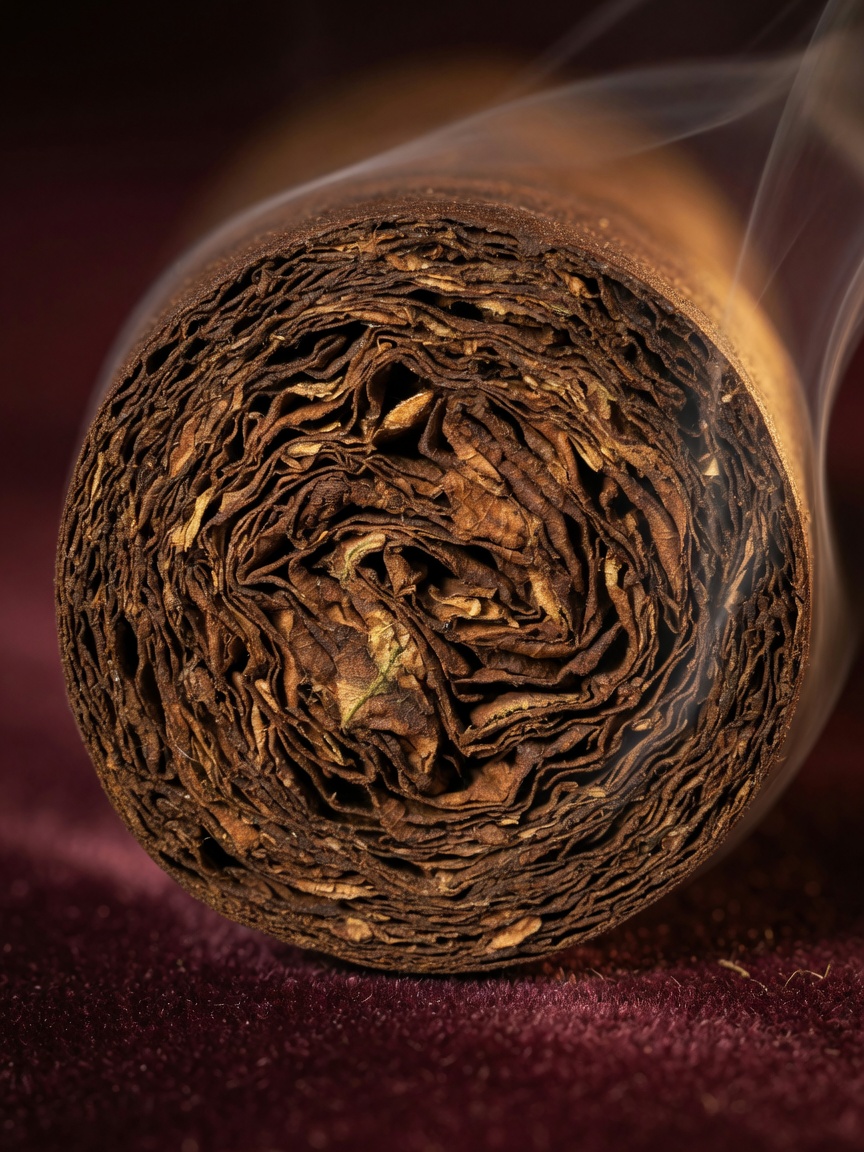
The internal structure of a cigar consists of complex channels formed by the intertwining of countless leaf layers. When you draw, you are driving airflow through these channels, exchanging heat with the tobacco leaves in the combustion zone.
- **The Cost of Being Too Tight: A Dual Crisis of Heat and Oxygen**
When the fill density is too high, the gaps between the leaves are compressed to the limit. This triggers two chain reactions: first, air resistance surges, leading to insufficient oxygen supply and struggling combustion; second, due to the lack of convective cooling from airflow, the temperature in the combustion zone rises rapidly. This accumulation of heat destroys the natural oils in the tobacco leaves, releasing a burnt bitterness that does not belong to the original variety. This is why many overly tight cigars feel "hot" and "bitter" when smoked.
- **The Cost of Being Too Loose: Loss of Combustion Control**
Conversely, if the fill density is too low, irregular "low-resistance cavities" form inside the cigar. According to fluid dynamics, airflow preferentially selects these cavities, creating an "air short-circuit." The result: some areas burn too fast and too hot, while other areas go out due to oxygen deprivation. This uneven combustion produces extremely chaotic smoke, making it impossible to capture the cigar's original delicate flavors.
2. Practical Guide: How to Perform Non-Destructive Measurement
You don't need a laboratory, but you do need a systematic "quantified somatosensory method."
#### A. Visual and Tactile Preliminary Screening
Before picking up the cigar, first observe its surface texture. A well-filled cigar should show a natural, tight tension on the wrapper, rather than being loosely draped over the filler.
Next is the key finger pressure feedback method. Use your finger pads to apply uniform, firm pressure across different sections of the cigar.
- **Seek "Damping Sensation"**: The ideal density should offer an elastic feedback similar to that of a "ripe fruit."
- **Watch for "Hardness" and "Hollowness"**: If you feel almost no deformation when pressing, or detect obvious hardness, it is too tight; if you feel noticeable depressions or an internal hollow sensation, it is too loose.
- **Consistency Check**: This is the most easily overlooked point. Be sure to check whether the pressure is consistent from the head to the foot of the cigar. Any localized pressure abnormality indicates performance fluctuations during combustion.
#### B. Advanced: A Simple "Density Index" Model
If you pursue a more rational judgment, you can introduce a simplified mathematical logic. Prepare an electronic scale with 0.01g precision, and record the cigar's weight (W), length (L), and ring gauge (G).
Although this cannot fully replace professional physical measurement, you can establish a personal "density baseline value":
Fill Density Comparison
Too Tight
Air resistance surge → oxygen deficiency → temperature spike → oil destruction → burnt bitterness
Too Loose
Low-resistance cavities form → air short-circuit → localized over-burning → chaotic smoke