The True Technical Mechanism of Tar Formation During Tobacco Combustion and Its Influencing Factors
Late one night in November 2024, in the combustion dynamics laboratory of the Tobacco Science Research Institute, I stared at the automatic puffing test machine running before me, surrounded only by the low hum of cooling fans. At the time, we were conducting a series of stress tests on how the air permeability of a new cigarette paper affects combustion stability. The infrared thermography camera of the experimental group showed that the temperature at the burning coal of the cigarette jumped violently between 650°C and 920°C as the puffing frequency changed, and this unstable thermal fluctuation appeared on the sensor data as an almost chaotic sawtooth pattern.
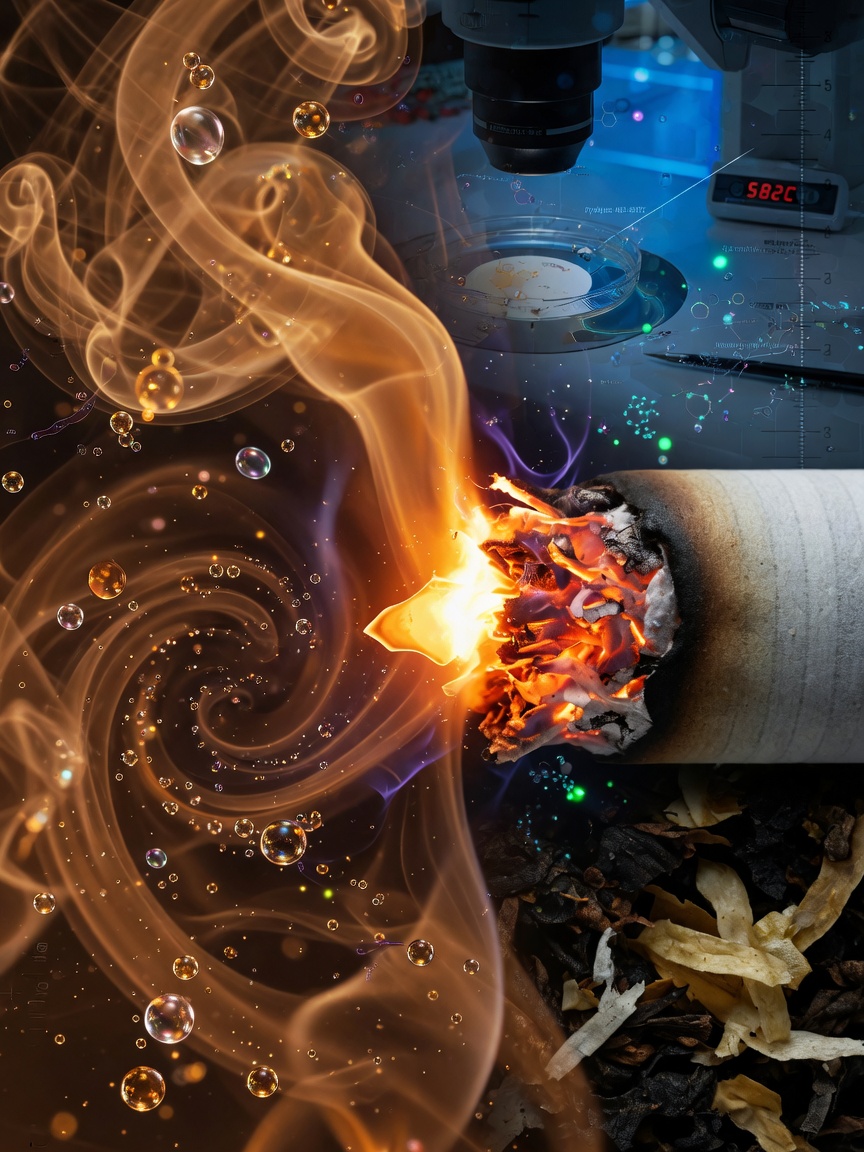
At that moment, watching the thick smoke with a faint brownish sheen continuously precipitating at the filter and condensing into droplets, I suddenly realized that the word "tar" we so frequently mentioned in our reports is, at the microscopic scale, actually an extremely dynamic and fragile equilibrium product. It is not some single, preordained chemical substance, but a precise game of "pyrolysis and condensation" jointly directed by temperature, oxygen supply, and residence time, unfolding on a millisecond timescale. If we simply regard it as the "residue" left after combustion, we completely overlook the astonishing chemical complexity involved in its formation.
When we attempt to dissect the essence of tar, we must first demarcate the battlefield. Inside the burning cigarette rod, there exist two distinctly different regions that are even mutually contradictory in chemical logic: one is the high-temperature, oxygen-rich "Combustion Zone," and the other is the "Pyrolysis Zone" located immediately downstream of it, with lower temperatures and extreme oxygen depletion.
The combustion zone, what we commonly call the "Coal," is the source of energy. During puffing, air is drawn in, and oxygen undergoes a violent oxidation reaction with the carbonized tobacco, releasing a large amount of heat, with local temperatures capable of instantly soaring above 900°C. In this region, the main theme of chemical reactions is oxidation. Cellulose, proteins, nicotine, and other organic macromolecules are thoroughly "dismantled" here, converted into simple gas molecules such as carbon dioxide (CO₂), carbon monoxide (CO), and water vapor (H₂O). Although this process provides the energy needed to sustain combustion, it is not the main birthplace of tar; instead, it is more like a "shredder" that shreds complex organic matter into smaller fragments.
The true "cradle" of tar lies downstream of the combustion zone, namely the pyrolysis zone. Here the temperature is usually maintained between 200°C and 600°C. In this range, oxygen has been largely consumed by the oxidation reactions of the combustion zone, and combined with the obstruction of the cigarette paper and tobacco filler, a typical "oxygen-poor" or "anoxic" environment is formed. Under such conditions, the biological macromolecules of tobacco no longer undergo complete oxidation but instead experience bond breaking and rearrangement through pyrolysis (Pyrolysis).
I recall that in a TGA (thermogravimetric analysis) experiment on a specifically formulated tobacco, when the heating rate was controlled at 10°C/min, we observed an extremely steep turning point in the mass loss curve of the tobacco residue around 450°C. This was precisely the signal of a massive release of primary tar. In the pyrolysis zone, lignin begins to crack and produces large amounts of phenolic substances, while cellulose generates dehydrated sugars and furan compounds through dehydration reactions. These gaseous molecules volatilized at high temperatures and in a supersaturated state rapidly move with the airflow toward the filter; because the temperature drops abruptly, they undergo physical condensation in an extremely short time, ultimately forming the liquid aerosol we can see with the naked eye that constitutes the core of the smoke—what we call tar.
This physicochemical gradient from high-temperature oxidation to medium-temperature pyrolysis and then to rapid condensation constitutes the underlying logic of tar formation. If this gradient shifts even slightly, the composition of the products will undergo earth-shaking changes.
If the pyrolysis zone is the cradle where tar is born, then temperature is the core variable that determines the "build" and temperament of this "newborn." In the thermochemical kinetics of tobacco combustion, temperature is not merely a thermodynamic parameter; it is more like a precise "molecular scissors" that, by controlling the energy threshold for chemical bond breaking, switches between completely different reaction pathways across different temperature ranges.
In the course of our research, we often encountered a very intuitive yet highly misleading phenomenon: if the temperature is too low, the yield of tar drops significantly. This is not because the reaction is not vigorous enough, but because the energy is insufficient to drive the breaking of chemical bonds in organic macromolecules. In the low-temperature range below 200°C, what we observed was more of a physical "distillation (Distillation)" process. At this stage, moisture, nicotine, and some low-molecular-weight flavor components volatilize as heat rises, but they do not undergo any substantial change in chemical structure. They are more like complete molecules that "escape" from the solid matrix. For tar, this stage contributes mainly light, volatile components, which condense rapidly after leaving the heat source and constitute those components in the smoke that carry typical aromatic flavors.
The true chemical turning point occurs between 300°C and 550°C. This is what I personally consider the most critical "golden zone." In this temperature range, the energy is sufficient to break the backbones of biopolymers such as cellulose, hemicellulose, and lignin.
In the controlled-temperature pyrolysis experiments in the laboratory, we used a tube furnace to conduct stepped heating tests on tobacco samples. When the temperature climbed to about 450°C, we recorded an extremely pronounced mass loss peak. From a chemical essence perspective, this was the eruption of a large-scale pyrolysis reaction. In this range, cellulose undergoes dehydration and depolymerization, generating large amounts of dehydrated sugars and furan substances; while lignin undergoes complex fragmentation, releasing large quantities of phenolic compounds (Phenols) and methoxybenzene derivatives. The primary tar (Primary Tar) produced at this stage has an extremely high molecular weight and complex structure, and it is the main source of the particulate phase in smoke. If you carefully observe the condensate produced in this temperature range, you will find that its viscosity is very high and its color presents a deep amber hue, precisely because a large number of medium-molecular-weight organic compounds undergo spontaneous condensation reactions during the condensation process.
However, when the temperature further breaks through 600°C and even approaches 800°C, the situation begins to turn strange, even showing a "counterintuitive" trend.
According to our experimental data, as the temperature continues to rise, the decline curve of total particulate matter (TPM) becomes obvious. This is not because the tobacco no longer decomposes, but because a so-called "secondary cracking (Secondary Cracking)" occurs. Under the powerful action of high temperature, those originally formed, relatively stable medium-molecular-weight tar components are further "clipped" into smaller, more stable gas molecules, such as methane, hydrogen, or lighter hydrocarbons. From a macroscopic perspective, the yield of liquid tar does decrease, but this absolutely does not mean the smoke has become "cleaner."
On the contrary, the side effects of high temperature are extremely hidden and dangerous. High temperature not only promotes the cracking of tar but also induces free radicals to trigger a series of complex secondary reactions, especially dehydrogenation cyclization and aromatization reactions. This is precisely the cradle for the large-scale generation of polycyclic aromatic hydrocarbons (PAHs)—including highly carcinogenic substances like benzo[a]pyrene. In a high-temperature test environment at 750°C, although the measured liquid tar residue decreased by nearly 30% compared with that at 450°C, gas chromatography-mass spectrometry (GC-MS) analysis found that the concentration of aromatic compounds in the smoke actually rose exponentially.
This phenomenon of "total weight declining, but toxic components rising" reveals the double-edged-sword nature of temperature in tar formation: it is both the driving force that generates substances and the catalyst that alters the nature of substances. When designing any combustion control strategy, how to avoid this "toxic burst zone" by precisely controlling the temperature gradient while maintaining combustion stability has always been the core difficulty of our research.
In the theater of thermochemical reactions, oxygen plays an extremely subtle role—it is both the fuel of combustion and the "inhibitor" of tar generation. If we pursue complete combustion (Complete Combustion), then oxygen should be in excess, with the goal of converting all organic carbon into carbon dioxide. However, the combustion logic of a cigarette is exactly the opposite; it relies on a kind of "controlled incomplete combustion."
Inside the cigarette rod, the oxygen distribution presents a highly characteristic gradient distribution (Oxygen Gradient). At the edge of the cigarette paper, due to the natural permeation of air, the oxygen concentration is relatively high, and here occurs a relatively thorough oxidation reaction; but in the core region of the tobacco filler, especially during the smouldering (Smouldering) stage, the oxygen supply is severely deficient. This local "oxygen-poor" state is precisely the chemical precondition for the large-scale production of tar.
I once participated in a study on the influence of cigarette paper porosity on combustion products. At that time, by changing the microstructure of the cigarette paper, we artificially regulated the rate at which oxygen entered the tobacco core. The experimental results were very shocking: when the oxygen supply was restricted to an extremely low level (simulating the anoxic environment of the core), the total organic matter (TOM) content in the smoke increased significantly, and exhibited a large number of complex components with high-molecular-weight characteristics. From a chemical mechanism perspective, the lack of oxygen means that organic macromolecules cannot be completely degraded through oxidation reactions, but are forced onto the pyrolysis pathway. On this pathway, carbon, hydrogen, and oxygen atoms, in the absence of an oxidant, recombine through dehydration, decarboxylation, and other reactions into complex hydrocarbons, phenols, and aldehydes. It can be said that the "quantity" of tar largely depends on to what extent oxygen can be "absent."
However, oxygen is not a complete "enemy." Moderate oxygen participation can promote the oxidative cracking of certain intermediate products, thereby reducing the accumulation of certain specific tar components. This subtle balance between "complete oxidation" and "pure pyrolysis" determines the final chemical spectrum of the smoke.
If temperature determines the "intensity" of the reaction and oxygen determines the "direction" of the reaction, then residence time (Residence Time) determines the "depth" of the reaction. In the extremely dynamic system of a cigarette, the process by which smoke particles move from the high-temperature pyrolysis zone to the condensation zone often takes place within one second or even less.
Residence time refers to the duration that gaseous products stay in the high-temperature environment (i.e., the pyrolysis zone). Tiny fluctuations in this timescale will have a decisive impact on the final form of tar.
In laboratory simulation experiments, we once used a high-speed gas flow reactor to simulate the puffing process. By adjusting the gas flow velocity, we could precisely control the residence time of the smoke in the heating zone. We found that when the residence time is extremely short (for example, on the order of 100 milliseconds), the components in the smoke exhibit obvious "primary pyrolysis characteristics": a large number of intermediate products (such as various unsaturated hydrocarbons and alcohols) can "escape" the secondary destruction of the high-temperature zone and condense rapidly after leaving the heating zone. In this case, the yield of tar is the highest, and the components are relatively homogeneous.
However, once we extend the residence time, even if only to a few seconds, the situation changes drastically. The longer the residence time in the high-temperature environment, the more complete the secondary reactions (Secondary Reactions) become. Those primary products will undergo more collisions, rearrangements, and cracking in the high-temperature zone. As we observed in the high-temperature experiments, longer residence times promote the transformation of tar toward smaller molecular weights, leading to a reduction in the mass of liquid tar; but at the same time, they lead to the formation of soot (Soot) and a substantial increase in the concentration of aromatic compounds (especially polycyclic aromatic hydrocarbons).
This logic of "exchanging time for space" is vividly displayed in tobacco combustion. The frequency and intensity of puffing not only change the oxygen input but also directly manipulate the residence time by altering the gas flow velocity. A frequent, deep puffing process is actually, by changing the timescale, toggling between the "integrity" and "destructiveness" of the pyrolysis products.
From these interactions, the formation of tar is absolutely not a simple physical deposition process, but a complex thermochemical evolution involving the three-way synergy of temperature, oxygen, and time.
Temperature provides the driving force of the reaction and determines the threshold of the reaction; the absence of oxygen provides the pathway of the reaction and determines the chemical essence of the products; while residence time controls the progress of the reaction and determines the final form of the products. These three factors intertwine and couple within the microscopic space of cigarette combustion, jointly shaping that complex and dangerous cloud of smoke.
Understanding the deep logic of this mechanism not only provides guidance for improving the combustion performance of tobacco products, but also offers an important reference in the broader fields of biomass pyrolysis and clean energy conversion. When we attempt to reduce tar release through technical means (such as heated-not-burned technology), the essential logic is not to seek a new chemical substance, but to try to break this chemical cycle composed of pyrolysis and condensation, which is difficult to circumvent, by redesigning the temperature gradient, oxygen distribution, and airflow dynamics.
Large-scale pyrolysis eruption and massive generation of primary tar: dehydrated sugars, furans, and phenolic compounds, with high molecular weight and high viscosity.
Secondary cracking dominates and liquid tar decreases by about 30%: but concentrations of carcinogens such as polycyclic aromatic hydrocarbons (PAHs) rise exponentially.
Note: TGA stands for thermogravimetric analysis, GC-MS for gas chromatography-mass spectrometry, "TPM" for total particulate matter (tar amount), and "TOM" for total organic matter.