This article breaks down an aroma-recognition training method from L1 to L6, with time, numbers, and failure records.
How to Train Your Ability to Recognize Tobacco Aromas
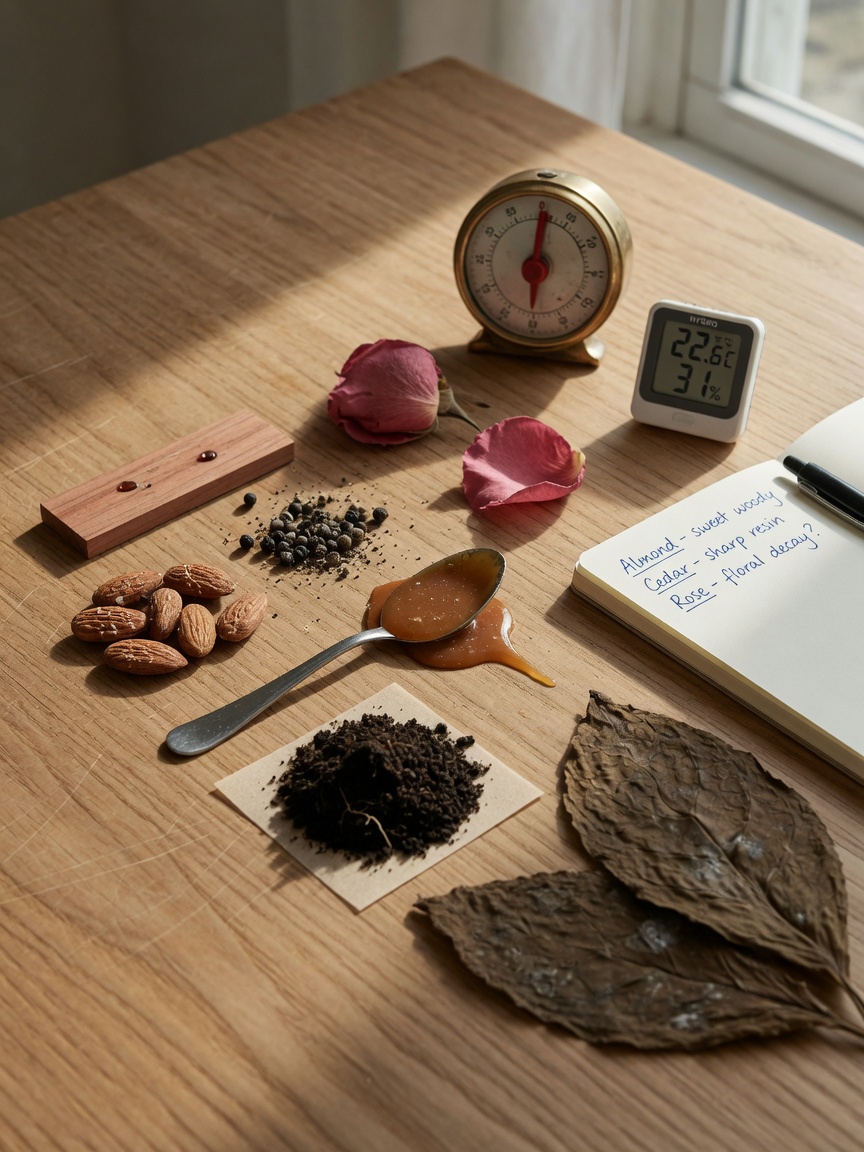
At 10:15 a.m. on February 3, 2024, in a south-facing rental room in northern China, I ran my first formally timed reference-object training session. The radiator was hot to the touch, and the desktop thermo-hygrometer showed 22.6°C with a relative humidity of about 31%. Six items sat side by side on the table: two lightly roasted almonds, an unfinished cedar wood strip, a pinch of freshly ground black pepper, a dried rose petal, half a spoon of light cream, and potting soil that had been touched with a damp tissue. The timer was set so that each item was sniffed for 10 seconds, with a 10-second interval between items, followed by a 2-minute rest after each round.
The first three items went smoothly enough. When I got to the black pepper, I wrote "pungent, sharp, like the kick of smoke" in my notes — then immediately rejected it. Pepper is a spice image; the kick is a physical impact. Bundling the two into one word was the most common flaw in three years of my notes. That day the sixth item, soil, stuck me for nearly three minutes: all I could write was "earth," unable to tell "freshly dug potting soil" from "a damp basement." I kept my phone recording on, listened back to my hesitant description, and admitted a hard-to-hear fact: it wasn't that the smoke lacked layers; it was that my nose had no dictionary and my mouth had no scale.
This article is about the training method I gradually worked out after that: from simple to complex, with time, numbers, failure records, and review tables. The goal is not to turn you into a factory tasting-panel expert, but to move you, within three months, from "smells nice / a bit harsh" to "mid-section woodiness 3, retro-nasal nuttiness 2, irritation lands in the throat, finish still dry at 2 minutes."
Let me nail down the boundaries first:
- Higher recognition ability does not lower health risk. Even if you can separate caramelized sweetness from woodiness, burning or heated tobacco products still carry nicotine dependence and multiple harmful exposures.
- This article teaches training and recording, not smoking more. If you are quitting or have never smoked, reference objects + cold sniffing (unlit) is enough to complete L1–L3; there is no need to light a cigarette for "advancement."
- Your state rewrites the results. A stuffy nose, perfume, mint toothpaste, coffee, hotpot, consecutive tasting sessions, and air fresheners all invalidate your notes.
- Vocabulary is a public agreement; sensation is private. What can be aligned is "roasted-almond nuttiness, 3 points," not "like a Caribbean highway at dusk."
1. Why Most People "Encounter Tobacco Aromas Daily" Yet Barely Improve Their Recognition
I have seen two extremes. One is the person who has smoked for ten years and whose notes are always the same three words: smooth, harsh, fragrant. The other is the person who has read many flavor-wheel screenshots and can instantly say "cedar, cocoa, white flowers, leather," yet fails blind testing — cover the labels and their hit rate is close to guessing.
My assessment is blunt: recognition ability is not a function of exposure time; it is a function of "number of namings × number of reference comparisons × number of feedback rounds." Smoking without naming is like a listening course that only plays songs and never has you repeat after the track.
Common sticking points (ranked by how often they appeared in my 2021–2024 training logs):
| Sticking point | What it really looks like | The damage I have suffered |
|---|---|---|
| Vocabulary gap | Can only write "smoky/tobaccoy" | About 80% of my entire 2021 notebook was ineffective; three months later I could not even read it myself |
| No reference objects | Nuttiness and woodiness purely imagined | Wrote scorched taste as "deep-roasted hazelnut" |
| Collapsed dimensions | Writes kick, irritation, and dryness all as "strong" | Mistook high-nicotine impact for high aroma |
| Only the first puff | The honeyed sweetness of the first 30 seconds decides the lasting impression | Mid-section wet-cardboard off-notes were automatically ignored |
| Olfactory fatigue | Past 4 consecutive tasters everything starts to "seem about the same" | In 2021 I rated 6 in a row in Shanghai and my notes filled with "kinda fragrant" |
| Cross-contamination from environment | Cedar box, leather case, fridge, perfume | Cold sniffing was all box, misjudging the leaf's primary aroma |
| No plan, no review | Sniffs only when in the mood | Skills never accumulate; three months later you are back at zero |
The public logic of sensory training is actually highly parallel to coffee, essential oils, and wine: first build single-odor memory, then move to blends, then to products, then use blind testing to monitor performance. Professional aroma evaluation also stresses: normal state of the sensory organs, samples from few to many, a balance of strength and type, and an environment as free of stray odors as possible. You do not need a laboratory, but you do need to translate these principles into actions you can finish in 10 minutes a day.
My personal take: Do not chase "describing a cigar like a master" from the very start. Pursue two things first — the correlation between two recordings of the same cigar, and not confusing pepper with irritation during blind tests. Poetry can come later; the scale must come first.
2. The Master Training Table: Six Levels (From Simple to Complex)
The table below is the skeleton I have barely changed since 2024. Each level has an acceptance criterion; if you do not meet it, drop down a level and make up the work — do not force your way through by "smoking two more."
| Level | Name | Needs ignition? | Suggested period | Time per session | Acceptance criterion (my thresholds) |
|---|---|---|---|---|---|
| L1 | Baseline & environment | No | 3–5 days | 5 min | Can stably record temperature/humidity and your own state, and rule out interference |
| L2 | Reference-object dictionary | No | 14–21 days | 8–15 min | Blind sniffing of the 6 main families, accuracy ≥70% (family level is enough) |
| L3 | Cold-sniffing tobacco samples | No | 7–14 days | 10 min | Forced 3 words + 0–5 score; can separately flag box/paper notes |
| L4 | Post-ignition timeline | Yes* | 2–4 weeks | 12–20 min/cigar | Stable columns for first/middle/last + retro-nasal/oral |
| L5 | Blind testing & triangle | Cold or ignited* | Ongoing interludes | 15–25 min | Weekly hit rate recorded; error types can be categorized |
| L6 | Interference & blends | Depends | Advanced maintenance | 15–30 min | Can do down-weighted judgments under humidity differences, fatigue, and cross-contamination |
*L4 and part of L5 apply only to readers who already use tobacco products and do not plan to fully stop in the short term. If you are in withdrawal, stop at L3, or convert L4 into "memory-based cue breakdown" (see the end of the article).
Intensity is uniformly scored 0–5:
0 none; 1 faint; 2 clear but weak; 3 one of the clear main tones; 4 prominent; 5 overwhelming everything else.
3. L1: Baseline & Environment — Don't Rush to "Train Your Nose"
During Beijing's heating season in January 2023, I cold-sniffed in a room at about 28% RH and everything was harsh dry grass; after the same sample equilibrated for two days at roughly 55% RH, the green harshness in cold sniffing dropped a notch and the sweetness surfaced. If I had not known to record the environment at the time, I would have permanently tagged that cigar as "heavy green off-note."
The 2-minute self-check before every session
- Nose: Train only when it is clear; if one side is blocked, switch days or do only a written review.
- Mouth interference: Avoid coffee, spicy food, mint candy, gum, and strongly flavored toothpaste for 30–60 minutes before training.
- Room: No perfume, incense, cooking fumes, or air freshener; air the room out and wait for the smell to dissipate before starting.
- Equipment: Water, tissues, a timer, notes (paper first — a phone easily becomes "sniff while scrolling").
- Principle: complete one task of one level at a time. Greed is an accelerator of olfactory fatigue.
Personal rule: The page header always carries date / temperature / RH% / nose state / pre-training food. Skip one item and the review three months later turns into guesswork.
4. L2: The Reference-Object Dictionary — The True Foundation of Recognition
A common practice in essential-oil and food sensory training is to start from single, easy-to-recognize smells, a small amount daily, recording character and intensity, then move to blends. I compress the tobacco context into six main reference families (heavily overlapping with common smoke descriptions):
| Family | Reference (household level) | The "image" to remember | Easy to confuse with |
|---|---|---|---|
| Woody | Cedar strip, pencil shavings | Dry wood, cool cypress feel, or dull wet wood | Paint smell, cedar-box cross-contamination |
| Nutty | Lightly roasted almond vs raw almond | Roasted aroma, almond skin, toasty feel | Scorch, rancid oil |
| Caramel-sweet | Light caramel-color syrup, very faint roasted sweet-potato skin | Caramel, honeyed edge | Pure sweetener sweetness, burned-bitter |
| Floral | Dried rose, extremely faint jasmine tea cold sniff | Dried flower, watery floral; not a perfume bomb | Shampoo residue, perfumed florals |
| Spicy | Freshly ground black pepper, one crushed clove (tiny amount) | Spice aromatic + pointy prickle | Physical irritation, ammonia kick |
| Earth/dust | Slightly damp potting soil, clean coarse burlap | Earth, dust, mild humus | Mold, damp cardboard |
Standard routine (the version I do every morning)
- Environment: fragrance-free, light ventilation allowed.
- Posture: sample about 2–3 cm from the nose, natural inhalation; do not bury your nose in a bottle and inhale hard. Scent strip or direct sample both work; a gentle Z-shaped sweep can let the odor molecules arrive in layers — a very practical trick in aroma training, and it applies to tobacco references too.
- Timing: about 8–10 seconds per sample; about 10 seconds between samples; after 2–3 samples in a row, rest 1–2 minutes (leave your seat or sniff your own cuff to "reset"; some people use coffee beans to clear the nose — I personally prefer leaving the scene for 60 seconds).
- Output: for each sample, force-write: family + 3 words + 0–5 intensity + one optional private association. Writing only "smells good" is forbidden.
- Dose: 2–3 samples a day is enough, rotating through the six families; greed makes the names tangle starting around the 5th sample.
Minimum 14-day training volume (my prescription):
- First 7 days: labeled training only (look at the label and write the description).
- Next 7 days: enter family-level blind testing — have someone shuffle them, or fill opaque bottles the night before and draw lots the next day.
- Acceptance: two consecutive days of ≥70% accuracy on blind testing of the six families. If you cannot reach it, add 7 more days; do not skip levels.
Failure log
In the summer of 2022, I wrote a slightly-burnt reference roasted nut as "deep-roasted hazelnut"; the next day, comparing with a real hazelnut, I had to admit it was simply over-roasted. The rule has been in my notebook ever since:
When the burn/heat state is abnormal, down-weight the nutty description; suspect the operation first, then the talent.
Another, harsher rule:
If you cannot name the reference object, you are not allowed to use that aroma word in your smoke notes.
That rule made my adjective count plummet in the first month, but reviewability soared. I side with reviewability.
5. L3: Cold-Sniffing Tobacco Samples — Connecting the Dictionary to "Real Cigarettes"
Cold sniffing is training with an unlit cigar (or only sniffing the air near the tobacco end / filter end at close range). Its value: it pins the L2 words onto the volatile top notes of real products, while exposing storage problems.
Procedure (about 10 minutes)
- Fix the metadata in writing: type (flue-cured / blended / cigar, etc.), labeled tar and nicotine (if any), approximate purchase / opening time, storage method (original pack, tin, cedar box, whether it has been in the fridge).
- About 2–3 cm from the tobacco end, inhale naturally twice, close your eyes for 3 seconds.
- Forced output: 3 attribute words + a 0–5 score for each; if the first reaction is "cigarette smell," void it and rewrite.
- On a separate line, write suspected interference: box wood, paper, plastic, mold, dampness, perfume cross-contamination.
- Do the same cigar two days in a row and check the correlation; when correlation is poor, check environment and your own state first instead of blaming the product.
Personal take: the ability most worth training at the cold-sniffing stage is not "discovering high-end growing-region stories" but "flagging contamination sources first." In March 2024, at roughly 45% RH, I cold-sniffed a sample that had long lived in a cedar box; the first noseful was all box. After two days of equilibration at about 65% RH, the leaf's own sweetness surfaced. In my notes I force an extra line: woodiness source suspicious: box / leaf / both?
Readers who are quitting or do not smoke: this is where you can form a complete skill loop — dictionary + cold sniffing + recording. No need to enter L4.
6. L4: The Post-Ignition Timeline — The Middle Section Is the Most Honest (For Existing Users Only)
If you already smoke and choose to do structural analysis during this period of use, treat L4 as a tool for cutting down mindless chain-smoking and raising the quality of each observation, not as an excuse for extra practice. My hard limits:
- Seriously review only 1 cigar at a time; at most add 1 more for comparison, with plain water and quiet breathing for ≥5 minutes in between.
- From the third consecutive cigar onward, my floral/nutty resolution is visibly off-line — with my own nose as the sample, this is a physiological reality, not a willpower issue.
- Hold the smoke in the mouth for about 2–4 seconds, then exhale slowly through the nose (light and short, not a deep lung-inhalation performance); going over time easily amplifies irritation and bitterness, turning nuttiness into scorch.
- I usually space puffs at about 30–60 seconds; too fast creates "fake spiciness" (overheating irritation).
Four-layer structure (written into every sheet)
- Cold-aroma skeleton (before ignition)
- Timeline: first ~1–3 puffs / stable mid-section burn / tail section
- Oral sensation: sweet/bitter, dry/moist, astringency, kick, irritation locus (nostril wing/throat/root of tongue)
- Finish: 30 seconds and 2 minutes after stopping (add 5 minutes if you have the energy)
In industry and textbook contexts, tasting commonly discusses aroma, harmony, off-notes, irritation, and finish; they also distinguish a more holistic feel from the "pause at entry then exhale through the nose" path. Consumer-side notes do not need industrial scores, but they do need separate columns — one column for aroma, one for irritation, one for off-notes; never let a single "pleasant" swallow everything.
The 40-second routine for reviewing the middle
- A moderate draw (not gorging for "strength").
- Hold in the mouth about 2–4 seconds, touch the tip of your tongue lightly, move the smoke near the soft palate.
- Exhale slowly through the nose, paying attention to retro-nasal olfaction.
- Immediately write two columns:
- Oral: sweet/bitter/dry/astringent/oily + score
- Retro-nasal: caramel-sweet, nutty, woody, floral, green off-note, dusty, scorch + score
- Repeat 2 rounds to see if it is stable. One sample per round; first check re-lighting, draw speed, and whether the cigar went out.
My strongly held personal take:
The first puff is the most deceiving, the middle is the most honest, and the finish exposes your state and the craftsmanship. At an informal comparison in Guangzhou in August 2023, sample A was all honeyed sweetness 30 seconds after ignition, and all four people at the table nodded; recorded at puffs 6–8, retro-nasal olfaction brought up a wet-cardboard-like off-note, and the astringency on the oral sides rose. Recording only the opening would have earned a high score; forcing the middle + through-the-nose + 2-minute finish dropped the score a notch. That is not affectation; it is the information channel opening up.
Irritation ≠ spiciness. Briefly sniff the main smoke stream for 1 second: if there is only prickling and no spice image, record irritation; if you can stably associate pepper/clove, then record spiciness. This distinction is my "life-saving sentence" that I still review weekly after passing L2 blind tests.
7. L5: Blind Testing & Triangle Tests — Use Hit Rates to Slap Down Self-Confidence
Training without feedback turns confidence into an illusion. The core of L5 is it can be counted.
1) Double-cup / double-cigar blind labeling (entry level)
- Two samples of the same type that you believe are "obviously different"; have someone label them A/B, or pack them yourself the night before.
- Cold sniffing alone is fine; users may add one round of mid-section retro-nasal sniffing.
- Output: judgment + confidence level (low/mid/high) + 3 basis words.
- After the reveal, you must write: which type of error it was (family error / intensity error / contamination-source error / fatigue error).
2) Triangle test (advanced)
- Of three samples, two are identical and one is different; find "the different one."
- In public sensory methods, this kind of difference test is a classic tool for training and screening panelists; at home, do the simplified version.
- My home version: same brand, different batches, or the same type under different storage conditions (one cedar box, one original pack); the difference must really exist — do not deliberately make it hard down to the "hum" level.
3) Weekly statistics (must do)
Every Sunday, spend 10 minutes filling in:
| Item | This week's number |
|---|---|
| Days of reference training | |
| Cold-sniffing sessions | |
| Formal ignited tasting sessions (if any) | |
| Blind tests / hits | |
| Most frequent error type | |
| Newly locked words this week (≤2) |
Personal take: blind-test hit rate is a hundred times more important than flavor-wheel posts on social media. I have had two straight weeks of self-congratulatory "progress," only to drop to 40% in a blind test — the problem was entirely training on through fatigue and writing box-woodiness into the leaf aroma.
8. L6: Complex Interference — Stress Training for Recognition
After L5, what you lack is not more adjectives, but knowing when to down-weight in a dirty environment.
Interference topics you can do (pick only one each time)
- Humidity difference: cold-sniff the same sample once at low humidity (e.g., heating-season RH<35%) and once at moderate humidity; compare only the shift of "prickle/dry/sweet."
- Box cross-contamination: cedar-box storage for 48 hours vs original pack; cold sniff with a forced contamination-source line.
- Fatigue retest: 20 minutes after a formal tasting, blind-test 3 families with L2 references and watch how much accuracy collapses — you will regain respect for "one serious tasting a day."
- Cross-category anchoring: right after the middle section, sniff almond or wood strip for 5 seconds and ask whether the "nutty 3" you just wrote still stands.
- Blended description: "caramel-sweet 3 + woody 2 + irritation 2" is allowed; averaging into "overall 8 points" is forbidden.
In open expert-panel training, common types include attribute training, consensus training, and performance monitoring. One person cannot become a panel, but you can imitate the structure: attributes (word list), consensus (aligning yourself with last week's you), monitoring (blind-test hit rate). The flavor wheel's role is to unify language, not to make you fill out a full wheel every time.
My word-expansion discipline: only after a core word list has been used in about 20 valid records may you add 1–2 sub-words (e.g., from "woody" to "cedar-like / oak-like"). No more than 2 new words per week. Vocabulary bloat is an illusion of recognition.
9. The Recording System: Without Records, There Is No Training
1) Single-session training log (L2/L3 common)
Date:
Temperature / RH:
Nose state: clear / partially blocked
Training level: L2 / L3 / ...
Pre-training food / interference:

[Reference object or sample]
1. Name / number:
   Word1() Word2() Word3()
   Intensity: family___ score___
   Suspected contamination source:
   Private association (optional):

Error prediction (if blind):
One-sentence review after reveal:
2) Ignited tasting table (L4, if applicable)
Sample:
Storage:
Environment:
Own state:

Cold aroma (3 words + score):
First 1–3 puffs:
Middle oral:
Middle retro-nasal:
Irritation locus:
Kick (physiological, not merged with aroma):
Off-notes:
Tail changes:
Finish 30s:
Finish 2min:

Operation notes (draw speed / re-ignition / holding over time):
Uncertain items (listed with down-weighted confidence):
3) Error log (more useful than praising yourself)
Fixed categories with tags, convenient for weekly statistics:
- E1 Irritation written as spiciness
- E2 Scorch written as nuttiness
- E3 Box wood written as leaf wood
- E4 Only the first puff recorded
- E5 Forced writing through fatigue
- E6 Literary metaphor that cannot be re-checked
- E7 Environment/food contamination not recorded
In my error log for the first half of 2024, E1+E3 accounted for more than half. For these two types, I did two weeks of targeted work: only training the distinction between pepper and plain boiled-water steam irritation, and paired cold sniffs with/without the box. Only then did the hit rate return to a respectable level.
10. A 12-Week Sample Rhythm (You Can Copy It Directly)
| Week | Main task | Daily time | Weekend extra |
|---|---|---|---|
| 1 | L1 consolidation + L2 labeled rotation of six families | 10 min | None |
| 2–3 | L2 blind-test sprint | 10–15 min | One fully blind round of six families |
| 4–5 | L3 cold sniffing, same cigar 3 days in a row | 10 min | Box storage vs original pack |
| 6–8 | L4 timeline (if applicable) or deepen L3 | 1 formal cigar/day or every other day | Finish-timing review |
| 9–10 | L5 blind tests every week | Interludes | 1 triangle test |
| 11–12 | L6 pick 2 interference topics + freeze word list | Maintenance | Overall review: hit-rate curve |
If you only have fragmentary time: prefer 8 minutes of L2 every day over lighting three cigars on a weekend pretending to advance. Olfactory memory feeds on repeated naming, not single-day heroics.
Olfactory training (OT) in the medical context also emphasizes: brief sniffing, intervals between odors, a fixed daily time slot, and a duration of several weeks. You do not need to pathologize your nose, but the rhythm awareness is fully worth borrowing — I fix my main training around 10 a.m., because afternoon coffee and outside cooking fumes stir up the baseline.
11. The Nine Personal Rules I Stick To (More Useful Than Any Flavor-Wheel Screenshot)
- 14 days of references first; discuss smoke layering only afterward.
- Intensity score and location come before adjectives.
- Irritation, kick, and aroma go in three columns and are never merged.
- If you cannot name the reference, you have no right to that aroma word.
- One serious cigar per session; data from the third onward is down-weighted by default.
- Middle + 2-minute finish, both required (L4).
- When uncertain, down-weight and write it into "uncertain items" — no literary fill-in.
- Lock at most 2 new words per week.
- Blind-test hit rate and error types are the only progress dashboard.
These rules are not pretty, but they moved me from "a person who can smoke" to "a person whose notes are still readable three weeks later."
12. How It Connects to Quitting and Harm-Reduction Contexts (Light but Necessary)
If your goal is to reduce or stop tobacco use:
- Put the training focus on L1–L3: recognize environmental triggers (after meals, at the workstation, cedar-box ritual), recognize whether "I want to smoke" is just a hand-typing program.
- Use the same recording sheet to write craving triggers: time, place, mood, whether the nose is dry, whether there is social pressure. Aroma recognition here serves de-automation, not prolonging use.
- People whose noses are naturally sensitive, who have rhinitis, or who are recovering olfactory function should prioritize medical advice; reference training should be light, short, and interruptible.
One more emphasis: sniffing finely does not equal smoking safely. None of the techniques in this article change the basic risk structure of burning tobacco.
13. The Smallest Action You Can Start Today (12 Minutes Today)
- Prepare 3 references: almond, wood strip (or pencil shavings), black pepper.
- Write the header: time, approximate temperature/humidity, whether the nose is clear.
- 10 seconds per sample, 10-second intervals, forced 3 words + score.
- Blind-pick one of them and see if you can name the family.
- Record the error type as an E number.
After these 12 minutes, you are already closer to real recognition training than "smoking one more and savoring carefully."
Recognition ability is not a talent exhibition; it is repeatable manual labor: compare, name, interval, record, blind test, down-weight. What you equip is not a tongue better at enjoying, but a set of a nose and a pen that still recognize you three months later. Start with the L2 almond and wood strip — when the dictionary is on the table, the layers stand firm in the smoke (or, when you decide not to light up anymore, in your memory and triggers).
Notes
- Note: L4 and part of L5 apply only to readers already using tobacco products who do not plan to stop in the short term
- Note: sniffing finely does not equal smoking safely — this article does not change the basic risk structure of burning tobacco