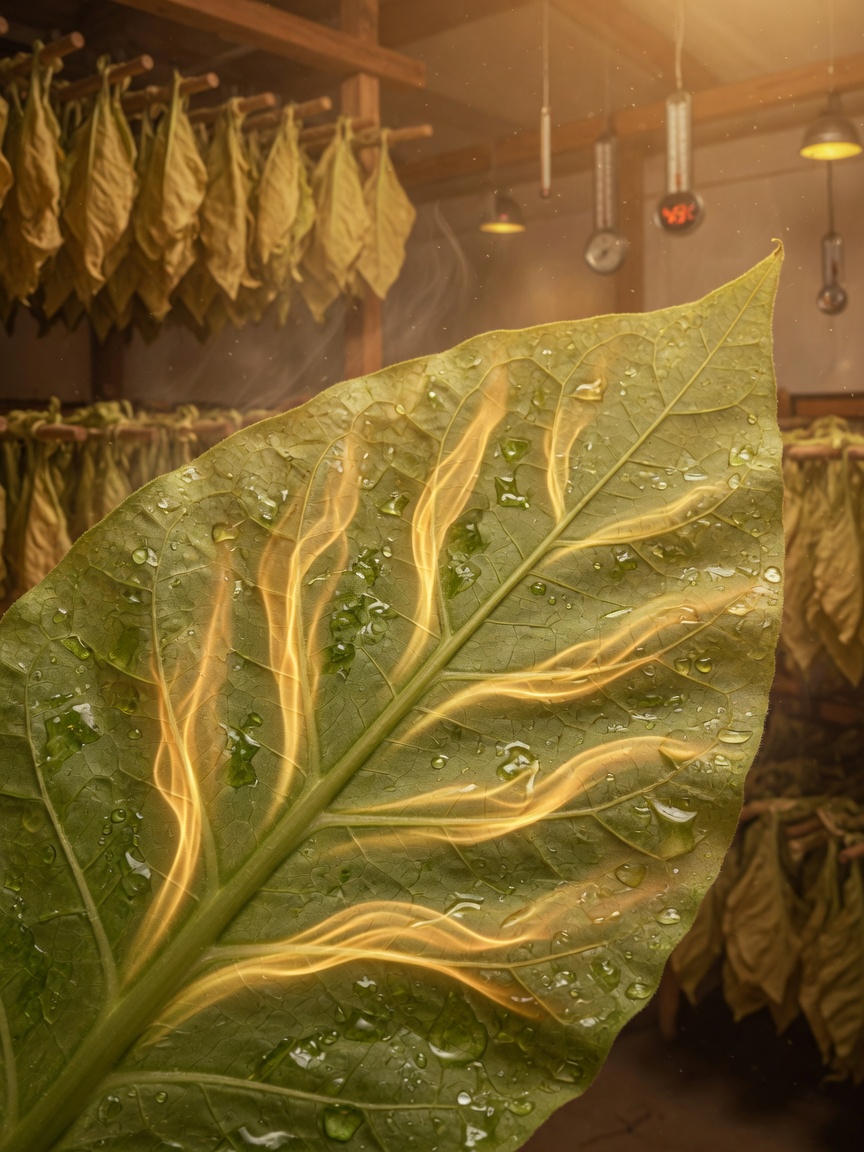
In the long history of tobacco processing, if the wilting stage is the prelude that awakens leaf vitality, then the stem-drying stage is the decisive movement that determines the final direction of the entire symphony. Many beginners and even some experienced craftsmen often fall into a misconception: believing that the stem-drying stage is merely about "drying" the leaves — as long as moisture is reduced, the job is done. This idea is extremely dangerous, as it ignores the most core and subtle logic of flue-cured tobacco processing — the dynamic balance between water migration and cell structure evolution.
In my thirty years of flue-cured tobacco work, I have seen too many cases where slight deviations in stem-drying parameters caused entire batches to appear "thoroughly dry" but were in fact ruined. The stem-drying stage is not just about physical water migration; it also deeply involves biochemical reactions. Temperature and time are not two independent variables — they are highly coupled "double-edged swords."
I. The Underlying Logic of the Stem-Drying Stage: The "Game" Between Water Migration and Cell Walls
To understand the stem-drying stage, we must first look at the microscopic structure of the leaf. After wilting, the water inside cells undergoes an initial redistribution through osmosis and transpiration. Entering the stem-drying stage, the real challenge lies in how to allow the water at the center of the leaf (the "stem" part) to migrate orderly and evenly through intercellular spaces to the leaf surface, while also ensuring that the cell walls undergo moderate hardening during water loss to lock in aroma substances, rather than letting the cell structure collapse completely.
This process is essentially driven by a "moisture gradient." Temperature determines the magnitude of the "driving force" of this gradient, while time determines the sustained depth of this force. If this balance is found accurately, the leaves will exhibit an ideal, resilient stem-dried state with extremely uniform moisture distribution, and the resulting smoke will be naturally mellow. If the balance is wrong, the leaves will either be "dry outside but wet inside" or "dry and brittle" — both outcomes directly destroy the final combustion performance.
II. The "Double-Edged Sword" of Temperature: From Enzymatic Reactions to Cell Structure
In the stem-drying stage, temperature control is the primary factor determining success or failure. I often tell my apprentices that temperature is definitely not the higher the better, nor the more stable the better — it must follow the physiological state of the leaves.
1. The "Golden Window" of the Optimal Temperature Range
Based on my practical experience, the core temperature range of the stem-drying stage should be strictly controlled between 45°C and 55°C. Within this range, the enzymatic reactions inside the leaves — especially those involved in coloring and aroma formation — remain relatively active but controlled. At this point, the rate of water migration from the veins to the leaf flesh is moderate, and the cell walls undergo moderate lignification under appropriate thermal stress. This "drying while hardening" process is key to ensuring good elasticity and uniform combustion performance of the tobacco leaves.
2. The "Devastating" Consequences of High Temperature: Premature Hardening and Aroma Loss
Once the temperature exceeds 60°C, the situation deteriorates rapidly. I once experienced a case during a hot summer operation where the temperature control system malfunctioned, causing the stem-drying temperature to surge to 62°C. The result was disastrous: the leaf surface lost water rapidly, forming a thick, hard "crust." This crust acted like a plastic film, tightly locking the moisture inside the leaf.
This is the classic case of "premature hardening." Because the surface hardened too early, water could no longer migrate smoothly through the intercellular spaces, leading to a severe "dry core, wet leaf" phenomenon inside the leaf. Macroscopically, although the leaf felt dry to the touch, once moisture testing was conducted, the moisture content in the central part remained shockingly high. Even more fatal, the high temperature directly destroyed the fragile volatile aroma components in the leaves, resulting in smoke that not only burned unevenly but also carried a burnt smell, completely lacking the full-bodied character that tobacco should have.
3. The "Stagnation" Consequences of Low Temperature: Impaired Water Migration and Fermentation Risks
Conversely, if the temperature is controlled below 40°C, the stem-drying stage falls into a "dead" state. Low temperature means insufficient kinetic energy of water molecules, resulting in extremely slow water migration. Under such conditions, the chemical changes inside the leaf also stall, and enzymatic reactions cannot proceed as planned.
I once encountered a situation where, due to consecutive rainy days, the heating equipment of the curing barn could not keep up, causing the stem-drying temperature to remain around 38°C for an extended period. That batch of leaves ultimately presented a strange state: although the time was extended and they appeared dry, the leaf texture was very soft and pliable, completely lacking the "dry but not brittle, tough but not hard" feel characteristic of a proper stem-drying stage. These "dry but not fully dried" leaves are highly prone to mold during subsequent storage or combustion, or they produce large amounts of irregular smoke during burning, severely affecting smoke quality.
III. The "Scale" of Time: Rhythm Determines the Depth of Quality
If temperature is the "thrust," then time is the "travel distance." In the stem-drying stage, time management is essentially the control over the degree of completion of water migration.
1. The Coupling Effect of Time and Temperature
We cannot discuss time in isolation. The same 50 hours of stem-drying at 48°C versus 52°C produce vastly different results. I have summarized an empirical formula: stem-drying quality ≈ temperature × effective coupling of time.
In actual operation, we must pay attention to the "heating rate" and "cooling rhythm." The temperature increase during the stem-drying stage should not be too rapid, otherwise thermal stress will cause leaf cell rupture; the temperature decrease should also not be too drastic, otherwise water will "flow back" inside the leaf, causing localized high humidity.
2. The Lesson of Insufficient Time: The Incomplete "Dehydration Journey"
Often, to meet deadlines, some operators shorten the stem-drying time. The direct consequence is "uneven moisture distribution." Because the water has not fully diffused from the veins to the leaf flesh, the leaf interior still maintains a high moisture gradient. When such leaves are burned, the vein portion burns rapidly while the leaf flesh portion still slowly releases moisture, resulting in an extremely unstable combustion process with erratic smoke output.
3. The Cost of Excessive Time: Overdrying and Embrittlement of Physical Structure
Conversely, if the stem-drying time is too long, even with proper temperature control, "overdrying" will occur. Excessively long stem-drying forces all water in the leaf to be completely extracted, even removing the bound water that maintains elasticity within the cell structure. This causes the leaf to become extremely fragile, crumbling into powder at the slightest touch. When such leaves are burned, lacking the necessary trace moisture to regulate the combustion rate, they exhibit extremely high combustion temperatures, producing large amounts of soot and acrid smoke.
IV. Field Review: The "Failure Lesson" from the Xiangxi Producing Area
To give everyone a more tangible understanding, let me share a case I personally experienced.
It was in the summer of 2015, when I was providing technical guidance at a large curing barn in Xiangxi. Due to continuous rainfall at the time, the air humidity was unusually high. To cope with this high humidity, we originally planned to slightly increase the starting temperature of the stem-drying stage to accelerate water migration.
We set the starting temperature at 53°C, hoping to offset the humidity effect. However, due to the excessive humidity, water evaporation from the leaf surface was hindered, causing the humidity inside the curing barn to remain at high levels for a long time. This "high temperature and high humidity" environment completely disrupted the logic of the stem-drying stage: although the temperature was sufficient, the water could not be effectively expelled; instead, the high temperature accelerated the hardening of the cell walls.
As a result, after drying, those leaves felt dry to the touch, but when rubbed by hand, the central part of the leaves still showed noticeable toughness, even with a hint of dampness. This is the classic case of "false stem-drying caused by high temperature and high humidity." Later, through testing, we found that the central moisture content of these leaves was a full 3 percentage points higher than the surface. Ultimately, this batch of leaves performed extremely poorly in combustion tests — the smoke was not only lacking in richness but also carried a noticeable sour taste. This lesson made me deeply realize: during the stem-drying stage, temperature must always serve humidity control; one should never blindly raise the temperature in pursuit of "dryness."
V. Summary: The Underlying Thinking of Stem-Drying Control
Parameter control during the stem-drying stage is by no means a simple numerical exercise; it is a precise art of "rhythm" and "balance."
Excellent stem-drying craftsmanship pursues a kind of "dynamic order." Through precise temperature control, we provide stable driving force for water migration; through scientific time management, we ensure that water can thoroughly and uniformly complete its transfer from the inside out.
As technical personnel, we must constantly monitor not the numbers on the thermometer, but the "life state" of the leaf under the influence of temperature and time. We need to perceive through experience: did that temperature cause unwanted hardening in the cells? Did that time allow the water to complete its proper migration? Only by truly understanding the biochemical logic behind temperature and time can we maintain high-quality smoke characteristics under ever-changing climatic and raw material conditions.
We must remember: stem-drying is not about "driving away" water, but about "organizing" water. Only by organizing the water properly can we organize the soul of the smoke.